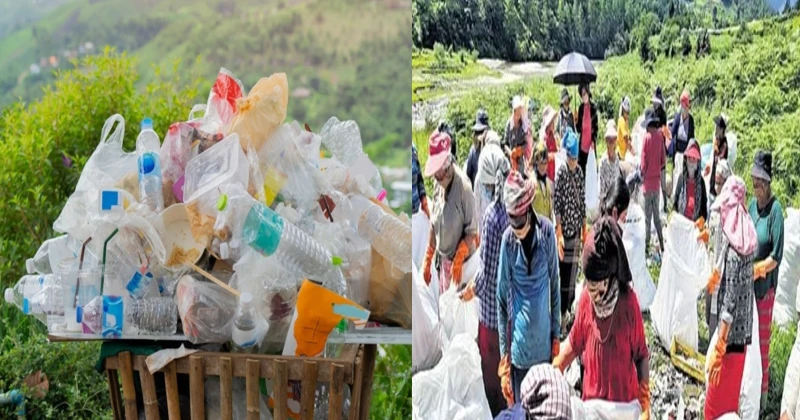
In the mountainous range and valleys of Northeastern India, the river bed crosses through lush forests and local communities have lived and breathed in harmony with their environment for generations. People from Northeast are constructing a Sustainable Waste Future. This transformation is engineered through practical and humble means where they have separated bins for garbage in public areas, degraded lands around garbage dumps regaining their green hue and remaking their roads along with markets and water bodies as their own society part. In cities and townships within Northeastern India, a new vision for waste management is taking shape where one recognizes waste as an opportunity rather than a problem to discard and hide them from public sight and awareness.
Waste has been a progressively challenging issue for the Northeast for several decades. The widespread urbanization, lack of infrastructure, geographical challenges and delicate ecosystems has created dump sites in the rivers, forests and open plots. A new chapter is being written in Assam, Mizoram, Arunachal Pradesh, Tripura and Nagaland, where peoples and organizations are showing, how the challenge of waste management can actually be met by integrating scientific approaches in teamwork. Nothing appears in these efforts and it achieves through systematic processes.
Assam: Uniting People and Rehabilitating Lands
North Lakhimpur in Assam is one such example that illustrates how urban waste matters might be improved as a result of dealing effectively with longstanding issues. North Lakhimpur Municipal Board, as part of the Swachh Bharat Mission Urban 2.0, took up the clearance of the legacy waste at the Chandmari dumping site. A cumulative waste of 79,000 metric tonne of garbage was cleared, from the area that has been neglected for more than decades. It released 16 bighas of land and future plans have been made for another 10 bighas to be developed as an Urban Forest and Urban Retreat Zone.
This swachhta movement was not only confined to land restoration. The Sumdiri River which had been impacted by dumping of waste and subsequent runoff water, has experienced an environmental rebirth through the cleanup. The reappearance of bird species, fish and other aquatic organisms not only indicates an improvement of water quality but an ecological rebalance.
North Lakhimpur processes the range of 36-42 TPD (Tonnes Per Day) of municipal waste. At Japisajia, the first joint facility that accommodates a Material Recovery Facility (MRF) and a Waste to Compost (WTC) Plant where the processes of segregation, recycling and composting are done at the same facility. It functions with the processing capacity of 100 TPD and spreads over an area of 7,000 sq. ft., thereby providing the facility to recover and reuse the recovered waste. WTC facility processes the waste of 25 TPD and converts the wet waste into valuable compost, which gets further used by the local farmers.
Aizawl: Adopting Dustbins for Waste Managements
The trend of participatory waste management has been seen in Aizawl, the capital of Mizoram. The Adopt a Dustbin Scheme of Aizawl was launched on 5 June 2025, World Environment Day, has been a major component of its Comprehensive Plan for Municipal Waste Management. Citizens are induced to adopt public dustbins and keep their surroundings clean until such time as it would take the municipal waste management agencies.
The impact has been visible and quantifiable. 95 dust bins have been adopted at 75 different spots, including markets, footpaths, residential areas and institutional areas. Apart from regular maintenance, many adopters have also put up sign boards, done area developments, and ventured into awareness campaigns. Aizawl has demonstrated through the program that managing waste is not only an M-scaling process but also involves the social aspects of the area.
Arunachal Pradesh: Community Enterprise and Environment
In Roing growing waste problem triggered an intervention that emphasized community participation. In 2022, Roing Municipal Council joined the Self-Help Group, organized Green Roing to form a Public-Private Partnership for the project named Roing Waste Collectors, which started its activities with a staff of 12 for the collection of domestic waste in the most affected parts by plastic waste.
Dumping sites were barricaded to discourage further dumping, while street plays, advocacy campaigns and education efforts were also used to sensitize people to practice waste segregation and responsible waste disposal. This initiative has been extended to involve a private owned Material Recovery Facility that segregates and processes three tons of waste per month. Recyclables sourced from residential areas, roads and drains are sold to earn money for SHG members, making the waste management system economically sustainable.
One of the projects that Roing is most associated is the Waste to Wonder Butterfly Park at Eze Park. Built using waste materials such as 10,000 plastic bottles, it is both an entertainment facility and an example of the work that can be accomplished through community waste management initiatives. Roing projects and experiences demonstrate how blending the needs of environmental conservation and livelihood can be achieved.
Tripura: Protection of Water Resources through Prevention and Participation
In Tripura efforts have been made to ensure that waste does not enter water bodies. This is because the Urban Local Body of the state has constructed wired mesh screens and manual sweeping systems on drains leading to water bodies. Such measures ensure that solid waste is intercepted before reaching water bodies and polluting water bodies and aquatic ecosystems.
Infrastructure initiatives receive support from effective outreach initiatives. The conduct of campaigns and consultations at the ward level has been helpful in spreading awareness about proper waste disposals and the aftereffects of water pollution. In areas where dumping was still a problem, clean-up initiatives and outreach programs were carried out. The result is the effective reduction in levels of pollution and this illustrates the need for preventive initiatives and support from the people.
Nagaland: A Zero Waste Model at the Hornbill Festival
The 26th edition of Nagaland’s Hornbill Festival proved that it is quite feasible to hold massive cultural festivals responsibly too. The festival was completely zero waste and zero-plastic and the festival banned the use of single-use plastic products like straws, plates, cups and bags. In place of those, the festival used banana leaf plates, bamboo straws and bagasse cutlery. The festival was able to avoid the usage of one million plastic items and reduce the emissions of nearly 50 MT of CO₂.
Vendor checks ensured compliance and the use of segregated bins, volunteers made waste disposal easy. Dry wastes went for recycling and wet wastes were composted. Further it was distributed to nearby farmers. Refilling points replaced bottled water and use of personal cutlery was advocated for, there were 42 toilets that ensured proper hygiene was maintained. Through local use of materials, the festival proved that sustainability does not diminish celebration but rather improves it.
The Strength of Steady Change with help of Citizens
Across Northeast India such projects demonstrate a lesson, a clean environment requires as much trust and cooperation as infrastructure can provide. Land has been won back from garbage, rivers restored from detritus, public spaces reclaimed from neglect. Waste removed from festivals without subtracting their fervor and small towns converted garbage into gold or so it seems when seen from a distance where change is hard to discern until it becomes a culture. Such lesson from Northeast India is exactly what other states need a lesson to make a clean environment, becomes a daily practice rather than a singular success story that can teach so much more than infrastructure alone ever can.