
“We must ensure that our Nation stands firm on this foundation and our society is enabled to live a healthy, progressive and purposeful life. We shall have to end a number of traditions and set in reforms which are helpful in the development of values and of national unity in our society. We shall remove those traditions which obstruct this process. Whereas one need not mourn the limitations of the human body, one must undergo the required surgical operation if any part of the body has a cancerous growth. There is no need to amputate healthy limbs” –Pandit Deendayal Upadhyaya, in his speech on Integral Humanism, delivered on April 25, 1965
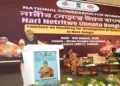
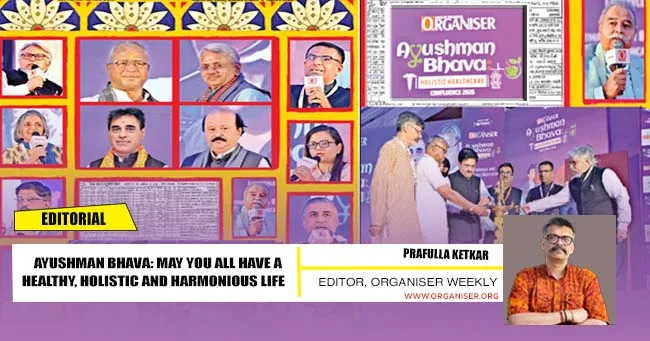
Ayushman Bhava literally translates as ‘May you Live Long’! However, if we go into the spirit behind it, the real meaning is not just long life but a purposeful and healthy life. After the COVID-19 pandemic, there is a growing realisation that mere economic prosperity will not make our lives meaningful. The lifestyle-related diseases are increasing, the medical bills are making holes in our pockets – thereby helping the insurance companies and pharmaceutical sector. The medications are having numerous side-effects, and the trust factor is missing between the doctors and patients. The primary reason for all these problems is the absence of awareness, dialogue and a holistic approach towards the concept of being ‘healthy’. When we are approaching another Samvatsar – the Bharatiya New Year, this is an opportune time to revisit the idea of a healthy lifestyle. Ayushman Bhava confluence, hosted by Organiser in collaboration with the Swaminarayan Mandir, Jetalpur Dham, brought together representatives from various dimensions of the healthcare industry and sought to foster dialogue in the second consecutive edition.
In the post-COVID-19 world, everyone is talking about holistic healthcare. Bharat’s Ayurveda and Naturopathy are increasingly getting worldwide acceptance. Atmanirbharta in the health sector has also become a core issue for the policymakers. An integral approach to well-being is also advocated, where various pathies are not seen as opposites but as complementary to each other. Yet, the process of integration of various pathies, affordability, and accessibility issues remains a concern. Moreover, the vested interests developed to sustain the existing system, operating from foreign soil, continue to influence policy decisions and execution in various ways. Not that the annual dialogue will resolve all these issues, but it can definitely bring the best possible practices to the table.
The dialogue process at least brought out the acceptance of the strengths and limitations of each pathy. There cannot be mixopathy – an Allopathy-trained practitioner employing Ayurveda or Homoeopathy treatment, or vice versa. Ultimately, all medical practitioners want to cure the patient. The deliberation on a neutral platform can shed light on biases and help each other understand differences and possible collaborations.
At the same time, it is essential to pursue a healthy, hygienic lifestyle and provide common people with access to affordable medical facilities, ensuring a healthy, disease-free life for all citizens. Today, the diseases arising out of unhealthy lifestyles are growing, and medical services are becoming out of reach for common citizens due to the unaffordable cost. There is also an issue of regional and urban-rural imbalance in healthcare facilities, which makes affordability and accessibility even more critical. Industry people have an important role to play in addressing this challenge. In 2016, the Rashtriya Swayamsevak Sangh (RSS) passed a resolution to promote affordable and accessible healthcare, and, as a follow-up, many Swayamsevaks, taking the medical fraternity along, are trying to develop a people-friendly healthcare system.
With policy initiatives like Ayushman Card, governments are also trying to support the common man. However, healthcare is not just an issue related to the State or hospitals. Every individual has a responsibility towards himself, his family, and society to lead a meaningful and healthy life so that he can make a constructive and meaningful contribution. Following our scientific calendar, changing food habits with the seasons and living in harmony with nature and not trying to master it, as Western civilisation tried to do, is the best solution. Chaitra Pratipada, the Bharatiya New Year, is a reminder that Dharma-based festivity, economy, science, and lifestyle make life healthy and prosperous. With different names, in different states and communities across Bharat, the New Year is celebrated differently, but the philosophy behind it remains the same. Collective resolve to adopt a healthy and season-friendly lifestyle will be a true celebration of a New Year. May all have a Happy and Healthy Chaitra Pratipada!