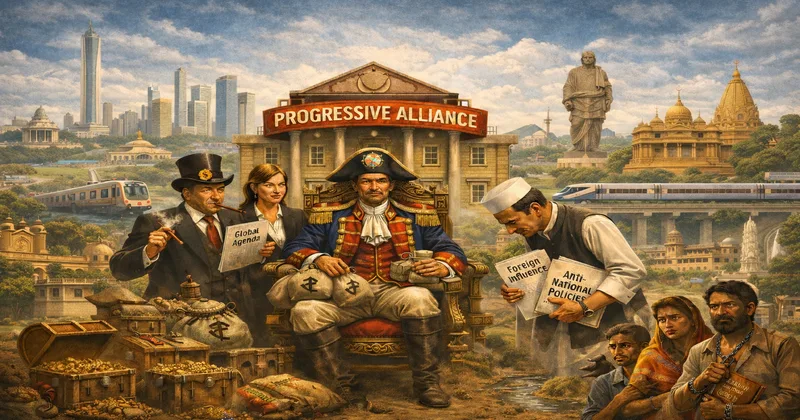
Bharat did not win freedom merely to change rulers; it fought to reclaim control over its destiny. Our independence was born from sacrifice, gallows, prisons, lathi charges, hunger, and unyielding faith that this civilisation could govern itself. The East India Company was ultimately defeated not just because it was foreign, but because it represented a system that drained Bharat’s wealth while preaching reform, fairness, and global integration. The freedom struggle taught a hard and enduring lesson: political freedom without economic sovereignty and institutional dignity is an illusion. Today, many Bharatiyas sense that this lesson is being forgotten, as a new ideological structure, the Progressive Alliance, emerges with a worldview disturbingly similar to that of the old Company, and with the Indian National Congress increasingly functioning as its domestic carrier.
How the East India Company Actually Ruled Bharat?
The East India Company did not arrive as an empire. They arrived as a trader and advisor. It spoke the language of efficiency, fairness, and global commerce. It claimed indigenous systems were corrupt and incapable, portrayed Indian enterprise as inefficient, and insisted that progress required external supervision. Long before political control was formalised, the Company had already captured markets, redirected wealth outward, and broken the confidence of native industry. By the time direct rule arrived, Bharat had already been economically weakened and psychologically conditioned. This is why historical parallels matter. Domination rarely begins with force. It begins with ideas, narratives, and elite collaboration.
The Progressive Alliance and Its 2024–2027 Agenda
The Progressive Alliance’s Political Working Agenda for 2024-2027 openly declares that progress can only be achieved by “building solidarities that transcend national borders” and by internationalising political action. It frames the present moment as an “epochal shift” caused by failures of existing national systems and argues that nationalism and self-reliance must be countered through global cooperation. The agenda repeatedly emphasises that internationalism must be the response to nationalism, and that political movements must actively engage multinational and multilateral institutions so that a shared progressive agenda is reflected in global processes.
Crucially, the document does not treat sovereign national decision-making as central. Instead, it calls for coordinated transnational action, global economic governance, and the development of a “new global social and ecological blueprint” that spans both the Global North and South. It explicitly states that progressive parties must influence multilateral institutions and international bodies so that their ideology is embedded in national policy. This is not mere cooperation. It is agenda harmonisation across borders.
The Progressive Alliance as the Modern Company Model
The similarity with the East India Company becomes clear here. The Company once operated through a board far removed from Indian realities, setting rules that served its interests while local agents executed them. The Progressive Alliance functions in much the same way, albeit through ideology rather than charters. It presents itself as a moral authority, defining which governments are acceptable, which economic models are legitimate, and which political outcomes warrant scrutiny.
Where the East India Company spoke of civilising missions, the Progressive Alliance speaks of democratic resilience, fair economic governance, and international solidarity. In both cases, authority shifts away from the nation-state toward transnational centres of influence.
Congress as the Domestic Executor of the Progressive Alliance Agenda
The Indian National Congress is no longer merely interacting with this ecosystem; it is internalising and advancing the Progressive Alliance worldview within Bharat. Congress leaders repeatedly echo the alliance’s language, describing nationalism as dangerous, self-reliance as isolationist, and national economic assertion as morally suspect. Their political messaging increasingly mirrors the Alliance’s core belief that domestic institutions and markets cannot be trusted without global supervision.
This reflects a familiar historical pattern. During colonial times, sections of the elite believed that Bharat required foreign guidance to modernise. Today, that belief returns in progressive language.
Why the RSS and Narendra Modi Are Targeted?
The relentless attacks on RSS and Prime Minister Narendra Modi are neither accidental nor limited to electoral politics. They stem from a deep ideological hostility toward the idea of Bharat standing on its own feet. Through decades of work by organisations like the Swadeshi Jagaran Manch, the RSS ecosystem has consistently argued that true freedom is incomplete without economic self-reliance, protection of indigenous enterprise, and resistance to exploitative global capital. Prime Minister Modi gave this vision national expression by repeatedly and unapologetically pushing Atmanirbhar Bharat, not as a slogan, but as a civilisational necessity rooted in the Swadeshi spirit that once challenged the East India Company itself.
This is precisely why these forces are targeted. A Bharat that rebuilds domestic manufacturing, strengthens Indian entrepreneurs, trusts its institutions, and values cultural confidence becomes immune to external ideological supervision. For Congress and its global ideological allies, this self-assurance is perilous. By demonising Modi, vilifying the RSS, and mocking Swadeshi ideas as outdated or extremist, they seek to weaken the resistance to a transnational agenda that thrives on dependency and doubt. The attack is not merely political; it is an attempt to uproot the Swadeshi consciousness that blocks foreign dominance in economic, cultural, and policy spaces. Break that resistance, and Bharat can once again be reduced from a confident civilisation to a managed market, echoing a past our freedom fighters fought and died to end.
Undermining Indigenous Economic Confidence: The Make in India Pattern
This alignment becomes visible in concrete public statements. At the very outset of Bharat’s manufacturing push, Rahul Gandhi declared, “Make in India was a good idea, but it failed,” framing a long-term industrial mission as conclusively unsuccessful even before its ecosystem had matured. On another occasion, he dismissed it by saying, “Make in India is just assembly, not manufacturing,” repeatedly emphasising dependency rather than capacity-building.
Manufacturing-led growth is inherently slow and structural. It requires infrastructure, skills, supply chains, and patient capital over years. To brand such an effort a failure at inception is not critique; it is narrative sabotage. This mirrors how the East India Company once portrayed Indian industry as incapable of scale, thereby justifying foreign dominance.
“Crony Capitalism” as a Tool to Weaken Indian Enterprise
Congress leaders have also persistently framed Bharat’s economic growth through the lens of “crony capitalism,” often reducing the entire corporate ecosystem to a caricature of a few favoured players. While accountability is essential, this blanket moral delegitimisation of Indian corporates has strategic consequences.
It creates an environment in which domestic capital is treated with suspicion, whereas foreign multinationals are perceived as neutral and virtuous by default. This mirrors the East India Company’s first economic move: discredit Indian traders and bankers before imposing systems that favoured its own interests.
What pricked them? The Story of Indian Automobiles vs Foreign Giants: Atmanirbhar Bharat in Action
Bharat’s automobile sector offers a powerful rebuttal to the Progressive Alliance’s worldview that foreign scale is inherently superior. Indian companies such as Maruti Suzuki, Tata Motors, and Mahindra & Mahindra succeeded because they understood Bharatiya consumers, road conditions, price sensitivity, fuel efficiency needs, and service ecosystems. They localised manufacturing, built domestic supply chains, empowered vendors, and created lakhs of jobs while becoming globally competitive.
In contrast, foreign automobile giants that entered Bharat during earlier Congress-led eras struggled to survive. Ford shut down manufacturing after years of losses. General Motors exited despite decades of presence. Fiat faded after failing to connect with Indian consumers. Even Harley-Davidson, a global icon, withdrew after realising that importing foreign premium narratives without localisation does not work in Bharat. This contrast proves that Bharat’s progress depends not on foreign dominance but on indigenous enterprise rooted in national understanding, a truth the East India Company never grasped and the Progressive Alliance risks repeating.
Delegitimising Institutions to Internationalise Pressure
The Progressive Alliance agenda repeatedly warns of democratic decline, unfair elections, and compromised institutions worldwide. In Bharat, Congress leaders mirror this language by alleging “vote chori,” questioning the Election Commission, and asserting that democratic processes are manipulated. Rahul Gandhi has framed elections as a battle between “truth and untruth,” openly suggesting institutional capture.
When such claims are amplified through global ideological platforms, domestic disputes become international judgments on Bharat’s legitimacy. This is exactly how colonial intervention was once justified, by declaring native systems incapable of fairness and self-correction.
Derailing Progress Before Replacing Control
Progress does not collapse accidentally. It is stalled deliberately. A nation that doubts its institutions, mistrusts its entrepreneurs, and is paralysed by constant narrative warfare becomes easier to influence. The East India Company allowed disorder to grow, then stepped in as administrator. The same logic applies today.
If the Congress- Progressive Alliance project succeeds, Atmanirbhar Bharat will be dismissed as dangerous nationalism, domestic enterprise will operate under permanent suspicion, and economic policy will increasingly defer to global ideological approval. Bharat may remain sovereign on paper, but real control over direction and priorities will drift outward.
A New East India Company Without Cannons
This will not be the East India Company of muskets and charters. It will be subtler and therefore more dangerous. It will rule through ideology, regulation, narrative pressure, and economic dependency. It will not annex territory; it will annex policy space. It will not fly flags; it will impose norms, benchmarks, and moral frameworks that serve interests far removed from Bharat.
The Progressive Alliance fits this model with alarming clarity, and Congress’s willingness to act as its domestic executor makes the parallel impossible to ignore.
The Freedom Struggle’s Unfinished Warning
Our freedom fighters did not give their lives so that Bharat could once again be supervised from abroad. The Swadeshi movement was not symbolic; it was an economic form of resistance to Company rule. Thousands endured prison, bullets, and the gallows so that Bharat would never again be reduced to a market governed by external interests.
To now adopt a worldview that weakens indigenous enterprise, questions national institutions, and seeks foreign ideological approval over domestic confidence is to forget that sacrifice.
Bharat Must Recognise the Pattern
History rarely returns in identical form, but it often follows familiar patterns. The East India Company succeeded because Bharat did not recognise the danger early enough. Today, the pattern is visible: a transnational ideological bloc questioning sovereignty, a domestic political party advancing its agenda, economic confidence under attack, institutions delegitimised, and progress deliberately slowed.
Bharat must ask itself a hard question: are we witnessing the rise of a new East India Company, this time without ships or soldiers, but with ideology, global coordination, and influence? A civilisation that once freed itself from Company rule cannot afford to submit to it again under a different name.