For the nth time in his monthly “Mann Ki Baat”, Prime Minister Narendra Modi mentioned J&K. In different episodes, over the years, there have been different issues pertaining to J&K that he has mentioned. During the G20 summit meeting held in Srinagar, the PM offered a milk-made delicacy called “Kaladi” to the guests gathered there worldwide. Those producing Kaladis, mostly rural women in hilly areas of the Jammu region, particularly Reasi, Udhampur, got such publicity that it is one of the most sought after delicacies in marriage functions in the Jammu region.
On December 28, PM Modi mentioned Baramullah, a district in north Kashmir, during his talk, and its Buddhist past, going back more than 2,000 years! This aspect of Buddhism being one of the religions established and being followed by the people of Kashmir was brought out beautifully by PM Modi in his talk, the last for this year. According to the 2011 census figures, Baramulla is at least 95 per cent Muslim with about three (03) per cent Hindus and 1.5 per cent Sikhs. There are some Christian and Buddhist families but in terms of percentage, the numbers are negligible (both communities numbering less than half a percentage point).
PM Modi said that the discovery of an old, blurry photograph of three Buddhist stupas preserved in a museum archive in France has helped reveal Kashmir’s glorious past, dating back nearly 20 centuries. The PM said recent archaeological findings in J&K had brought to light large, human-made structures that reflect the region’s rich cultural and historical heritage. He said the developments would fill people with pride about Kashmir’s civilisational legacy. It goes without saying that Kashmir was once entirely Hindu and several great sages like Abhinavgupta had made it their “karam bhoomi”.
Incidentally, it needs to be mentioned here that historical and archeological evidence suggests that Buddhism flourished at one time in the whole of J&K, and Ladakh. Perhaps the Buddhists of that era travelled along the river Chenab which crosses into Pakistan after flowing through Akhnoor town on this side where Maharaja Ranjit Singh had anointed Gulab Singh as Raja of Jammu on June 17, 1822.
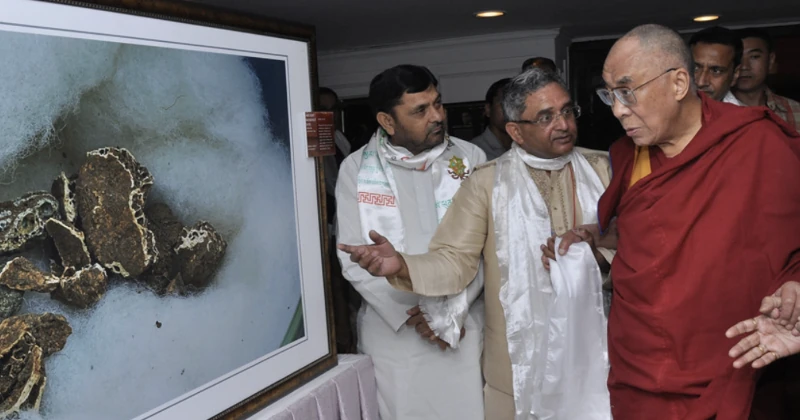
Ambaran in Akhnoor is a globally recognised Buddhist site, very well maintained, where His Holiness Dalai Lama had visited once on the invitation of late Madan Lal Sharma, MP from Jammu. HH Dalai Lama was in Jammu and then proceeded to Ambaran on November 16, 2011, to see the Buddhist site and relics kept there. He had then said that he will visit Ambaran again but that has not materialised till date. The purpose of the visit was to bring this Buddhist site Ambaran on the map of Buddhist pilgrims visiting India.
Before visiting Ambaran, it was an exhibition organised by photographer and author Vijay Kranti on Ambaran in Delhi which HH Dalai Lama attended.
In the Jammu region, hundreds of Buddhist families live in the remote Padder area of the picturesque Kishtwar district. A new Legislative Assembly segment of Padder-Nagseni was created in the last delimitation held in J&K in the year 2022. The Nagseni area is named after the great Buddhist scholar Nagsen. According to local history, it is believed that a Buddhst conference was held in the area in the second century BC (Before Christ). Historical ruins comprising stone temples, broken idols and stone inscriptions have also been found in the region.
Referring to Baramulla’s Zehanpora area, Modi said that for years local residents had noticed tall mounds in the landscape but were unaware of their significance. These mounds were considered ordinary until an archaeologist closely observed the site and found that the formations appeared unusual. The PM said this observation led to a detailed scientific study of the area. Drones were deployed to capture aerial images, and the land was systematically mapped. As the research progressed, it became clear that the mounds were not natural formations but the remains of a large, man-made structure, the remains of Buddhist stupas.
He said a further breakthrough came when, thousands of kilometres away from Kashmir, an old photograph was discovered in the archives of a museum in France. The photograph, though unclear, showed three Buddhist stupas in Baramulla. According to Modi, this visual evidence helped connect the archaeological findings in Zehanpora to Kashmir’s ancient Buddhist past, pushing the historical timeline back nearly two millennia.
The PM said the Buddhist complex at Zehanpora stands as a reminder of Kashmir’s rich and diverse identity. Archaeologists believe the site to be part of an ancient Buddhist centre dating to the Kushan dynasty, between the first and third centuries CE, a period when Buddhism flourished across the region. Excavations at Zehanpora are said to have added a new dimension to the understanding of Kashmir’s past, linking the site to the wider network of Buddhist centres visited by travellers and scholars, including Chinese monks such as Xuanzang, who documented similar sites like Ushkur, also known as Hushkapur.
The PM said such discoveries underline the depth of Kashmir’s historical heritage and the importance of preserving and studying these sites to better understand the region’s role in the cultural and spiritual history of the subcontinent.