As tensions rise at Thiruparankundram, a chain of administrative actions, contested policing and political statements has triggered sharp debate in Tamil Nadu over minority appeasement, religious freedoms and the DMK government’s stance ahead of the 2026 Assembly elections
With the Tamil Nadu Assembly elections 2026 approaching, the sequence of fast-paced developments around Thiruparankundram has exposed the DMK’s deepening minority appeasement strategy and its increasingly adversarial posture towards Hindu religious practices.
The administrative decisions of DMK have now emerged as a tightly interlinked chain of actions — denial of Karthigai Deepam, court defiance, an impeachment motion against a sitting judge, selective policing, the tragic death of Poornachandran, suppression of
Moksha Deepam, and parallel facilitation of Muslim religious events — together revealing a political design operating on the ground.
The latest flashpoint came when the DMK government allowed Muslims to conduct the Santhanakoodu festival at the Hazrat Sikandar Dargah, located atop the Thiruparankundram hill, with full police security. Late on the night of December 21, a group of Muslims hoisted a ceremonial green flag to mark the anniversary of Sultan Syed Ibrahim Shaheed Badusha Nayagam. The Santhanakoodu festival is scheduled to continue until January 6, 2026.
Already, the situation at Thiruparankundram was tense following DMK’s denying permission to light the traditional lamp at the ancient stone deepa stambha (vilakku thoon) on Karthigai Deepam. In the midst of this, on December 18, Poornachandran, a fruit seller and a member of a staunch DMK family, self-immolated after being unable to light the lamp on Karthigai Deepam. He later succumbed to burn injuries, leaving behind his wife and son. His death became a moral and political rupture. A Government that routinely announces Rs 10 lakh ex gratia assistance for victims of illicit hooch consumption and minority community deaths remained silent in Poornachandran’s case, a silence that spoke louder than any official statement.
Public anger intensified. Former Idol Wing IG Pon Manickavel, after personally visiting the family, described the act on December 21 as an “altruistic suicide” for a social cause and reminded officials that High Court orders must be obeyed. His remarks were widely interpreted as a pointed indictment of the Madurai District Collector and Commissioner of Police, who are now facing contempt proceedings for allegedly defying repeated court directions.
On the ground, policing became increasingly coercive. Thousands of Hindu Munnani cadres were detained across Tamil Nadu for attempting to light Moksha Deepam in memory of Poornachandran on December 21. FIRs were registered even after lamps were lit and devotees had dispersed, often based on later video footage. Another action of the DMK government that sparked intense anger was the denial of permission to Hindus to visit the Kashi Viswanathar Temple on December 21 to light Moksha Deepam atop the Thiruparankundram hill. The police blocked devotees by barricading the path. Following the escalation of Hindu protests, the recalcitrant DMK Government police machinery, on December 22, allowed Hindu devotees to climb the hillock to offer prayers at the Kashi Viswanathar Temple, but with a rider: devotees were required to provide their names, addresses and mobile numbers, an act of intimidation aimed at silencing dissent and discouraging worshippers.
BJP Tamil Nadu leader H Raja accused the DMK government of deliberately creating an “unnecessary and provocative situation”, alleging that Hindus had been barred from worship at the Kashi Viswanathar Temple for over 20 days while Muslims enjoyed unrestricted access to the Dargah. He questioned why Kandhuri and Santhanakoodu rituals were allowed if Hindu worship posed no threat other than political inconvenience.
DMK’s Christmas Remarks Trigger Political Row
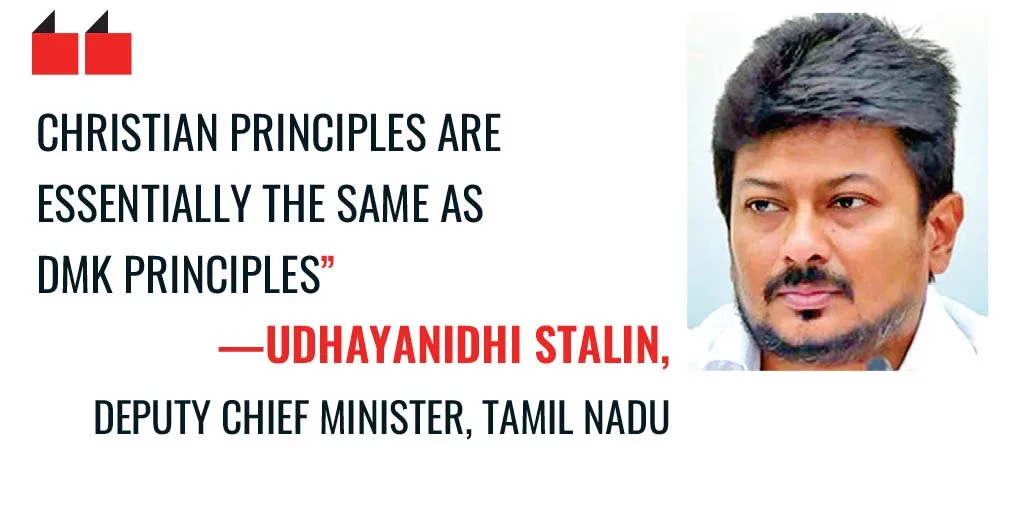
While Thirupparankundram is to appease the Muslims, DMK chose the temple town Madurai to appease Christians. On December 19, 2025, marking the Christmas celebrations, TN Deputy Chief Minister Udhayanidhi Stalin said, “Christian principles are essentially the same as DMK principles”, asserting that both Christianity and the Dravidian movement are rooted in love, compassion, equality and humanitarianism, and place human dignity at their core.
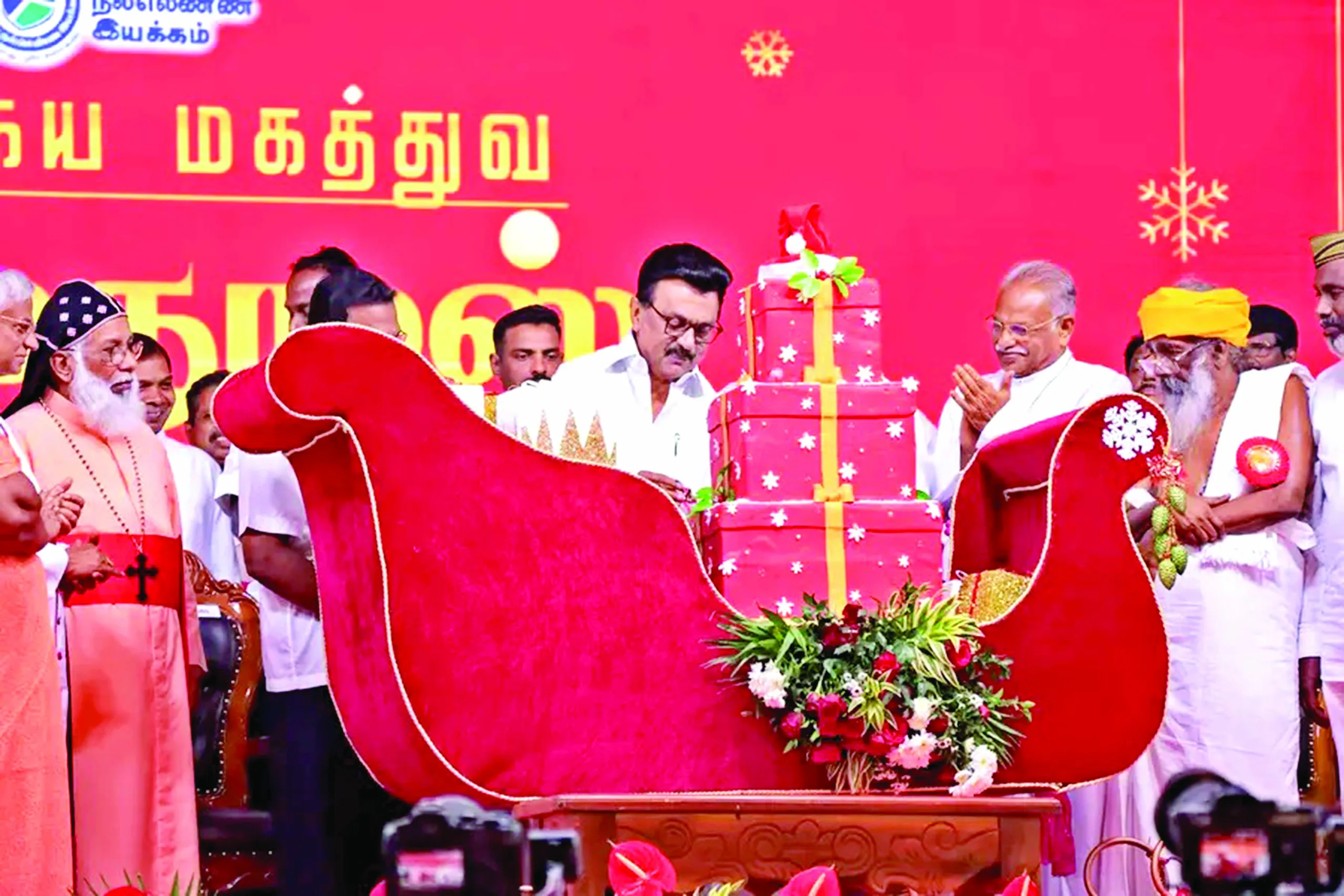
A day later, on December 20, his father and Tamil Nadu Chief Minister MK Stalin echoed similar sentiments while addressing the Manitha Neya Christmas event organised by the Christian Goodwill Movement at Palayamkottai in Tirunelveli district. The Chief Minister said the Dravidian Model government functioned as a testament to Jesus Christ’s idea of “everything for everyone, regardless of which religion one belongs to”.
The CM also cited a Biblical verse, cautioning, “Be wary, be careful, let no one deceive you”, accusing the BJP of attempting to disturb peace in the State and alleged that certain forces were dividing people who had been living harmoniously. He claimed Tamil Nadu had realised that the path some organisations sought to lead society down, in the name of spirituality, was a path to violence.
The Chief Minister also accused BJP led NDA Government as a threat to minorities and said the DMK had consistently opposed measures such as the Citizenship Amendment Act (CAA), the National Register of Citizens (NRC), and the Special Intensive Revision (SIR), among others.
These remarks drew an immediate and sharp response from the BJP’s Tamil Nadu unit, which accused the DMK of blatant minority appeasement. The party alleged that while the State government had opposed, despite court orders, the lighting of the lamp atop Thiruparankundram, it was now delivering sermons at Christian events and lecturing political opponents on secularism. The BJP further claimed that the DMK’s assertion that its government was a testament to Jesus Christ amounted to rank appeasement politics, driven by apprehensions that actor-turned-politician Joseph Vijay could erode the party’s Christian support base.
In a statement, Tamil Nadu BJP spokesperson ANS Prasad questioned the moral authority of the DMK leadership, asking how “Bhagwan Murugan, the supreme deity of Tamil dharma and vanquisher of demons”, could extend his blessings to a government he described as hostile to Sanatan Dharma. He said that the ruling party’s actions and statements reflected deep hypocrisy. He said that in the sacred land of Tamil Nadu, where Bhagwan Murugan’s vel symbolises righteousness and devotion, the contradictions of the DMK regime stood “glaringly exposed”, likening them to mythological forces opposed by Murugan in the battle of dharma. He argued that the ruling party’s public posturing and administrative conduct revealed a deep inconsistency between its claims of secular governance and its actions on the ground.
Recalling a statement from 2022, he noted that at a Christmas celebration in Chennai, Udhayanidhi Stalin had openly declared his Christian faith and spoken of his personal and familial ties to Christianity. What was earlier presented as a personal belief, he said, had now been expanded to define the ideological character of the DMK itself. By equating Christian principles with DMK ideology, the Deputy Chief Minister had, he alleged, elevated the party into a Christian political identity, an act he claimed amounted to an assault on Tamil Hindu spirituality.
The BJP leader said the party had no objection to genuine appreciation of the moral values of any faith and reiterated that his party stood by sarva dharma samabhava, respecting all religions while opposing forced conversions and religious extremism. However, he argued that the DMK leadership’s assertions reflected a calculated political strategy that risked eroding the foundations of Sanatan Dharma.