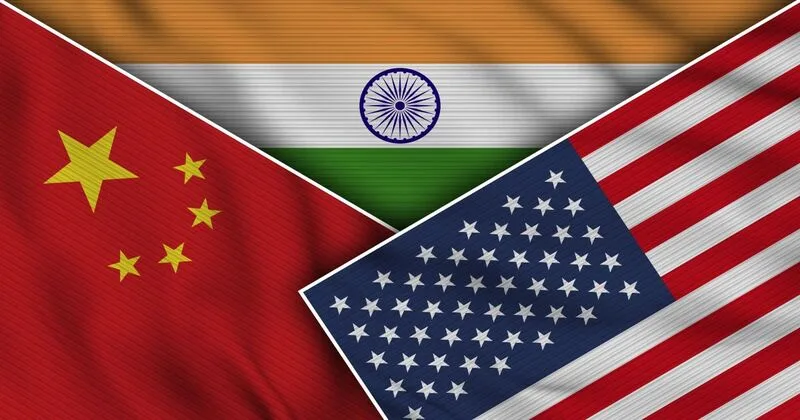
NEW DELHI: Beijing has strongly criticised the recent Pentagon report of the United States. The report discussed the potential conflict between India and China over Arunachal Pradesh. China views Arunachal Pradesh as a key lever in advancing its hegemonic ambitions, and the region is among China’s core interests under its “great rejuvenation by 2049” policy, according to the Pentagon. The report came at a critical juncture, when New Delhi and Beijing are on the path of resetting and stabilising their bilateral ties, post the Galwan clash of 2020.
However, Beijing has responded to the Pentagon report, asserting that Washington aims to fulfil its hegemonic ambitions by fueling the rift between India and China. The Foreign Ministry of China said that the United States has a distorted view of Beijing’s defence policy and is only seeking to derail the momentum gained in improving relations between India and China. Beijing also rejected the Pentagon’s claims that China used the de-escalation achieved between India and China across the Line of Actual Control (LAC) to undermine India-US ties.
“China views its ties with India from a strategic and long-term perspective”, said the spokesperson of the Foreign Ministry of China, Lin Jian. He further added that the border issue was a matter between China and India. No foreign or external interference is tolerated in a purely bilateral issue, said the Chinese Foreign Ministry in a strong response to the Pentagon report on the India-China border tensions. “We object to any country passing judgement about this issue”, asserted Beijing. The US report is a ‘tactic’ to maintain military supremacy and create a hoax. Beijing further criticised the Pentagon report.
The Pentagon, the United States’ military headquarters, reported that China aims to undermine the stable and growing relations between India and the United States. The report also discussed Beijing’s expansionist motives across the Indo-Pacific, including Taiwan, the South China Sea, and other regions such as Arunachal Pradesh. According to a U.S. report, China has three primary motives to consolidate its hegemony across the geopolitical chessboard: maintaining the Chinese Communist Party (CCP) ‘s continued control over the nation, rapid economic development, and asserting expansionism and territorial claims in nearby regions.
However, the Chinese Foreign Ministry’s debunking of the Pentagon report on India-China relations and hailing the ties with India as “strategic and long-term” marks further momentum to stabilise the relations with China, which is on the path of re-engagement post the Galwan clash of 2020, when the bilateral relations had hit an all-time low. Lately, India and China have been rebuilding bilateral ties by resuming visa issuance, establishing direct air connectivity, and implementing other diplomatic measures. Prime Minister Narendra Modi also visited Tianjin, China, for the SCO Summit, thus embarking on a new chapter in the New Delhi-Beijing relations.