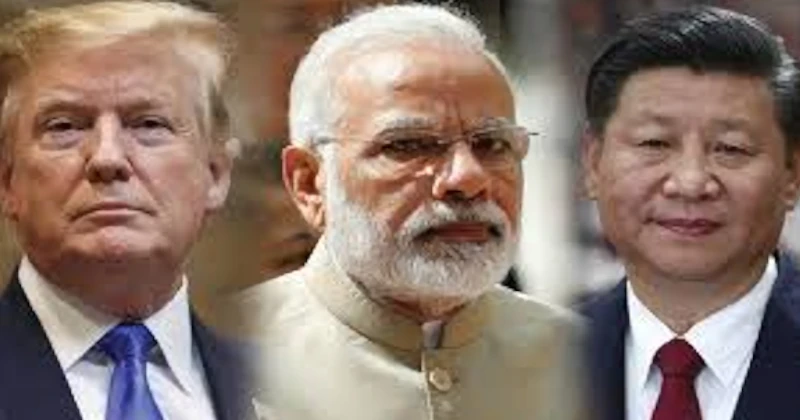
A fierce war of words has erupted between the United States and China, with India emerging as a central strategic reference point. While India and China have, for now, chosen dialogue and diplomatic engagement to prevent further escalation following the Galwan Valley clash, Washington has accused Beijing of using this period of relative calm to advance its own strategic interests at India’s expense. The allegation appears in the Pentagon’s latest annual assessment, Military and Security Developments Involving the People’s Republic of China – 2025. According to the report, China is exploiting the diplomatic pause along the India–China border to consolidate military and civilian infrastructure, while simultaneously attempting to undermine India’s growing strategic partnership with the United States.
The Pentagon report alleges that China has not halted construction activity along the Line of Actual Control (LAC), including roads, bridges, logistics hubs, and so-called “border villages.” These developments, the US assessment claims, are being pushed forward under the cover of peace talks, with Beijing treating diplomacy as a tactical delay rather than a genuine effort to restore the pre-2020 status quo. From New Delhi’s perspective, this reinforces long-standing concerns about China’s credibility. While India has consistently emphasised disengagement, de-escalation, and restoration of normalcy as prerequisites for stable relations, Beijing’s actions on the ground continue to tell a different story. The Pentagon bluntly notes that India does not regard China as a reliable partner and continues to view Chinese behaviour along the border with deep suspicion.
India–US ties rattle Beijing
The report also underscores China’s unease over India’s growing strategic alignment with the United States. According to Washington, Beijing is actively attempting to dilute India–US cooperation by projecting an image of improving ties with New Delhi, even as it maintains pressure on the border.
Recent diplomatic engagements such as the meeting between Prime Minister Narendra Modi and Chinese President Xi Jinping, and discussions on resuming direct flights and easing visa restrictions, are described by the Pentagon as part of China’s tactical messaging rather than a fundamental shift in policy. India, the report suggests, remains alert to these manoeuvres and is unwilling to confuse optics with substance. Crucially, the Pentagon points out that China continues to deepen its military and strategic cooperation with Pakistan even as it claims to seek stability with India. This dual-track approach, Washington argues, is designed to keep India under constant strategic pressure while buying time to strengthen China’s hostile posture along the LAC.
Beijing has reacted sharply to the Pentagon’s assessment. Chinese Foreign Ministry spokesperson Lin Jian dismissed the report as interference by a third party, asserting that India–China relations are “strategic” and guided by a long-term vision. He maintained that the border issue is strictly a bilateral matter and warned external powers against passing judgment. India, however, has consistently held that peace on the border is the foundation of any meaningful bilateral relationship. Until that condition is met, New Delhi’s strategic calculus remains firmly rooted in safeguarding sovereignty and territorial integrity.
Global Fault Lines Widen; Gold and oil price surge
Beyond South Asia, the Pentagon report situates the India–China dynamic within a rapidly deteriorating global geopolitical environment. Efforts led by Washington to broker an end to the Russia–Ukraine war appear to be unravelling, adding to broader international uncertainty.
In a Christmas message, Ukrainian President Volodymyr Zelensky declared that Russian President Vladimir Putin was “lost,” even as reports emerged that Moscow is distancing itself from the US-backed peace framework. Russia has reiterated its non-negotiable demands that Ukraine must withdraw from Donetsk and Luhansk, and NATO must abandon any expansion ambitions.
Without these concessions, Moscow has made clear that no peace plan will be implemented. At the same time, multiple flashpoints are intensifying worldwide mainly the US–Venezuela standoff, American military action against terrorist networks in Nigeria, tensions between China and Japan over Taiwan, the Cambodia–Thailand border dispute, and the continuing conflict in Syria. Together, these crises are casting a long shadow over global stability and economic confidence.
Unsurprisingly, renewed geopolitical stress is fuelling volatility in global commodity markets. Gold, traditionally seen as a safe-haven asset, has surged sharply. A day after Christmas, international gold prices crossed the $4,500-per-ounce mark, briefly touching $4,528 before easing slightly to around $4,493. In India, domestic gold prices are expected to rise in line with global trends. Silver has also joined the rally, jumping 3.45 per cent in international trade to reach an all-time high of $74.4 per ounce, reflecting heightened investor anxiety and demand for safe assets.
Crude oil prices, meanwhile, are being driven higher by geopolitical supply risks. US pressure on Venezuela, disruptions to Venezuelan oil exports, and continued Ukrainian attacks on Russian oil tankers have tightened market sentiment. West Texas Intermediate (WTI) crude rose 0.33 per cent to $58.54 a barrel in morning trade, while Brent crude gained 0.32 per cent to $62.44.