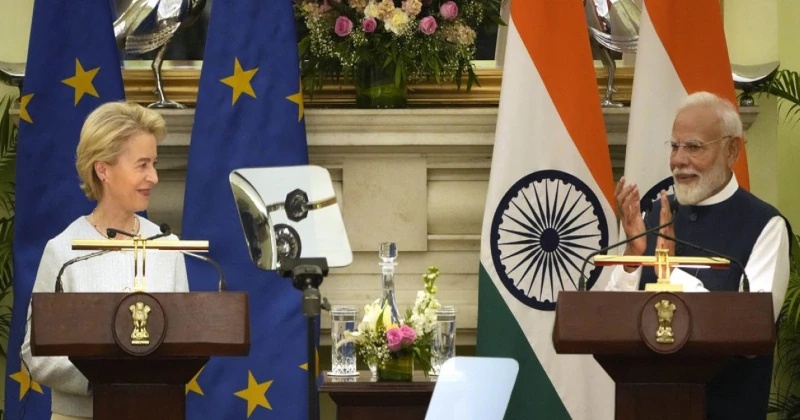
Even as the United States pressures European countries to impose tariffs on India, Europe is moving decisively to deepen its economic engagement with New Delhi. The long-pending India–European Union Free Trade Agreement (FTA) is now widely expected to be announced in the near future, signalling a strategic shift in Europe’s trade priorities and India’s growing centrality in the global economic order.
A key step in this direction will be the visit of Piyush Goyal, India’s Union Minister for Commerce and Industry, to Brussels on January 8 and 9. Brussels, the capital of Belgium, also serves as the headquarters of the European Union, and the visit is expected to push negotiations into what officials describe as their final and most demanding phase. This will be followed by a high-profile diplomatic signal that leaders of the 27-member EU bloc are expected to arrive in New Delhi as special guests for India’s Republic Day celebrations on January 26.
Government sources on both sides indicate that the broad contours of the agreement are largely in place and that a formal announcement could come soon. This momentum has gathered pace despite global trade turbulence, including aggressive tariff measures announced earlier by US President Donald Trump. Although Trump imposed a steep 50 percent import tariff on Indian goods, including a 25 percent countervailing duty, Indian officials maintain that the move did not cause a major setback to India’s export sector. Instead, it appears to have accelerated New Delhi’s push to diversify markets through bilateral and multilateral trade agreements, particularly with Europe.
India has already signed a trade agreement with Oman and concluded another with New Zealand. Negotiations are also progressing rapidly with countries such as Canada, Israel, and Chile. Within this broader strategy, the India–EU FTA is viewed as a cornerstone agreement, given the size, regulatory influence, and economic weight of the European bloc. Strong signals of political support for the deal have emerged from several European capitals. Finland’s Ambassador to India, Kimmo Lahdevirta, has described the India–EU Free Trade Agreement as a major potential achievement for both sides. As part of strengthening bilateral ties, Finland has committed to invest approximately four billion euros in India, roughly equivalent to Rs 50,000 crore. India, in turn, is expected to invest around ₹10,000 crore in Finland, underlining the growing two-way nature of the economic relationship.
This approach marks a clear departure from earlier pressure exerted by Washington. At one stage, Trump had urged the European Union to impose tariffs on India over its imports of Russian oil. That demand was firmly rejected by Finland and found little support within the EU. Rather than adopting punitive measures, the European Union has chosen to pursue a comprehensive trade agreement with India, reflecting a more pragmatic and long-term strategic outlook.
Finland’s Foreign Minister, Elina Valtonen, has explicitly stated that the EU is not seeking to increase tariffs on India but aims to reduce them to facilitate a more balanced and mutually beneficial trade framework. This sentiment has been echoed at the highest levels of the European Commission. Ursula von der Leyen has publicly affirmed that concluding a trade agreement with India at the earliest is a key objective for the EU. Support for closer economic ties has also come from Finland’s President, Alexander Stubb, who has described India as a ‘rising superpower’ and a long-standing partner of both Europe and the United States. He has emphasised that strengthening trade relations with India is a strategic priority, particularly as India continues to emerge as one of the world’s fastest-growing major economies.
Substantively, negotiations between India and the EU are already at an advanced stage. Fourteen rounds of talks have been completed, and the upcoming Brussels visit by Minister Goyal is being described by India’s Commerce Ministry as the final and most arduous leg of the process. This visit is expected to provide political direction to negotiating teams as they attempt to resolve outstanding differences. According to officials familiar with the discussions, both sides are focusing on a range of complex issues. These include the European Union’s Carbon Border Adjustment Mechanism (CBAM), Geographical Indications (GI), access to critical minerals, intellectual property rights (IPR), and several regulatory and market-access concerns. Negotiators have reportedly exchanged preliminary lists of GI-tagged products that could be included in the agreement, even as parallel talks continue on an investment protection pact. India defines GI-tagged goods as products that originate from a specific geographical location and possess qualities, characteristics, or a reputation essentially attributable to that origin. Securing recognition and protection for Indian GI products in European markets is seen as an important objective for New Delhi, particularly for agricultural and artisanal exports.
Another sensitive issue concerns critical minerals. Sources indicate that the EU is seeking access to the export of critical minerals from India, viewing them as essential for Europe’s energy transition and industrial strategy. This demand comes in the backdrop of the EU’s recent challenge at the World Trade Organization against Indonesia’s ban on nickel exports, underscoring Europe’s broader push to secure reliable mineral supply chains. India, for its part, is expected to seek exemptions or carve-outs for certain exports, particularly stainless steel, in light of higher duties imposed by the EU. The Ministry of Commerce and Industry has already held consultations with stakeholders from the automobile and steel sectors to assess the potential impact of European regulations and tariffs.
A major area of concern for Indian exporters is the proposed expansion of the EU’s CBAM framework. The EU has suggested extending CBAM to cover up to 180 downstream goods, with CBAM certificates scheduled to be sold from February 1, 2027, for goods imported in 2026. Indian negotiators are expected to push for transitional arrangements or exemptions to protect domestic industries from sudden cost increases.
Minister Goyal has already held detailed discussions with Maros Sefcovic, the EU Commissioner for Trade and Economic Security, during meetings in New Delhi on December 8 and 9. These talks were aimed at offering strategic guidance to negotiating teams and accelerating progress towards concluding the agreement.
The EU’s diplomatic mission in India has also acknowledged the significance of the current phase. Herve Delphin previously described the negotiations as entering a fundamentally new stage, referring to them as “EU–India FTA negotiation 2.0” after the completion of the 14th round. The economic stakes are substantial. The European Union is India’s largest trading partner, with bilateral goods trade reaching $137.5 billion in the financial year 2023–24. While India is seeking greater market access and lower duties for its labour-intensive exports such as textiles, leather, and engineering goods, the EU aims to expand exports of automobiles, alcoholic beverages, and high-value manufactured products to the Indian market.
India has also pressed for recognition as a data-secure country under EU regulations, a move that would significantly ease trade in digital services. Additionally, New Delhi is seeking improved access for its skilled professionals under the EU’s labour mobility frameworks.
Government sources suggest that EU approval for Indian fisheries exports could help offset potential losses arising from US tariff measures. Officials remain cautiously optimistic, noting that negotiations are proceeding smoothly and remain on track for conclusion within the targeted timeframe.
Taken together, the developments point to a decisive strengthening of India–Europe economic ties. As global trade realigns amid geopolitical uncertainty and protectionist pressures elsewhere, the proposed India–EU Free Trade Agreement is emerging as a defining pillar of India’s outward-looking trade strategy and Europe’s recalibrated engagement with a rising global power.