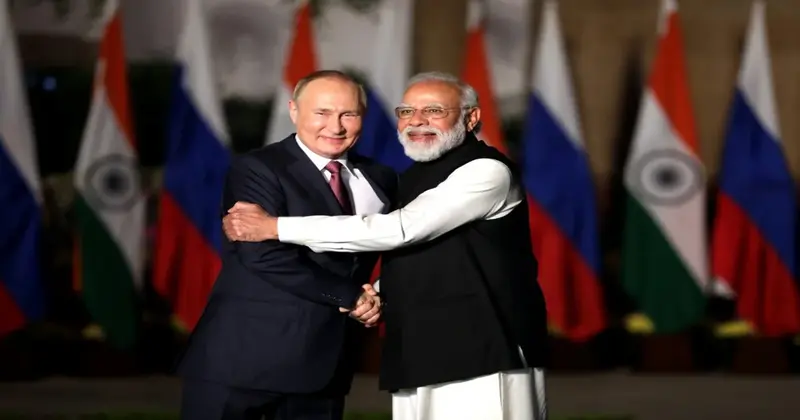
“Every Indian considers Russia to be India’s friend in good and bad times”, said Prime Minister Narendra Modi at Moscow on July 9, 2024.
India and Russia share one of the most enduring, resilient and trusted partnerships in modern international relations. While formal diplomatic relations were established soon after India’s independence in 1947, the foundations of Indo-Russian friendship stretch back several centuries. This relationship is not merely a product of Cold War geopolitics, but is rooted in historical contacts, cultural exchanges, strategic trust and shared civilisational connections.
Today, despite dramatic collapse of the old institutions and transformations in the global order, the rise of new power centres and shifting geopolitical alignments, India and Russia continue to regard each other as dependable partners. Their relationship has evolved from Cold War solidarity into a comprehensive strategic partnership encompassing defence, energy, trade, science and technology, space cooperation, education and cultural.
Historical foundations of friendship
The roots of India-Russia relations predate modern diplomacy by several centuries. In 1467, the Russian merchant and traveller Afanasi Nikitin journeyed to India, becoming one of the earliest Russians to document Indian society and culture. His travelogue remains an important historical record of Indo-Russian contacts.
Between 1598 and 1605, Indian merchants established active commercial links with Russia. Recognising their importance, Tsar Boris Godunov granted protection to Indian traders operating within Russian territories. These interactions demonstrated the early economic and cultural connections between the two societies. In 1900, Russia opened a consulate in Bombay, further institutionalising contacts between the two regions.
The modern phase of relations began with the establishment of diplomatic relations in April 1947, shortly before India attained independence. During the Cold War, the Soviet Union emerged as India’s most significant strategic partner. Soviet support was crucial in India’s industrialisation, heavy engineering development, scientific advancement, and defence modernisation.
A landmark moment came with the Treaty of Peace, Friendship and Cooperation of 1971, signed during a period of intense geopolitical tension surrounding the Bangladesh Liberation War. Soviet diplomatic and strategic support helped India navigate one of the most critical moments in its post-independence history.
Following the dissolution of the Soviet Union in 1991, both countries adapted to new realities. A major revival occurred in October 2000 when India and Russia signed the Declaration on Strategic Partnership, laying the foundation for a modern strategic relationship. In December 2010, this relationship was elevated to a Special and Privileged Strategic Partnership, a status accorded by Russia to only a select few countries.
Buddha Dhamma: A civilisational bridge
While geopolitical cooperation often dominates discussions on India-Russia relations, an equally important dimension lies in the civilisational sphere.
In 1741 Buddha Dhamma recognised as the official religion of the Russian Empire. For six centuries, Buddhist traditions have flourished and integrated into Russian society, in regions that today form part of the Russian Federation, particularly Kalmykia, Buryatia, Tuva and Trans-Baikal regions. These communities have preserved their spiritual links with India, the birthplace of Dhamma.
The shared Buddhist heritage provides a unique foundation that distinguishes India-Russia relations from many other bilateral partnerships. Through Buddha Dhamma, India possesses a form of cultural and civilisational influence that complements strategic engagement.
Recent initiatives have revitalised these links. The Holy Buddha Relics “Dhamma Yatra” to Republic of Kalmykia in 2025 attracted thousands of devotees and generated enormous goodwill. Similarly, the Indian Cultural Days organised in Elista in May 2026 highlighted the growing role of cultural diplomacy in strengthening bilateral relations. These initiatives demonstrate that India-Russia relations are sustained not only by strategic calculations but also by centuries-old cultural and spiritual bonds.
Institutional architecture of the strategic partnership
One of the unique features of India-Russia relations is the existence of highly institutionalised mechanisms that ensure continuity regardless of political changes.
The principal mechanism is the India-Russia Intergovernmental Commission (IRIGC), which operates through two major pillars: IRIGC-TEC (Trade, Economic, Scientific, Technological and Cultural Cooperation), co-chaired by India’s External Affairs Minister and Russia’s First Deputy Prime Minister. And IRIGC-M&MTC (Military and Military-Technical Cooperation), co-chaired by the Defence Ministers of both countries.
Regular annual summits between the Prime Minister of India and the President of Russia provide strategic direction to the partnership. In December 2021, both countries introduced the 2+2 Ministerial Dialogue, bringing together the Foreign and Defence Ministers of both nations. This elevated India-Russia consultations to the highest level of strategic coordination.
Defence Cooperation: The cornerstone of relations
Defence cooperation remains the strongest pillar of India-Russia relations. For decades, Russia has been India’s largest defence partner. The most successful example of bilateral defence cooperation is the BrahMos missile project, jointly developed by India’s DRDO and Russia’s NPO Mashinostroyenia. BrahMos is recognised as one of the world’s fastest operational supersonic cruise missiles and symbolises the depth of technological collaboration between the two countries.
Another important initiative is the AK-203 assault rifle project in Uttar Pradesh, which supports India’s “Make in India” and Atmanirbhar Bharat initiatives through technology transfer and local production.
Economic and energy partnership
Economic cooperation has emerged as a major pillar of the relationship. Trade between India and Russia has expanded significantly in recent years, reaching record levels. Russia has become one of India’s leading suppliers of crude oil, contributing substantially to India’s energy security.
Nuclear energy cooperation remains another strategic sector. The Kudankulam Nuclear Power Plant stands as the flagship symbol of bilateral nuclear collaboration, with multiple units already operational and additional reactors under construction. Indian investments in Russian oil and gas projects such as Sakhalin-1, Vankorneft, and Tass-Yuryakh have further strengthened energy ties.
Connectivity initiatives such as the International North-South Transport Corridor (INSTC) and the proposed Chennai-Vladivostok Maritime Corridor are expected to transform Eurasian trade by reducing transportation costs and enhancing connectivity between India, Russia, Central Asia and Europe.
Science, technology and space cooperation
India and Russia have a long history of cooperation in science and technology. The Soviet Union played a vital role in launching Aryabhata, India’s first satellite, in 1975. This partnership continues today through collaboration between ISRO and Roscosmos.
Russia is also assisting India in the Gaganyaan Human Spaceflight Programme, including astronaut training and life-support technologies. Cooperation has expanded into artificial intelligence, nanotechnology, biotechnology and advanced scientific research.
Putin’s remarks and strategic autonomy
The strength of India-Russia relations was reaffirmed by President Vladimir Putin during the St. Petersburg International Economic Forum in June 2026. Responding to questions regarding India’s growing engagement with the United States, Putin emphasised that India’s relations with Washington do not undermine its friendship with Moscow. He rejected attempts to pressure India over its ties with Russia and praised India’s remarkable economic achievements.
His remarks reflected a deeper understanding within Russia of India’s longstanding commitment to strategic autonomy, a principle that remains central to Indian foreign policy.
And the friendship Druzhba continues
India-Russia relations stand for, far more than a conventional diplomatic partnership. They are built upon centuries of historical interaction, Solidarity, strategic trust, economic cooperation and a unique civilisational connection through Buddha Dhamma.
From Buddha Dhamma to the first European (Russian) traveller Afanasi Nikitin’s journey to India to the paintings of Nicholas Roerich in the Himalayas to contemporary cooperation in defence, energy, space technology, and global governance, the relationship has consistently demonstrated resilience and adaptability.
In an increasingly uncertain international environment, India and Russia continue to demonstrate that genuine friendship between nations is built on mutual respect, shared interests, historical trust and civilisational bonds. For India, Russia remains not merely a strategic partner, but a true friend.