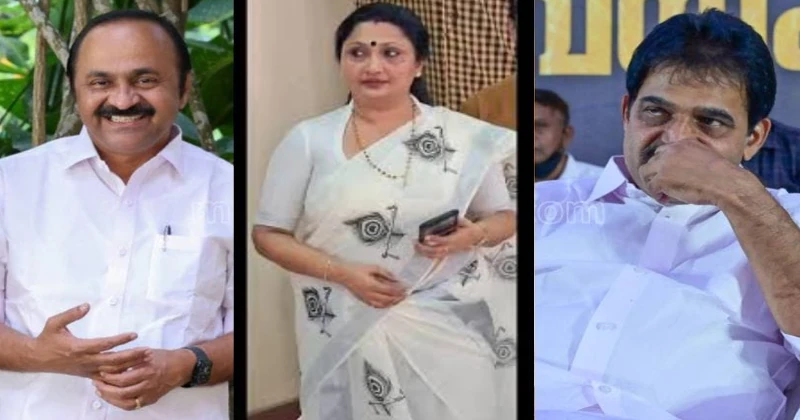
The political manoeuvres that kept Deepthi Mary Varghese out of the Kochi Corporation mayoral race have now been laid bare. What initially appeared as a routine organisational decision has turned into a revealing episode of internal conflict within the Congress, exposing a deepening struggle over power, leadership criteria, and ultimately, the chief ministerial race ahead of the Kerala Assembly elections. The controversy acquired sharper political meaning when Mathew Kuzhalnadan, MLA from Ernakulam, came forward with indirect yet pointed criticism against Opposition Leader V.D. Satheesan. Kuzhalnadan’s remarks have made it clear that the Kochi mayoral election is not merely about a civic post, but a symbolic battleground reflecting the escalating intensity of the Congress’s internal fight for the Chief Minister’s chair.
Kuzhalnadan openly questioned the selective application of the “majority principle” within the party. His argument was blunt: if numerical majority is the decisive criterion in choosing leaders, then it must be applied uniformly, everywhere, without exception. This statement, widely interpreted as a policy declaration rather than a casual remark, signals how future leadership decisions, including the selection of the Congress Legislative Party leader, could be shaped if the party comes to power. The implication is politically explosive. V.D Satheesan himself was not elevated to the post of Opposition Leader purely on the basis of majority support. At that time, several political considerations and balancing factors were weighed. By invoking majority now to justify Deepthi Mary Varghese’s exclusion from the mayoral post, Kuzhalnadan argues, the leadership is practising one standard in Kochi and another elsewhere, a contradiction that undermines internal democratic credibility.
The Congress had actively cultivated public sentiment in Kochi by creating the impression that Deepthi would be appointed mayor. This strategy worked. The party gained political traction in the city. However, once that objective was achieved, Deepthi, who is also a KPCC general secretary, was sidelined, citing lack of majority support among councillors. This reversal triggered widespread resentment among party workers and intensified factional fault lines. Kuzhalnadan, a prominent figure aligned with the KC Venugopal faction, responded sharply. If majority is the only yardstick, he argued, then it must also determine the selection of the Legislative Party leader. In effect, his statement was read as an assertion that K.C. Venugopal, AICC general secretary and a key power centre in the party, would emerge as the Chief Ministerial candidate if numbers alone prevail. This interpretation directly challenges Satheesan’s ambitions and signals that the Kochi mayoral issue is a proxy war in the larger CM succession battle.
Kuzhalnadan also pointed out that the Kochi mayoral election was conducted under the supervision of the Opposition Leader himself. Therefore, he argued, it is disingenuous to claim that the decision was purely majority-based when the Congress’s own history shows that leadership choices have often gone beyond mere arithmetic. “You cannot apply one justice in one place and another justice elsewhere,” he warned, adding pointedly that no individual can “carry the party in their pocket.”
The sidelining of Deepthi Mary Varghese has also had a significant emotional impact within the organisation. Many workers genuinely believed she would be considered for the mayoral post. Kuzhalnadan acknowledged this sentiment, stating that he too expected Deepthi to be appointed.
Instead, the ‘A group’ and the Satheesan faction jointly overturned the earlier understanding. Minimol was made mayor in the first term, and established KPCC norms were also bypassed in the process. Despite this, the KC Venugopal faction has chosen not to escalate the controversy further. However, discontent continues to simmer. The KC group was particularly shocked by Satheesan’s refusal to even accommodate Venugopal’s position. Venugopal himself has publicly stated that Deepthi is qualified and deserving of the mayoral post. Satheesan’s stance is being read as a message that his authority in Ernakulam is absolute and non-negotiable.
While allegations have been raised against the DCC president, the real target of criticism remains the Opposition Leader. Deepthi Mary Varghese’s public remark, that she did not enter politics through reservation, further sharpened the debate. DCC president Mohammed Shias claimed he merely communicated a leadership decision, while Political Affairs Committee member Ajay Tharayil alleged that a radical internal group orchestrated the attacks on Deepthi and pushed the DCC leadership into making serious missteps. As Deepthi continues to reiterate that she was unfairly treated, the DCC leadership insists that the decision was taken after broad consultations. Venugopal has urged party workers to accept the outcome, even while reaffirming that Deepthi was the most deserving candidate.
In the final analysis, the Kochi mayoral election has become far more than a municipal affair. It stands as a symbolic power rift within the Congress, reflecting the intensifying internal battle over leadership and the Chief Minister’s post ahead of the Assembly elections.