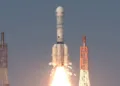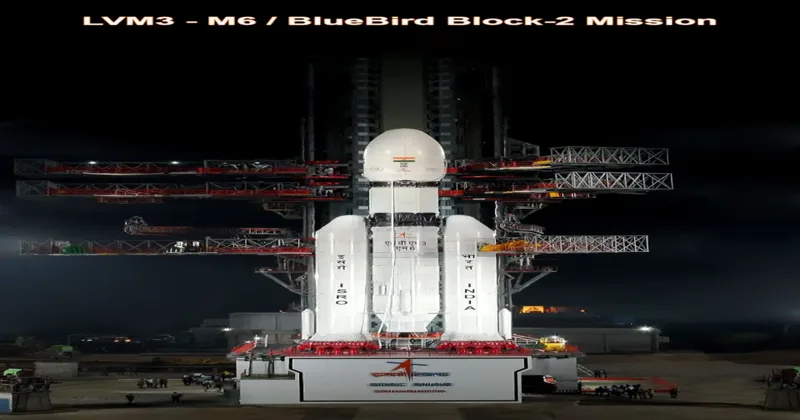
NEW DELHI: When the LVM3-M6 / BlueBird Block-2 Mission launches, it will share the story of India’s vision to create a heavy-lift launch vehicle, enter the commercial space, and establish itself as a major player in the space communications revolution. This marks the sixth commercial mission with the LVM3 spacecraft, also known as GSLV III. It has become widely recognised in the space race as India’s most powerful rocket.
ISRO’s LVM3 has seen many years of evolution. The requirement for this spacecraft arose from the need to exceed low-weight satellites in India’s plans to undertake challenging missions that require higher-weight satellites, along with advanced orbital injection performance. During the 1990s and early 2000s, research groups in India planned a launch vehicle to reduce the country’s reliance on foreign launchers for high-weight geosynchronous satellites. The stage was set when the design for LVM3 was finalised.
The construction of LVM3 was intended to enable India to launch its lunar missions, communication satellites, and constellations, among others. The initial development flights of this spacecraft signalled a new era for science in India, with the success of Chandrayaan-2, Chandrayaan-3, and other missions that brought global recognition to the LVM3 series of satellites. The LVM3 assisted in deploying 72 OneWeb satellites for two commercial missions.
LVM3-M6 is now ready to launch BlueBird Block-2, a commercial communication satellite made in America into the Low Earth Orbit. BlueBird Block-2 is the largest commercial communication satellite ever developed to be launched in LEO and the most massive satellite LVM3 has ever launched from Indian territory. BlueBird Block 2 is a next-generation constellation designed to deliver direct mobile internet to smartphones without requiring cell towers.
LVM3: A Three-Stage Strength System
The LVM3 technology is the culmination of several decades of engineering expertise. This spacecraft launcher is a three-stage launcher weighing 640 tonnes. It is 43.5 meters in height. Each stage has always been a testimony to unmatched technology.
S-200 Solid Strap-On Boosters
Starting with the lift-off stage, the LVM3 has two powerful S200 boosters, which rely entirely on solid propellant. Each S200 booster is among the most powerful solid-propulsion rockets in the world, used for space missions. The solid-propulsion boosters deliver a significant force during the initial stages of lift-off, helping the rocket escape Earth’s gravity and pass through Earth’s dense atmosphere.
L110 Liquid Core Stage
After the S200 boosters’ separation, the L110 stage enters. This liquid-propulsion system uses hypergolic propellants. This smooth-burning propulsion system helps the satellite maintain smooth acceleration and efficient throttling. In technical terms, the L110 stage is responsible for determining the satellite orbit. This is where the Indian government has excelled in its understanding and implementation of liquid propulsion. It has taken them in many years.
C25 Cryogenic Upper Stage
In the LVM3, C25 is a cryogenic upper stage, an engine stage, that burns supercooled oxygen and hydrogen, fuelled in tanks at temperatures below -180 degrees centigrade. It is also described as India’s biggest and most sophisticated cryogenic engine. There had been a desire to acquire cryogenic technology in the country since the 1980 and it was deemed to be more efficient and accurate in orbit insertion, in addition to the capacity of firing for longer duration compared to the existing user stage. The C25 stage meets the challenge and demonstrates the country’s technological independence.
Several strategic and technological imperatives shaped India’s long-term ambition for the development of LVM3. The programme aimed to develop an Indian geostationary launch capability to provide launch services for communication satellites, climate observation missions, and deep-space missions. In an autonomous manner, independent of foreign launch services, thus enhancing Indian national autonomy in space operations.
The above approach would increase the importance of developing indigenous geo-capability, as it would provide an Indian geostationary launch capability, communication satellites, climate observation, and deep-space missions in an autonomous manner.
There is a need to enhance India’s scientific presence in space. Missions such as Chandrayaan-2 and Chandrayaan-3 required a launch vehicle capable of carrying a higher lift-off mass, maintaining constant thrust, and supporting precise cryogenic operations. The LVM3 launch vehicle provided India with this capability, enabling the country to plan such ambitious scientific missions.
LVM3 was designed to focus on commercial expansion too. The rapid increase in satellite constellation launches worldwide, particularly for Broadband Internet connectivity, has led to the need for Heavy-Lift Launch Vehicles. LVM3 belongs to that segment, and the success of OneWeb missions has driven commercial maturity, opening the door to foreign customers.
LVM3 is a significant step toward technology sovereignty. The country has achieved technological independence in launch technology, joining a select few space-faring countries worldwide, by mastering cryogenic propulsion.
LVM3-M6: What This Mission Means to India
The launch of BlueBird Block 2 signifies a dramatic change. India is no longer launching its own national satellites or scientific endeavours; it is launching American communication systems. From a global perspective, India has developed a heavy-lift launch facility for heavy payloads, positioning itself as an export-ready operation.
BlueBird Block-2 can be connected to standard smartphones and serve as a communication tower in the sky. After its activation users can enjoy broadband connectivity even in remote areas, oceanic bodies, deserts as well as in places without actually having a network on earth. By undertaking LVM3 ISRO would be able to demonstrate its utility for commercial purposes. India has the capability for mass LEO missions. Commercial missions can be accomplished without using foreign space stations.
New Frontier for Indian Spaceflight
The LVM3 raises a question: What if India were to undertake the challenge of developing a heavy-lift launch vehicle on its own? The LVM3 series represents the intersection of scientific exploration and commercial success, with applications ranging from Chandrayaan landers to global broadband satellites. LVM3 M6 marks the sixth successful mission and marks the start of an era in which India launches the largest commercial communication satellite in LEO.
This is not just an expression of technological maturity and international trust, nor just a sign that India’s progress towards leadership in space has become and will remain irreversible. When its engines light up, its S200 boosters thunder, its cryogenic stage switches on, and its BlueBird Block 2 goes into orbit.