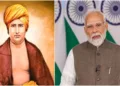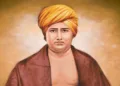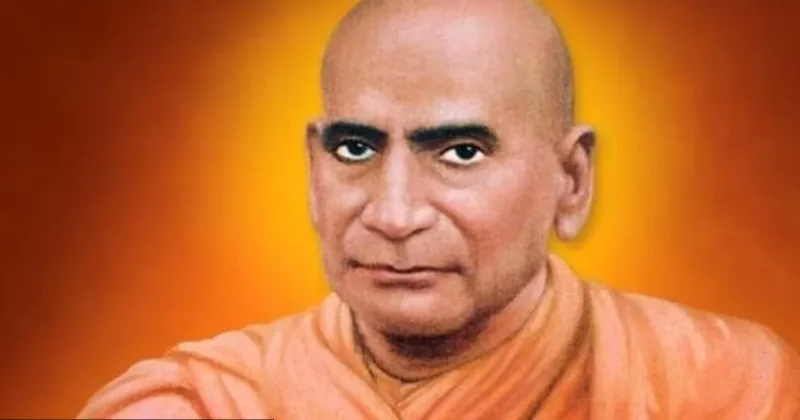
December 23 marks the martyrdom day of Swami Shraddhanand, a towering figure in India’s freedom struggle and social reform movement. A disciple of Swami Dayanand Saraswati and a prominent leader of the Arya Samaj, Swami Shraddhanand dedicated his life to education, social equality, national awakening and the consolidation of Hindu society. His assassination in 1926 shocked the nation and left an indelible imprint on India’s political and social discourse.
Early Life and Education
Swami Shraddhanand was born as Brhaspati Vij, popularly known as Lala Munshi Ram, on February 22, 1856 (Falgun Krishna Paksha Dwitiya, Vikram Samvat 1912) in Talwan village of Jalandhar district, then part of the Punjab Province under British rule. His father, Lala Nanak Chand, served as a police inspector in the East India Company administration.
Munshi Ram received his early education in Varanasi in the United Provinces (now Uttar Pradesh) and later completed his law studies in Lahore. Trained as a lawyer, he initially joined government service as a Naib Tehsildar before resigning. He later practiced law in Phillaur and Jalandhar, building a promising professional career.
He was married to Shiv Devi, who passed away when he was only 35 years old, leaving behind two sons—Harishchandra and Indra—and two daughters, including Ved Kumari. This personal tragedy played a significant role in shaping his spiritual and social outlook.
Encounter with Swami Dayanand Saraswati
A turning point in Munshi Ram’s life came when he encountered Swami Dayanand Saraswati, the founder of Arya Samaj. Initially sceptical and even antagonistic, Munshi Ram attended a public lecture of Swami Dayanand in Bareilly—an event his father was overseeing for security reasons.
Despite his initial disbelief, Munshi Ram was deeply influenced by Swami Dayanand’s intellectual rigour, fearlessness and reformist zeal. This encounter transformed his worldview and led him to formally join the Arya Samaj, committing himself to the revival of Vedic values and Indian cultural identity.
Champion of Indigenous Education
Swami Shraddhanand emerged as one of the strongest advocates of an Indian education system rooted in Vedic traditions and national values. During the late 19th century, Arya Samaj had established a network of DAV (Dayanand Anglo-Vedic) schools to combine modern education with Indian ethos.
However, ideological differences within Arya Samaj over the role of Western education led to a split in 1892. Swami Shraddhanand supported the Gurukul system, which emphasised residential education, discipline, spirituality and character-building. He eventually led the Gurukul faction and founded the Punjab Arya Pratinidhi Sabha.
In 1900, he established the first Gurukul at Gujranwala (now in Pakistan). Later, the institution was shifted to Kangri near Haridwar, becoming Gurukul Kangri, one of India’s most iconic centres of indigenous education. Swami Shraddhanand himself served as the first acharya, and even his sons studied there.
Gurukul Kangri played a historic role in India’s freedom movement and intellectual renaissance. Mahatma Gandhi stayed there upon his return from South Africa, and it was here that he was first addressed as “Mahatma.” In 1962, the Government of India granted Gurukul Kangri the status of a deemed university.
Spiritual Journey and Sannyasa
At the age of 35, Munshi Ram entered the Vanaprastha stage of life and became known as Mahatma Munshi Ram. In 1917, he formally embraced Sannyasa and adopted the name Swami Shraddhanand, declaring that his life had been devoted to the service of the Vedas and the upliftment of society.
Role in India’s Freedom Struggle
Swami Shraddhanand was an active participant in India’s freedom struggle. He opposed repressive colonial laws such as the Rowlatt Act and protested the imposition of martial law in Punjab. In 1919, following the Jallianwala Bagh massacre, he invited the Indian National Congress to hold its session in Amritsar and presided over it when others hesitated.
He also led massive protests in Delhi against colonial repression. In one notable incident at Chandni Chowk, British forces prepared to open fire on protesters. Swami Shraddhanand fearlessly stepped forward, declaring that he should be killed first before any innocent civilians. The troops reportedly lowered their weapons, allowing the procession to pass peacefully.
Historic Speech at Jama Masjid
In 1922, Swami Shraddhanand delivered a historic speech at Delhi’s Jama Masjid, where he recited Vedic mantras before addressing a largely Muslim audience. The event remains unique in Indian history and symbolised his belief in dialogue, courage and civilisational confidence.
Break from Congress and Hindu Mahasabha
Over time, Swami Shraddhanand grew disillusioned with the Congress, particularly on issues concerning Hindu interests and social reform. He later joined hands with leaders like Madan Mohan Malaviya and became associated with the Hindu Mahasabha, advocating Hindu consolidation and cultural self-assertion.
Crusader Against Untouchability
One of Swami Shraddhanand’s most significant contributions was his work for the upliftment of so-called “untouchables.” He demanded substantial financial support for welfare programmes, and when Congress declined, he resigned from its sub-committee.
Dr B.R. Ambedkar later described him as “the greatest and the most sincere champion of the untouchables.” Swami Shraddhanand also actively supported the Vaikom Satyagraha in Kerala, advocating temple entry for oppressed communities.
Journalism and Social Outreach
Swami Shraddhanand was also a prolific writer and journalist. He founded the Urdu newspaper Tej and the Hindi daily Arjun, using journalism as a tool for reform, debate and national awakening. He strongly promoted Hindi in Devanagari script, women’s education and social service.
Shuddhi Movement and Hindu Reorganisation
Concerned about religious conversions, Swami Shraddhanand led the Shuddhi Movement, aiming to reconvert Hindus who had embraced other religions. Large-scale Shuddhi programmes were conducted in regions like Agra, Mathura and Bharatpur, particularly among Rajput communities.
The movement significantly impacted social dynamics and brought Swami Shraddhanand into the national spotlight, earning both admiration and opposition.
Assassination and Martyrdom
On December 23, 1926, Swami Shraddhanand was assassinated at his residence in Delhi while recovering from pneumonia. A man named Abdul Rashid, posing as a visitor seeking discussion, shot him at close range. Despite efforts to save him, Swami Shraddhanand succumbed to his injuries.
His death sent shockwaves across India, with leaders from across political and ideological lines condemning the killing.
Enduring Legacy
Nearly a century later, Swami Shraddhanand remains a symbol of fearless reform, intellectual courage and national service. His work in education, social justice, freedom struggle and civilisational revival continues to inspire generations.
Though his life was cut short by violence, his ideas endure—embedded in institutions like Gurukul Kangri, in India’s reformist traditions, and in the ongoing discourse on education, social equality and cultural identity.
On his martyrdom day, India remembers Swami Shraddhanand not only as a victim of violence, but as a visionary who lived—and died—for the nation.