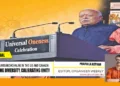
“In this era of uncertainty, India is showing itself in a different league, brimming with self-confidence; When the world speaks of slowdown, India writes a story of growth; when the world faces a crisis of trust, India is becoming a pillar of trust; and when the world moves towards fragmentation, India is emerging as a bridge-builder.” – PM Narendra Modi, while addressing the Hindustan Times Leadership Summit on December 6, 2025
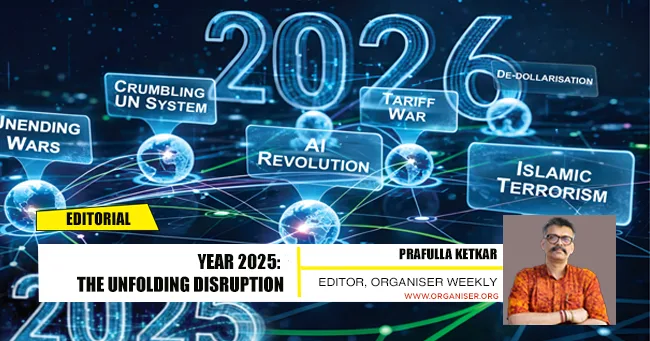
The Gregorian calendar makes little sense to common Bharatiya people who use their own Panchang (loosely translated as Almanac) in their personal lives. Still, in the global context, it is customary to take a stock of the calendar year, however unscientific it may be. The COVID–19 pandemic was disruptive enough to wake us up from the slumber of the ills of Western modernity. The year 2025 have further underscored that the disruption of the imaginary world order is still unfolding, and what we may experience in 2026 will be a series of global uncertainties. How should Bharat approach these developments?
A recent leaked report of the Pentagon suggests that the United States (US) could lose a large-scale conflict with China over Taiwan unless it rapidly overhauls its military posture. The “Overmatch” brief also highlights China’s capability to destroy US satellites, large ships, and fighter aircraft, underscoring significant supply-chain weaknesses in the event of a potential conflict. The grim picture is not just about the possible conflict but a vulnerable ‘world-order’ overwhelmed by the US logic of managing the international system. The Pax Americana emerged after World War II, rooted in five key structural dominations: liberal international organisations, dollar dominance, military supremacy across continents, knowledge and technological monopoly, and a web of multinational corporations. The military remains an unquestionable strength of the US. However, besides China and Bharat, the rise of other actors, is challenging the American hegemony in various fields. The American establishment itself accepts that the project of market globalisation has failed miserably. At the same time, the alternative of the socialist model with Chinese characteristics is untrustworthy and unsustainable, leading uncertainties.
Emergence of non-state actors challenging the nation-state system has acquired new dimensions with the growing influence Artificial Intelligence (AI), Islamist radical organisations that believe in terrorism as an instrument to bring about a Caliphate and multinational corporations (MNCs) that dictate the policies for the sovereign governments. OpenAI continues to face multiple suits for abetting suicides. The AI integration has dramatically changed technological applications across various professions in 2025, and not all of them are for the better. The real challenge is to ensure the artificial part does not take over the ethical and universal part of intelligence. The Bondi Beach incident, with a series of arrests and attacks globally in recent times, including the Red-fort bombing in Delhi, further accentuated the dangers of Islamist terrorism rooted in Kafirophobia. The MNCs, including Pharma, defence, and tech giants, are dictating terms to any economy, including the US and European Union. How the nation-state system would respond to this changed scenario will determine the emergence of future global systems.
Bharat is a shining star, with a civilisational ethos, a stable democracy, a rising economy, decisive leadership, and a demographic dividend. Challenging times offer new opportunities, and the Bharatiya mind tends to perform better when pushed to the wall. Post-Operation Sindoor, the new equations have emerged, and we are diversifying our import-export basket. Aatma-nirbharta and Swadeshi are not just slogans but policy initiatives backed by a participatory approach. Many countries in the Global South are looking upto Bharat as a leader to provide stable, prosperous and just international system. We can provide it if we continue to build self-confidence and adopt a bridge-building approach, as Prime Minister Narendra Modi discussed at the recent leadership summit.