Throughout the history of mankind, there have been civilisational milestones that mark one era from another. The discovery of fire, the invention of wheel, tools and language were all important landmarks. What is often overlooked in the long list of developmental junctures is the discovery of salt. Salt as a mineral of consumption not only highlights mankind’s evolution of taste but also hints towards an understanding of nutrition. It later developed into a commodity of trade and in colonial India’s case, a tool of oppression and later a symbol of resistance.
From being a symbol of taste to a token of power, salt’s journey mirrors the evolution of human society itself. While much of recorded history focuses on salt as a commodity or a coastal enterprise, the story of salt in Bharat hits a different trajectory. It is here that salt evolved not merely as a product of trade but as a reflection of human intellect and environmental understanding. Long before the advent of modern trade and industry, the people of the North Eastern region of Bharat as well had already developed intricate systems of resource management, production, and trade. Among the most remarkable examples of their indigenous scientific knowledge system was the production of salt — a substance so essential to human life that it stood as a measure of civilisational advancement. The Nocte community of present-day Arunachal Pradesh offers a striking glimpse into this early sophistication. To them, salt was not merely a commodity; it was a cultural adhesive, a marker of technological maturity, and a testament to human curiosity.
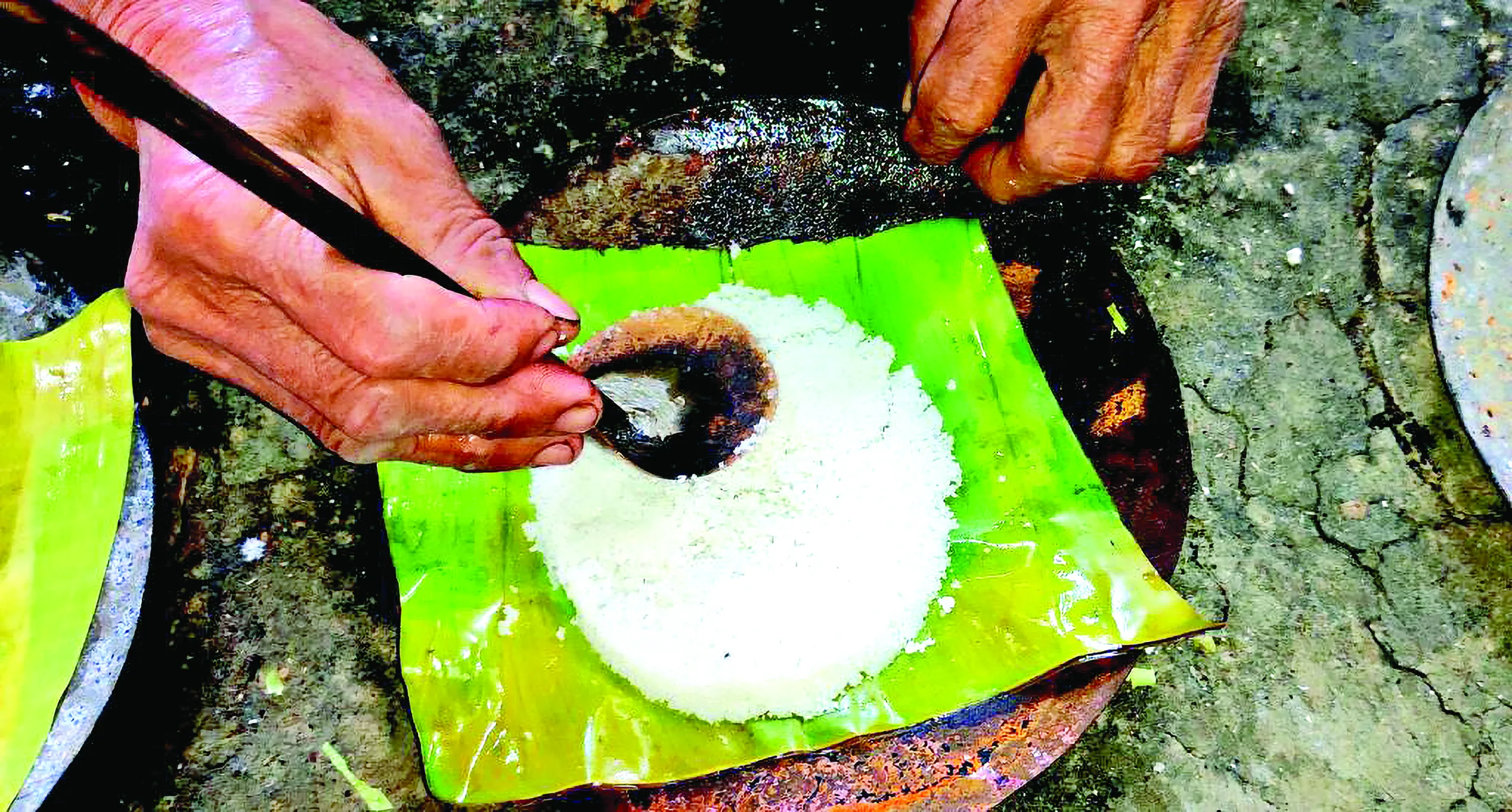
The scientific temperament of these societies is evident in every stage of their salt-making process. At its core, it required an understanding of chemistry, thermodynamics, and hygiene, centuries before such terms were formalised. The Noctes, for instance, fetched saline water using buckets made from specific leaves known to enhance mineral property, in Manipur’s salt sheds, the producers maintained exact heat levels, refilled the pans with timed precision, and moulded the crystallised salt into circular cakes. All these refined practices demonstrate an empirical understanding of material properties.
The very act of identifying a safe and edible salt source demanded experimentation, trial, and acute observation over generations. Early communities would have had to test countless sources, distinguishing edible salt from other harmful minerals. Each discovery, each failed attempt, and each refinement contributed to a growing body of collective knowledge that eventually solidified into an exact science. There was also a rhythm of labour that mirrored laboratory discipline. Immense precision was maintained to ensure purity and safety of salt, for even a minor chemical or physical error could render it toxic. The fact that communities consumed locally produced salt for centuries without harm stands as proof of their perfected craft.
A civilisational Binder
Beyond its physical properties, salt acted as a civilisational binder. Its production and trade fostered inter-community relations and shared practices. It flowed across community and territorial lines, becoming a medium of exchange and a symbol of trust. The making and sharing of salt were not just economic acts, they were acts of social cooperation and cultural cohesion. In many ways, salt was both a literal and metaphorical preservative: it sustained life and bound societies together. The salt wells were not just production sites but also social hubs. In most cases, the process began with prayers to the goddess of salt – a spiritual act that underscored both reverence and responsibility. The same spirit of interdependence extended to trade in the mountainous regions of Arunachal Pradesh, the Adi and Bokar Adi communities exchanged salt with Tibet, carrying the mineral over mountain passes and, in doing so, weaving networks of trust between Himalayan societies.
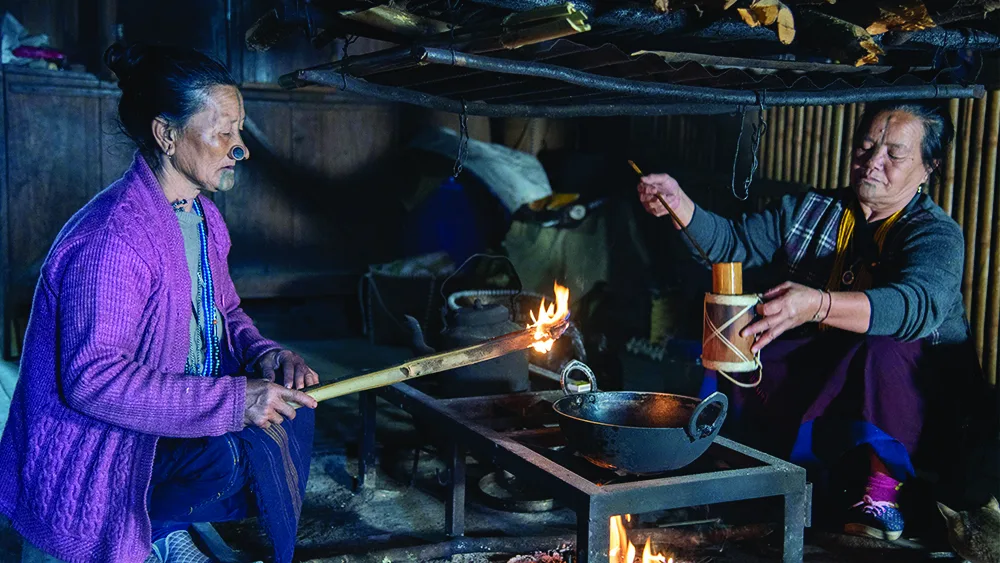
Salt production in the North East was never centralised. There were no vast evaporation plains as in the coastal regions, but instead there were scattered centers of production, each shaped by the landscape’s unique features. In Manipur, this meant brine wells, lakes and evaporation sheds known as Thum shung shang, where the process of salt production was so refined that it produced nearly twice the yield of European sea salt in the nineteenth century. Under the Ahom rulers, these decentralised practices found a new kind of organisation. The state recognised salt as an essential resource and institutionalised its management through a structured system of labour. Groups like the Lonpungias guarded wells, while others such as the Borkheremiya and Sarukheremiya supplied firewood, and the Longpotias provided leaves to wrap the finished salt blocks. This coordination of specialised roles preserved the autonomy of local producers while ensuring steady distribution and balance between state oversight and community expertise that prevented monopoly and sustained economic equilibrium.
Through their mastery of salt, North East , demonstrated a refined understanding of science, environment, and social organisation
The Key Centers
Geographically, certain regions stood out as key centers. The Mohong belt stretching from Tuensang in Nagaland to Namsai in Arunachal Pradesh was renowned for its high-quality black salt and was frequently mentioned in the Sodiyar Bornamoi Buranji. Sadiya and Shemkhor, too, emerged as major production sites, while Manipur’s brine wells at Ningel, Chandrakhong, Sikhong, and Waikhong added to the region’s diversity of sources. Together, these centers formed an intricate web of production, exchange, and social cooperation that sustained life across the hills and valleys. In places like the Dimasa territory, the Semsa clan of Dimasa-Kachari took charge of salt extraction in Shemkhor, while the Zemi community guarded the salt mountains a role of both spiritual and material importance. Across these landscapes, every grain of salt told a story of community labour and ecological balance of humans who worked with, not against, their environment. Speaking of which, the Garo Hills, where natural salt deposits were rare, the people turned to chemistry of a different kind: they created alkaline substitutes like karitchi from burnt banana stalks and khar in Assam from ash filtrate, revealing a scientific adaptability born of environmental necessity. This decentralised but interlinked network of techniques speaks not of isolation but of ingenuity, it speaks of a people capable of experimenting with nature and reproducing perfected results across diverse terrains.
In all these endeavours, salt was more than a mineral – it was a unifying force. Its production called for cooperation across clans, its trade facilitated interaction between distant peoples, and its consumption symbolised continuity throughout the Indic civilisation. To perfect the process of salt-making was to engage deeply with nature, to learn its laws through lived experience, and to translate that knowledge into survival and prosperity. Through their mastery of salt, North East demonstrated a refined understanding of science, environment, and social organisation. Their legacy reminds us that technological wisdom is not born of industrial machinery but of human observation, adaptation, and collective intelligence qualities that these communities embodied long before the modern world recognised their worth.