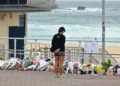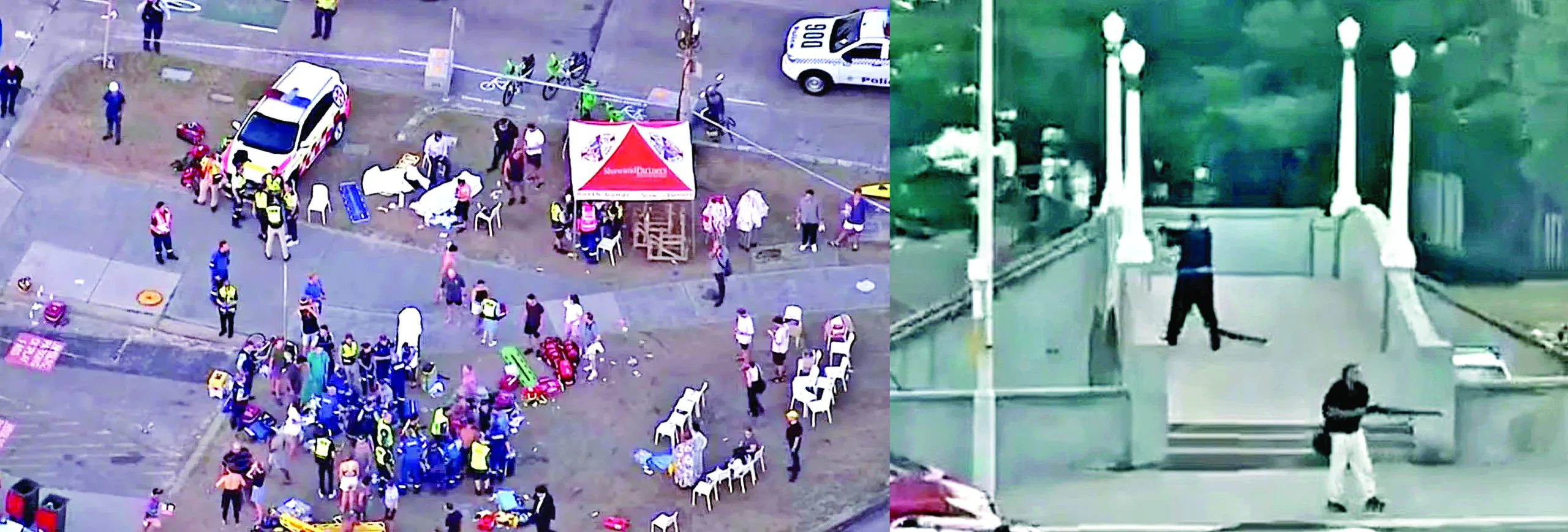
The evening of December 14, 2025, began like countless other summer evenings in Sydney. Families gathered at Archer Park beside Bondi Beach for a Hanukkah celebration. Children played near the water’s edge, and the iconic stretch of sand glowed under the setting sun. By 6:45 pm, that ordinary evening had become Australia’s deadliest anti-Semitic terror attack.
Sixteen people died. Dozens more were wounded. And in the chaos, a Syrian-Australian father named Ahmed al-Ahmed ran towards the gunfire, wrestled a weapon from one of the attackers, and became an unlikely hero in a tragedy that exposed dangerous fault lines in Australian society. Witness accounts describe the shooting beginning around 6:45 pm as the Hanukkah gathering drew close to a thousand people. Two gunmen, perched on a footbridge overlooking the park, opened fire from that elevated position. Their position allowed them a lethal line of fire into the crowd below. The tactical positioning was not accidental. It suggested planning, deliberate target selection, and an understanding of how to maximise casualties.
Holocaust Survivor Among Victims
The dastardly act at one of Australia’s iconic places – the Bondi Beach felt alien to many Australians who had hitherto believed that such violent actions belonged elsewhere. The casualty toll slowly grew. Statistics numb; Names don’t. The dead ranged from 10-year-old Matilda, described by her school as bright and joyful, to 87-year-old survivor of the Holocaust who had already lived through one genocide.
Rabbi Eli Schlanger came to spread light during Hanukkah. Marika Pogany had delivered thousands of meals to seniors without fanfare. Peter Meagher, a former NSW Police detective, was working as a photographer at the event. A case of wrong place and catastrophic timing. Reuven Morrison reportedly confronted one of the gunmen after they were disarmed, running toward danger on pure instinct.
Each of these human beings not just represents a life unfairly extinguished, but is also a reminder of what the attackers really targeted – people of a certain faith, the Jews. Jews who had gathered openly, as they celebrated their religious festivities, believing their society was safe enough to be normal, that sadly, was not.
The Perpetrators Exposed
Australian authorities identified the attackers as a father and son duo. Sajid Akram, 50, killed at the scene during the police response, and Naveed Akram, 24, critically wounded and later charged with 15 counts of murder and multiple terrorism-related offenses.
Interestingly, the firearms used for this attack had been acquired legally. That detail matters because it immediately raises uncomfortable questions about how someone later described by authorities as having connections to pro-Islamic State networks could pass the checks required for legal gun ownership.
Australia’s strict firearms laws emerged from the trauma of the 1996 Port Arthur massacre. The system is designed to catch exactly this kind of risk. Yet it didn’t. Investigators framed the attack as terrorism from the outset. Charges included “committing a terrorist act” and “displaying a terrorist symbol.” The Australian Federal Police and Intelligence officials have publicly described the shooting as ISIS-inspired, pointing to ideological motivations. It was not an act of violence born out of personal grievance or spontaneous disturbance.
One of the most troubling revelations came from Australia’s ABC. It reported that at least one of the alleged gunmen had longstanding links to a pro-Islamic State network yet wasn’t on a terrorism watchlist at the time of the attack. This shifts the question from “how did this happen?” to “how did this happen despite signals?”
Ahmed al-Ahmed, a 42-year-old father of two and a small-business owner, became the face of resistance against the attackers. Multiple witnesses credit him with tackling one gunman and wrestling away a weapon, sustaining multiple gunshot wounds in the process.
Ideological Architecture
Terrorism isn’t spontaneous madness. It is the endpoint of psychological conditioning, a slow walk from hatred to violence that follows recognisable patterns whether the attacker emerges from a madrasa, a university, or a suburban apartment.
The first stage is impersonal hostility where hatred is derived not from lived grievance but from inherited doctrine. In radical Islamist ecosystems, Jews are not encountered as neighbours or colleagues. They are theological abstractions: a metaphysical enemy, a civilisational corrupter, a cosmic adversary in an eschatological drama. This matters because when you’re taught to hate “the Jew” you have never met rather than a Jew you know. This distance causes moral disengagement that breeds hatred.
The danger multiplies in closed educational environments like seminaries and madrasas where texts are merely received. In these closed chambers authority flows vertically rather than dialogically. Places where dissent equals apostasy. These create what psychologists call sealed moral universes. Within them, Jews are discussed constantly but rarely encountered as human beings.
Where the System Failed
Australian security services focus on planning indicators: weapons acquisition, suspicious communications, travel patterns. But ideological conditioning often happens years earlier, quietly, legally, and socially protected. By the time planning becomes visible, the moral decision has already been made. It is merely looking for the opportunity to act. Many liberal societies treat religious doctrine as off-limits. Criticising sermons, curricula, or clerical teachings gets dismissed in the Western liberal circles as bigotry. This creates a perverse brand of immunity where the more radical the belief system, the less scrutiny it receives if framed as religious.
After attacks, the response follows a predictable pattern: “He was troubled.” “He acted alone.” “Mental health issues.” This is partially true and yet deeply misleading. Ideology doesn’t pull the trigger. But it loads the gun and points it. The reporting that one alleged gunman had links to pro-ISIS networks but wasn’t on a watchlist reveals how bureaucracies fail not from ignorance but from procedures that are born out of jurisdictional gaps, threshold problems, overloaded systems, and the difficulty of proving intent before the act. How do you quantify hate that is preparing for the kill?
False claims spread online within hours Misidentifications of perpetrators, fabricated details about their backgrounds were all over the social media. Governments issued rebuttals, but the damage was done. Bad actors race to attach crimes to their preferred enemies. Rival states exploit narratives. Ordinary people share the propaganda before verifying. This pattern is standard after mass violence. The cost is not an abstraction. Misidentification fuels retaliatory hatred and distracts from hard security questions about watchlists, firearms access, and institutional gaps.
The Hard Truths
Society must hold two realities simultaneously: most Muslims are not terrorists, and that Islamist anti-Semitic ideology is real, transmissible, and sometimes incubated inside protected spaces (also true). If a society can not name the second truth for fear of the first, it loses the ability to prevent violence.
Prevention requires three layers. First, upstream intervention: curriculum transparency where public money touches education, empowering credible internal counter-voices who can delegitimise distortion from within the tradition, and building cross-community contact because humanisation can conclusively counter dehumanisation.
Second, detection focused on behaviours rather than identities: obsessive consumption of dehumanising material, fixation on martyrdom narratives, praising prior attackers, moral rigidity framing violence as duty. These should be regarded as warning signs.
Third, disruption makes radicalisation harder: the system needs to reduce friction against terrorist propaganda. Incentives should be available for families to report such incidents in a safe and non-punitive manner. That will provide space for targeted interventions to save exploited youth in any society.
A Non-Negotiable Line
Belief ends where dehumanisation begins. Religion ends where murder is sanctified. The walk from anti-Semitic ideology to kinetic terror is not some mystery. It is slow, social, doctrinal, and visible. But only if societies are willing to look. The Bondi Beach attack exposed how preparation can happen in plain sight when wrapped in protected religious mumbo-jumbo. We saw how legal systems can arm future terrorists. How communities can miss signals or mistake tolerance for blindness. Sixteen families will never be whole again. A 10-year-old will never grow up. A Rabbi came to spread joy and left in a body bag. Australia now faces the choice every society confronts after every act of Islamist terror: whether to speak clearly about ideology while protecting innocents, or to blur distinctions in the name of cohesion.
The dead deserve the first. The living need it. And the next potential attacker, still forming in some
sealed moral universe, is watching to see which path Australia chooses.