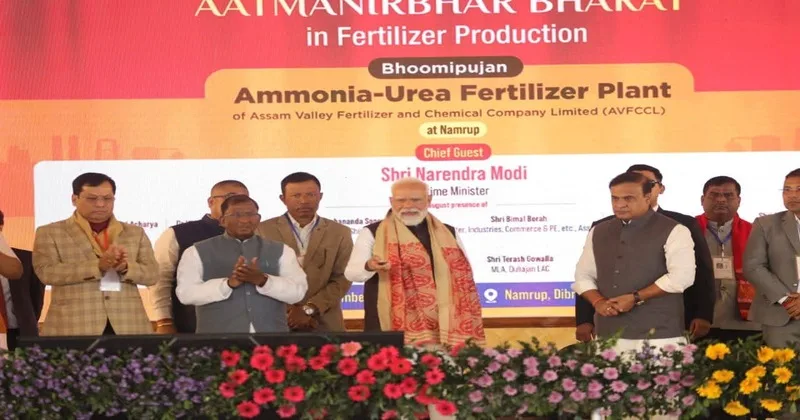
GUWAHATI: Prime Minister Narendra Modi on December 21 laid the foundation stone of the Ammonia-Urea Fertiliser Project of Assam Valley Fertiliser and Chemical Company Limited at Namrup in Dibrugarh, Assam. Addressing the gathering on the occasion, Modi remarked that this is the land of great heroes like Chaolung Sukhapa and Mahaveer Lachit Borphukan. He highlighted the contributions of Bhimbar Deuri, Shaheed Kushal Kunwar, Moran King Bodousa, Malati Mem, Indira Miri, Swargadeo Sarbananda Singh, and the valiant Sati Sadhani. The Prime Minister stated that he bows to the sacred soil of Ujani, Assam, this great land of valour and sacrifice.
Stating that today is a historic day for Assam and the entire North East, PM Modi remarked that the long-awaited dream of Namrup and Dibrugarh has been fulfilled, as a new chapter of industrial progress begins in the region. He highlighted that only recently he performed the bhoomi pujan for the Ammonia–Urea Fertiliser Plant and, before arriving in Dibrugarh, inaugurated the new terminal at Guwahati Airport. The Prime Minister noted that everyone is saying Assam has now caught a new pace of development. He emphasised that what is being witnessed today is only the beginning and that Assam must go much further. He recalled Assam’s strength and role during the Ahom kingdom and asserted that, in a developed India, Assam will play an equally powerful role. He highlighted the emergence of new industries, the development of modern infrastructure, semiconductor manufacturing, new opportunities in agriculture, the advancement of tea gardens and their workers, and the growing potential in tourism, affirming that Assam is progressing across all sectors.
Emphasising that, in building a developed India, the nation’s farmers and annadatas play a crucial role, the PM stated that the government is prioritising farmers’ interests and that farmer-friendly schemes are being extended to all. He highlighted that, alongside agricultural welfare initiatives, it is essential to ensure a continuous supply of fertilisers to farmers. PM Modi stated that, in the near future, the new urea plant will ensure this supply. He noted that around ₹11,000 crore will be invested in the fertiliser project, which will produce more than 12 lakh metric tonnes of fertiliser annually. He emphasised that, with production taking place locally, supply will be faster and logistics costs will be reduced.
Highlighting that the Namrup unit will create thousands of new employment and self-employment opportunities, Shri Modi remarked that, with the plant operational, many people will secure permanent local jobs. He added that related work, such as repair, supply, and other activities, will also provide employment for youth.
PM Modi questioned why such farmer welfare initiatives are happening only after their government came to power. He noted that Namrup had long been a centre of fertiliser production, and at one time, the fertiliser produced here strengthened the fields of the North East and supported farmers’ crops. He recalled that even when the fertiliser supply was a challenge in many parts of the country, Namrup remained a source of hope for farmers. However, he noted that the technology in the old plants became outdated over time, and previous governments paid no attention. As a result, several units at the Namrup plant were shut down, leaving farmers across the North East distressed, their incomes reduced, and agricultural difficulties worsening. The Prime Minister asserted that today, their governments at the Union and State are resolving the problems created by the previous ruling dispensation.
The Prime Minister noted that, as in Assam, fertiliser factories in many other states had also shut down. He recalled the difficult conditions farmers faced at the time: long queues for urea, police deployed at shops, and farmers subjected to lathi charges. He stated that the opposition had worsened these conditions, while the present government is correcting them. He noted that during the previous ruling dispensation, fertiliser factories were closing, whereas the current government has commissioned several plants in Gorakhpur, Sindri, Barauni, and Ramagundam. He added that the private sector is also being encouraged in this field. The Prime Minister emphasised that, as a result of these efforts, India is moving towards self-reliance in urea production.
“In 2014 the country produced only 225 lakh metric tonnes of urea, whereas today production has reached nearly 306 lakh metric tonnes”, highlighted the Prime Minister, noting that India requires about 380 lakh metric tonnes of urea annually and the government is working swiftly to bridge this gap. He emphasised that the government is highly sensitive to farmers’ interests. PM Modi noted that even imported urea, priced high abroad, is not allowed to burden farmers, as the government bears the cost through subsidies. He stated that Indian farmers receive a bag of urea for just Rs 300, while the government pays nearly Rs 3,000 to other countries for that same bag. He underlined that the remaining amount is covered by their government so that farmer brothers and sisters do not face any financial burden. He further urged farmers to conserve soil by optimising the use of Urea and other fertilisers.
Prime Minister Modi stated that today, from seed to market, their government stands firmly with farmers. He highlighted that money for farm work is being directly transferred into farmers’ accounts so they do not have to wander for loans. He remarked that so far, nearly Rs 4 lakh crore has been sent to farmers’ accounts under the PM Kisan Samman Nidhi. The Prime Minister noted that this year alone, two schemes worth Rs 35,000 crore have been launched to support farmers. He emphasised that the PM Dhan Dhanya Krishi Yojana and the Dalhan Atmanirbharta Mission will further promote agriculture.
Emphasising that the government is working to meet every need of farmers, Modi noted that when crops are damaged by adverse weather, farmers are supported through the crop insurance scheme. He highlighted that procurement arrangements have been improved to ensure farmers receive the right price for their produce. The Prime Minister affirmed that the government firmly believes the nation can progress only when farmers are strong, and that every possible effort is being made to that end.
The Prime Minister noted that, after the formation of the government at the Centre, livestock and fish farmers were also included under the Kisan Credit Card facility and are benefiting greatly from it. He emphasised that through KCC, farmers have received assistance of more than Rs 10 lakh crore this year. He added that the reduction of GST on bio-fertilisers has also provided significant relief to farmers.
Modi emphasised that the government is actively encouraging natural farming, with the launch of the National Mission on Natural Farming, which has already connected lakhs of farmers. He pointed out that in recent years, 10,000 Farmer-Producer Organisations (FPOs) have been established across the country. He further highlighted that, with a special focus on the North East, the government has launched an oil palm mission that will not only make India self-reliant in edible oils but also enhance farmers’ incomes in the region.
Underscoring that their Governments at the Union & State are governments for the poor, tribals, youth, and women, and is working to end decades of violence in Assam and the North East, Modi underlined that the government has always kept Assam’s identity and culture paramount, highlighting symbols of Assamese pride on every platform. He pointed out that this is why the government proudly built a 125-foot statue of Mahaveer Lachit Borphukan, celebrated the birth centenary of Bhupen Hazarika, and promoted Assam’s art, crafts, and the Gamosa to global recognition. He mentioned that just a few days ago, when Russian President H.E. Mr. Vladimir Putin visited Delhi, he gifted him Assam’s black tea with great pride.
The Prime Minister stated that every effort to enhance Assam’s dignity is prioritised. He remarked that when they undertake such work, it causes the greatest discomfort to the opposition. He recalled that when the government conferred the Bharat Ratna on Bhupen Hazarika, the opposition openly opposed it, with its national president commenting, ‘Modi was giving Bharat Ratna to singers and performers’. He added that even when a semiconductor unit was set up in Assam, the opposition opposed it. The Prime Minister reminded that it was the opposition government that for decades denied land rights to the tea community brothers and sisters, whereas their government has given them land rights and a dignified life. He stated that the opposition continues to push anti-national thinking, seeking to settle Bangladeshi infiltrators on Assam’s forests and lands to strengthen its vote bank.
The Prime Minister further stated that the opposition has no concern for Assam, its people, or their identity, and is only interested in power and government. He remarked that the opposition prefers illegal Bangladeshi infiltrators, settles them, and continues to protect them. He highlighted that this is why the Opposition opposes the purification of voter lists. PM Modi emphasised that Assam must be safeguarded from the poison of the Opposition’s appeasement and vote-bank politics. He assured the people that their party stands like a shield to protect Assam’s identity and honour.
Underlining that in building a developed India, PM Modi said the role of Eastern India and the North East is continuously increasing, reiterating that Eastern India will become the growth engine of the nation’s development. He noted that the new Namrup unit is a symbol of this transformation, as the fertiliser produced here will not only serve Assam’s fields but also reach Bihar, Jharkhand, West Bengal, and eastern Uttar Pradesh. He stressed that this is a significant contribution of the North East to the country’s fertiliser needs. The Prime Minister concluded by remarking that projects like Namrup demonstrate that, in the coming years, the North East will emerge as a major centre of a self-reliant India and will remain Asthalakshmi in a true sense. He once again congratulated everyone on the new fertiliser plant.
Earlier in the morning, the PM paid homage at the Swahid Memorial in Guwahati and remembered the 860 martyrs of the Assam movement. Later, he interjected with 25 selected students of Assam as part of his ‘Pariksha pe Charcha’ over the river Brahmaputra.