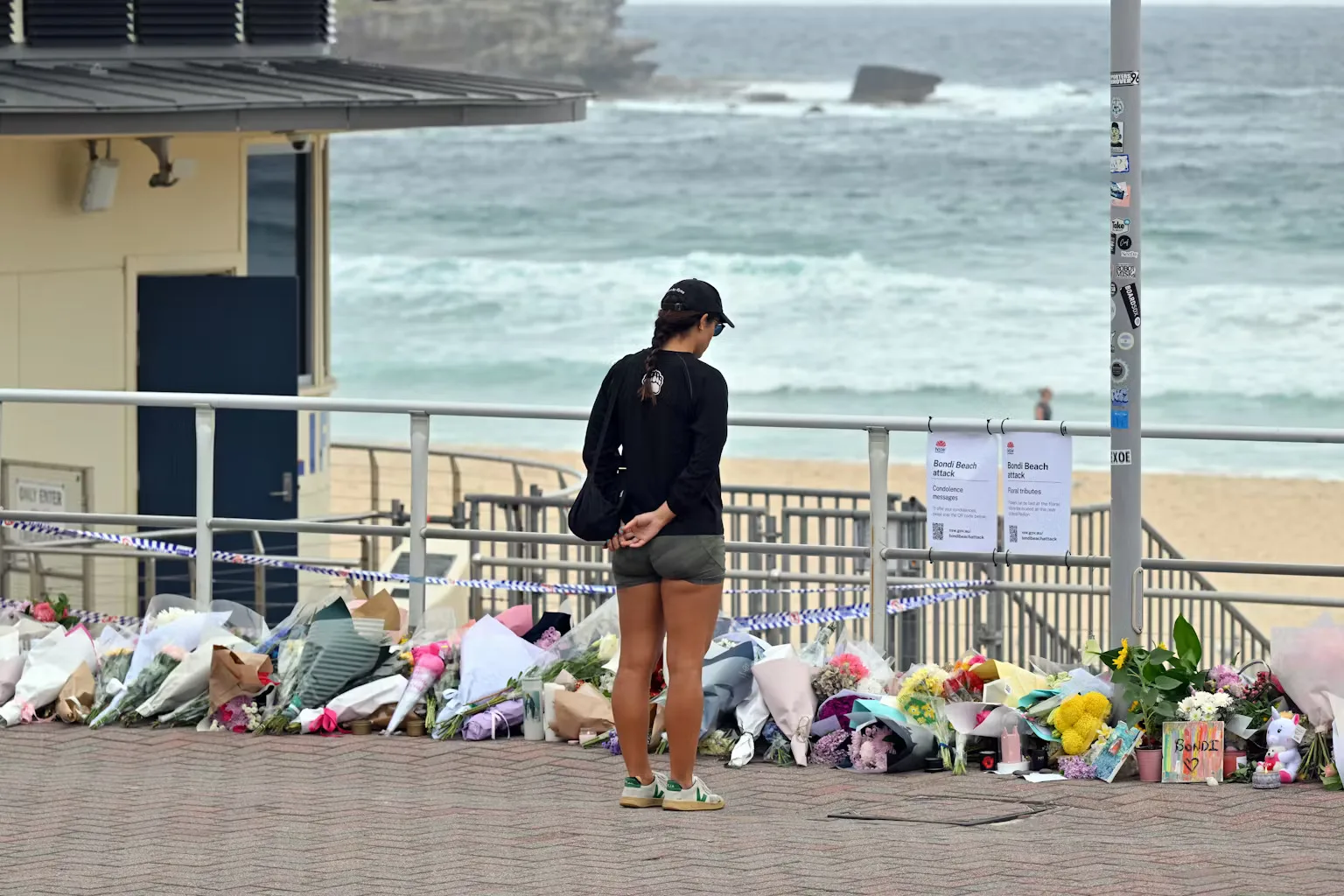
What was meant to be a joyous celebration of faith, light, and resilience ended in horror on Sunday (December 14) evening when gunfire erupted at Sydney’s Bondi Beach during a Hanukkah event attended by thousands. At least 15 people were killed and over 25 injured, including six critically, after two gunmen opened fire on a Jewish gathering celebrating the start of the eight-day Hanukkah festival.
The victims were part of the ‘Chanukah by the Sea’ event, a public celebration held annually at one of Australia’s most recognisable beaches. Bondi Beach, a symbol of Sydney’s cultural and social life, descended into chaos as panic-stricken crowds fled for cover amid sustained gunfire.
Australian Prime Minister Anthony Albanese condemned the attack as an act of “antisemitic terrorism,” describing it as “pure evil.” One of the attackers, a 50-year-old man, was shot dead by police at the scene, while the second gunman, his 24-year-old son, was wounded and taken to hospital under police custody.
Deadliest Shooting in Australia in Nearly 30 Years
Authorities have described the Bondi Beach massacre as the deadliest mass shooting Australia has witnessed in almost three decades, a shocking distinction for a country known globally for its strict gun control laws.
The attack followed a wave of antisemitic incidents that have unsettled Jewish communities across Australia over the past year. The deliberate targeting of a Jewish religious gathering has intensified concerns about rising religious hatred and radicalisation.
Among the dead were a 10-year-old child, a rabbi, a retired police officer, and a Holocaust survivor, a detail that has deepened the emotional impact of the tragedy both within Australia and internationally.
Investigators revealed that the father-son duo opened fire from an elevated pedestrian walkway overlooking the beachfront, giving them a vantage point over the crowd gathered below. Bystander videos later accessed by media showed people running for their lives, hiding behind parked vehicles, and seeking shelter as gunshots rang out.
In one widely circulated clip, an unarmed bystander was seen risking his life to snatch a firearm from one of the attackers, a moment that has since been hailed as an act of extraordinary courage.
Police confirmed that the rapid response by law enforcement prevented further loss of life, though the scale of the tragedy has already left an indelible mark on the nation.
Who were the Attackers
One of the attackers has been identified as 50-year-old Sajid Akram, while the second gunman is his 24-year-old son, Naveed Akram. Both were described by authorities as ISIS-inspired terrorists.
Sajid Akram was fatally shot during the police response, while Naveed Akram sustained injuries and remains hospitalised. Australian authorities confirmed that the father and son had travelled to the Philippines last month prior to the attack.
While the son holds Australian citizenship, Sajid Akram retained his Indian passport despite living in Australia for decades.
According to an official statement from Telangana Police, Sajid Akram was a native of Tolichowki in Hyderabad. He moved to Australia in November 1998 after completing a Bachelor of Commerce degree in Hyderabad, seeking employment opportunities abroad.
The statement revealed that Akram later married Ms. Venera Grosso, a woman of European origin, and settled permanently in Australia. Over the years, he reportedly made only six trips back to India, primarily for family-related matters, including visiting ageing parents and dealing with property issues.
Despite holding an Indian passport, Akram did not maintain close contact with his family in India. A senior government official, quoted by The Hindu, confirmed that Akram did not return to India even when his father passed away in 2017.
“After completing bachelors in commerce from Hyderabad, Akram moved to Australia and married a European woman. He retained his Indian passport,” the official said.
Telangana Police categorically stated that Sajid Akram had no criminal history in India before migrating to Australia. Authorities emphasised that preliminary investigations did not reveal any local links, influences, or radical networks connected to Telangana.
“Telangana Police has no adverse record against Sajid Akram during his stay in India prior to his departure in 1998,” the official statement said.
Police further clarified that his radicalisation appeared to have occurred overseas. “We do not have access to his activities in Australia. His background was checked based on information from our sources,” a senior officer said.
Family members, according to police, expressed no knowledge of his radical mindset or activities and were unaware of the circumstances that led to his radicalisation.
The Telangana Police urged media outlets and the public to avoid speculation, stating that investigations were ongoing and that the force remained committed to cooperating with central and international agencies.
Australian and Indian authorities in Contact
Sources confirmed that Australian authorities are in contact with Indian officials regarding the attack. Coordination between agencies is underway to establish a complete timeline of the attackers’ movements, travel history, and possible international links.
Authorities confirmed that while Naveed Akram held an Australian passport, Sajid Akram continued to use an Indian passport. Their recent travel to the Philippines has emerged as a point of interest in the investigation.
What is Hanukkah: The Festival targeted in the attack
Hanukkah, also known as the Festival of Lights, is an eight-day Jewish celebration that commemorates a defining moment in Jewish history dating back nearly 2,200 years. The word “Hanukkah” means “dedication” in Hebrew.
The festival traces its origins to the second century BCE, when Greek-Syrian rulers occupied Jerusalem and banned Jewish religious practices. In response, a small group of Jewish rebels known as the Maccabees rose up against the occupying forces to reclaim their faith and their temple.
Despite being vastly outnumbered, the Maccabees emerged victorious. When they sought to relight the Menorah, a sacred lampstand in the temple, they found only enough consecrated oil to last one day. According to tradition, the oil miraculously burned for eight days, a miracle commemorated by lighting one candle each night during Hanukkah.
Why Hanukkah is often called the ‘Jewish Diwali’
Hanukkah is frequently compared to Diwali, the Hindu festival of lights, as both celebrations revolve around light overcoming darkness and good triumphing over evil.
Diwali marks the lighting of lamps on the darkest night of the Hindu month of Kartik to symbolise the victory of Lord Ram over Ravana and the restoration of righteousness. Similarly, Hanukkah is observed during the darkest winter nights, when the Menorah is lit to symbolise hope, resilience, and religious freedom.
Both festivals celebrate survival against overwhelming odds and the preservation of cultural and spiritual identity.
Oil plays a central symbolic role in both Diwali and Hanukkah. Diwali traditions include lighting oil lamps, while Hanukkah commemorates the miracle of oil through the lighting of candles over eight days.
Food is another shared cultural element. Just as Diwali is associated with fried sweets and snacks, Hanukkah features fried foods such as latkes (potato pancakes) and sufganiyot (jam-filled doughnuts), reinforcing the symbolic importance of oil.
Like Diwali, Hanukkah is deeply rooted in family traditions. Families gather to light candles, pray, exchange gifts, and spend time together, strengthening communal bonds.
Because Hanukkah often falls in December and occasionally overlaps with Christmas, it is sometimes referred to as “Jewish Christmas,” particularly in Western countries. However, religiously, Hanukkah is considered less significant than festivals such as Yom Kippur or Rosh Hashanah, despite its cultural prominence.
The dates of Hanukkah vary each year as they are determined by the Jewish lunar calendar and can fall anywhere between late November and December.
A festival of light overshadowed by Terror
The targeting of a Hanukkah celebration at Bondi Beach has cast a dark shadow over a festival meant to symbolise hope, resilience, and the triumph of faith. The attack has not only left families grieving but has also reignited conversations around antisemitism, radicalisation, and public safety in Australia.
As investigations continue, the massacre stands as a stark reminder that even gatherings rooted in peace and celebration can become targets of hate-driven violence, transforming a festival of light into a moment of profound national darkness.