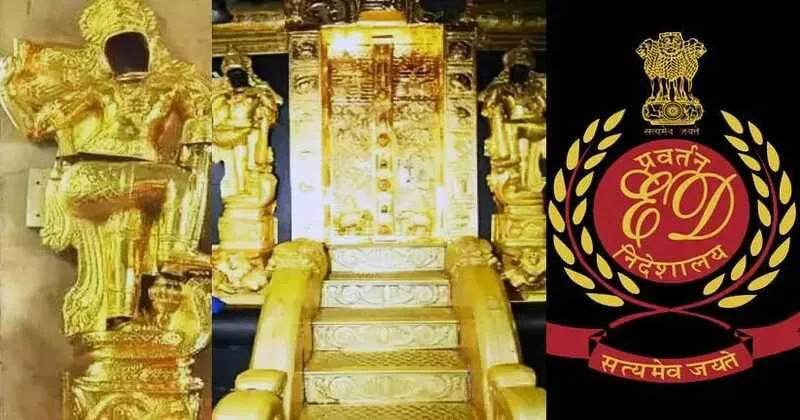
The Enforcement Directorate (ED) has initiated steps to formally register a case in connection with the Sabarimala gold heist. As part of this process, ED officials in Kochi have written to the agency’s headquarters in New Delhi seeking approval to register an Enforcement Case Information Report (ECIR). The probe will focus on suspected money laundering, illegal financial transactions, and the movement of gold linked to the alleged theft from the Sabarimala temple.
The development follows a crucial order by the Kollam Vigilance Court, which on Thursday granted permission to the ED to investigate the case. The court also directed that copies of all documents related to the investigation be handed over to the central agency, enabling it to proceed with its inquiry. This judicial clearance has strengthened the ED’s position to examine the financial trail behind the gold extraction and subsequent transactions.
A day earlier, the Kerala High Court rejected the bail applications filed by former Travancore Devaswom Board president N. Vasu, Deputy Devaswom Commissioner Murari Babu, and former Thiruvabharanam Commissioner K.S. Baiju. The bench observed that granting bail at this stage would seriously hamper the investigation and would be detrimental to the interests of the deity and lakhs of devotees. Justice Badaruddin, who is handling the case, observed that granting bail at this stage would adversely affect the investigation.
The High Court also relied on a specific incident cited in the investigation officer’s report while denying bail. According to the records, on June 17, 2019, when Murari Babu received an application seeking permission for gold plating of temple valuables, he ignored clear references to items already described as gold-plated. Instead, he recommended their immediate removal, characterising them as copper items. The court viewed this as a significant lapse warranting further investigation.
The bench further clarified that the health conditions cited by the accused did not justify the grant of bail. It noted that age-related ailments such as diabetes and hypertension, along with the need for regular medication, were insufficient grounds for release. The court observed that such conditions could be adequately managed by ensuring proper medical care through jail authorities or the investigating agency.
The investigation has also highlighted the immense value of the gold panels allegedly removed from Sabarimala. However, investigators have pointed out that monetary valuation alone does not capture the gravity of the offence. A bill recovered from Smart Creations stated that 989 grams of gold had been separated from the Dwarapalaka sculpture panels and related components. Of this quantity, 476 grams of gold were recovered from Govardhan, a jeweller based in Bellary in Karnataka.
According to the same document, the remaining 513 grams of gold were accounted for in two ways: 415.988 grams were used to plate the Dwarapalaka panels, while 97.012 grams were retained by Smart Creations as a work fee. The investigation further states that the door panels currently installed are newly manufactured and gold-plated, while the old panels are said to be stored in the Devaswom warehouse. If this claim is verified, it could weaken the argument that the original door panels were looted.
Former board president N. Vasu has argued that there is no evidence to prove that gold plating was carried out on the Kattilapalli structure (Door frame) in 1998 during the tenure of Vijay Mallya, who sponsored temple renovations at the time. Investigators, however, suspect that this argument was raised only after key evidence had been suppressed or destroyed, further strengthening suspicions of deliberate sabotage.
Serious questions have also been raised about whether the investigation was slowed during the recent local body election period due to political pressure. There are indications that efforts were made at the police level to prevent the arrest of former board members Shankaradas and Vijayakumar. It has also been questioned why former Devaswom Minister Kadakampally Surendran was not questioned, despite statements made by Padmakumar implicating higher-level decision-making.
In this context, observers believe that continuous judicial oversight by the High Court is essential to ensure a fair and comprehensive investigation. With mounting concerns over institutional failure and possible interference, many now see court intervention as the only remaining safeguard to uphold accountability and restore public confidence in the probe.