For decades, the Tamil language and the southern region were weaponised as tools of division, a legacy of British colonial experiments that attempted to portray the South, especially Tamil society, as culturally detached from the rest of Bharat. These narratives survived long after Independence, amplified by political parties such as Dravida Munnetra Kazhagam (DMK), Viduthalai Chiruthaigal Katchi (VCK), and several small and big groups claiming to be carriers of Dravidian identity theories and ideological battles. Against this backdrop, the Kashi Tamil Sangamam initiative, now in its fourth edition, emerges not merely as an event but as a quiet civilisational correction, an act of reconnecting what was never truly separated.
The initiative started by central government, BJP lead NDA, draws from an ancient truth: pilgrimages across regions were once natural acts of cultural exchange. Saints, scholars, farmers, poets and seekers moved freely across kingdoms. Language was never a barrier, and Kashi, the eternal spiritual seat of Bharat, was always a shared destination for devotees of Bhagwan Shiva from every corner of the land. That civilisational memory is palpable in today’s Sangamam.
A Living Connection, Not a Ceremony
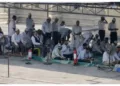
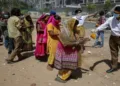
Being present at Kashi Tamil Sangamam 4.0 is less about scheduled programmes and more about lived experience. Tamil flows through the air, in conversations, signboards, announcements and temple spaces. The streets of Kashi echo with a linguistic familiarity that makes visitors feel at ease in Varanasi, almost forgetting that they are over 2,000 kilometres away, or that they are not somewhere deep inside Tamil Nadu.
It is often said, “Thamizh Manam Manakkudhu”—the fragrance of Tamil fills the air. That sentiment finds a natural home in Kashi. Without slogans or compulsion, the spiritual town reflects how cultural harmony works when it is lived rather than imposed.
Structure With a Soul
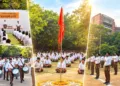
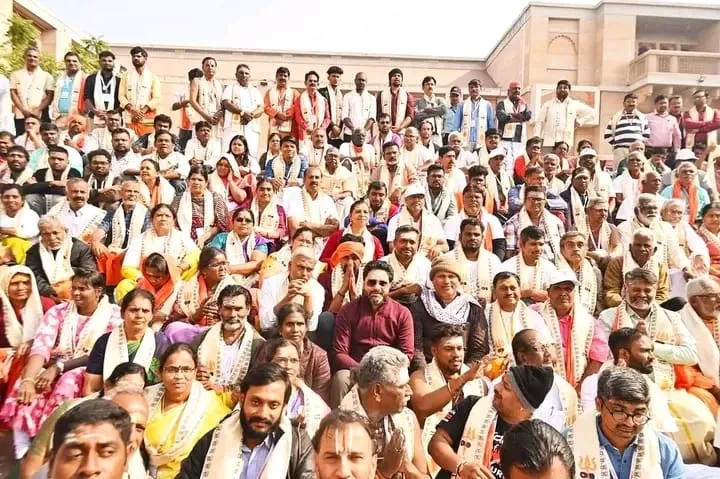
Now in its fourth edition, the Sangamam has organically evolved into a more structured yet deeply human process. Delegates are grouped into seven categories—students, teachers, writers and media professionals, farmers, artisans and professionals, women’s groups, and spiritual practitioners. Each group follows a tailored itinerary that aligns spiritual exposure with subject-specific learning.
Selection is merit-based and transparent, involving online tests, shortlisting, interviews and verification. Travel from Tamil Nadu to Kashi is staggered, ensuring smooth movement and focused engagement. While the spiritual core remains unchanged, the temples, ghats and sacred rituals, the interactions are more purposeful, allowing participants to carry memories that travel from dinner-table conversations to quietly dismantling divisive narratives deeply rooted among sections of society.
Hospitality That Becomes Part of the Story
What distinguishes this pilgrimage-like experience is the level of care woven into every detail. Delegates of KTS 4.0 received exceptional access to temples and shrines, often completing darshan within minutes, even as long queues stretched outside. For many, these moments felt less like privilege and more like grace.
Even though Uttar Pradesh is predominantly a Hindi-speaking state, the organizers took care to eliminate language barriers. Tamil speaking escorts, coordinators, and managers were placed with each group throughout the journey. Their presence made communication effortless and allowed every delegate from students to senior spiritual leaders to navigate the experience with ease. The beauty and essence of the Sangamam reflected in a way that the escorts and coordinators learned to speak a few terms Tamil while the delegates learned a few terms Hindi.
Security arrangements were meticulous, with visible yet unobtrusive police deployment ensuring complete safety. Women participants, in particular, described Kashi as reassuring and well-coordinated, supported by dedicated female coordinators who worked tirelessly from dawn until late night.
Food, too, became an emotional connector. Authentic South Indian vegetarian meals, prepared by Tamil cooks who arrived days in advance, ensured that no one felt culturally displaced.
Tamil Learning as a Bridge
The current theme of KTS 4.0 “Let’s Learn Tamil – Tamil Karkalam” places language at the heart of integration. The focus aligns with the national vision of Ek Bharat Shreshtha Bharat, recognising that culture deepens when language is shared.
The highlight of Kashi Tamil Sangamam 4.0 is its visionary theme: Tamil Learning and Linguistic Unity. While the earlier editions emphasized heritage, spirituality and cultural exchanges, this year, language as the core theme, recognizing it as most organic bridge between the societies.
It is reported that under this initiative, 50 Tamil teachers will be appointed in government and private schools in Varanasi. Trained at the Central Institute of Classical Tamil, they will introduce spoken Tamil, basic grammar and cultural expressions to local students. Each teacher will guide 30 learners, planting seeds of linguistic familiarity in North India.
The exchange flows both ways. Under Tamil Karpom, 300 students from Kashi will travel to Tamil Nadu, learning linguistic and cultural landscape.
Kashi, Bharathi and an Older Journey
Kashi’s connection with Tamil culture is not new. Mahakavi Subramania Bharathi spent over three years in this city. Though he did not compose works during his stay, but Kashi shaped his intellectual and spiritual growth, preparing the ground for the revolutionary poetry that would follow.
The KTS 4.0 also symbolically retraces the ancient route of Rishi Agastya, believed to have carried Tamil culture southward. The journey’s culmination at Rameswaram reinforces the north–south spiritual continuum, completing a civilisational arc rather than a tourist itinerary.
More Than an Event
With an estimated public investment of ₹75,000 per delegate, the Sangamam also generates tangible economic benefits, supporting hospitality workers, transport providers, caterers, local vendors and artisans across Varanasi. Yet its true return lies in connecting people to people.
Though, Kashi Tamil Sangamam 4.0 does not argue against division; it simply renders it irrelevant. It lights a lamp rather than fighting darkness. For the participants of speaking Tamil without hesitation in Kashi makes it clear that this is not a programme about unity, it is unity, experienced through everyday human connection. Here, in the world’s oldest living city, Tamil does not arrive as a guest. It feels at home.
In conclusion, amid the ongoing struggle between divisive and unifying forces in Bharat, initiatives such as the Kashi Tamil Sangamam have the potential to neutralise narratives constructed during colonial times through various intellectual and subversive tactics in the Madras Presidency, which projected the Tamil language and the southern region as separate from the rest of Bharat and deeply impacted society over generations. Instead of addressing and correcting these distortions after Independence, political forces, due to various factors, failed to bridge these divides; in this context, KTS 4.0 stands as a lamp that quietly dispels the darkness.