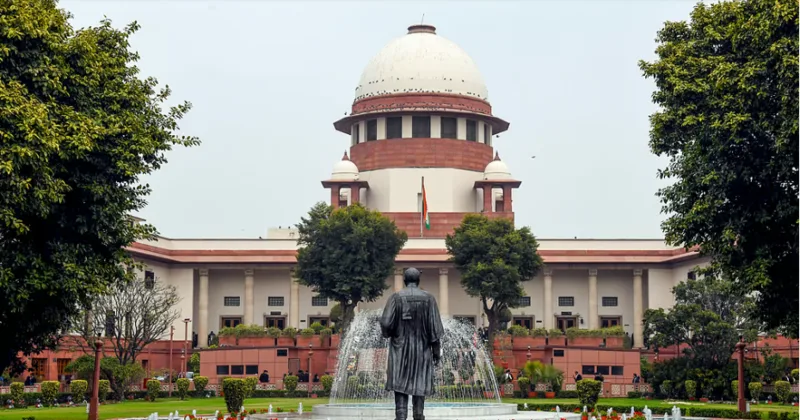
The Supreme Court on Wednesday (Dec 17) made a rare and candid observation on the issue of integrity within the lower judiciary, flagging what it described as a growing trend of judges passing a spate of questionable or improperly influenced orders just before their retirement. The remarks came from a bench led by Chief Justice of India Surya Kant while hearing a petition filed by a principal district judge from Madhya Pradesh who had challenged his suspension just days before superannuation.
The bench, also comprising Justice Joymalya Bagchi, made the observation while examining the circumstances under which the judicial officer was placed under suspension barely ten days before his scheduled retirement.
During the hearing, the Chief Justice made a pointed remark that caught the attention of the legal fraternity.
“Petitioner just before retirement started hitting sixes. It is an unfortunate trend. I do not want to elaborate on it,” the CJI said, indicating concern over judicial officers allegedly delivering a flurry of orders influenced by improper considerations at the end of their service tenure.
The petitioner, a principal district judge in Madhya Pradesh, was due to retire on November 30 but was suspended on November 19, reportedly on account of two judicial orders passed by him shortly before his retirement. His counsel told the court that the officer had an otherwise “impeccable” career record, backed by consistently high ratings in his annual confidential reports.
Senior advocate Vipin Sanghi, appearing for the petitioner, argued that the suspension was unjustified and arbitrary.
“How can an officer be suspended for judicial orders which can be appealed against and rectified by the higher judiciary?” Sanghi submitted before the bench.
The Supreme Court clarified that disciplinary proceedings cannot ordinarily be initiated against a judicial officer merely for passing erroneous judicial orders.
“Disciplinary proceedings cannot be initiated against a judicial officer for passing orders which are erroneous. He cannot be suspended for this. But if the orders are palpably dishonest?” the bench observed, drawing a clear distinction between judicial error and alleged misconduct.
CJI Surya Kant further noted that the judicial officer was not aware, at the time of passing the impugned orders, that his retirement age had been extended by one year. The Madhya Pradesh government had earlier increased the retirement age of its employees to 62 years, and the Supreme Court had directed that the benefit be extended to the petitioner as well.
The bench reiterated its concern over what it described as a worrying pattern in the judiciary.
“There is a growing trend of judges passing so many orders just before retirement,” the Chief Justice said, underscoring the need for greater institutional vigilance.
The court also questioned why the petitioner had not approached the Madhya Pradesh High Court to challenge his suspension.
The bench took strong exception to the petitioner seeking details related to his suspension through Right to Information (RTI) applications.
“It is not expected of a senior judicial officer to resort to the RTI route to get information,” the court remarked, adding that the officer should have first submitted a formal representation.
Senior advocate Sanghi responded that the petitioner, faced with a full court decision, believed approaching the Supreme Court was the only way to secure a fair hearing. However, the bench noted that several full court decisions have previously been set aside by High Courts on the judicial side.
Declining to entertain the plea, the Supreme Court held that there was no ground for its direct intervention at this stage. The bench directed the petitioner to make a representation to the High Court seeking recall of the suspension order.
“The High Court would decide his representation within four weeks,” the bench ordered, bringing the proceedings to a close.