
The Bharatiya Janata Party (BJP) has never been hesitant to experiment in Indian politics. In fact, it would not be an exaggeration to describe the BJP as the most successful political experiment in independent India. From its innovative use of technology and a vast network of full-time party workers to the creation of panna pramukhs and the institutional decision to reserve 33 per cent of organisational positions for women, the party has consistently challenged established political norms. These initiatives have not merely been symbolic; they have reshaped electoral mobilisation, party structure, and governance, setting new benchmarks for political organisation in the country.
This culture of experimentation gained even greater momentum under the leadership of Prime Minister Narendra Modi. Over the past decade, the BJP has pursued a clear philosophy of test–observe–analyse–scale, applying it to election campaigns, membership drives, welfare delivery, and internal party organisation. The party’s campaigns have become increasingly data-driven, its outreach more targeted, and its communication sharper. Modi’s leadership has also been marked by a willingness to take calculated political risks, often redefining conventional wisdom in the process.
One of the most significant and successful experiments under Modi has been the conscious creation and consolidation of a women-centric voter base through policies and schemes focused on women’s empowerment—ranging from financial inclusion and sanitation to housing, nutrition, and direct benefit transfers—the BJP has altered traditional voting patterns.
Rather than engaging solely with the rigid, often traditional caste framework, he has sought to reimagine social divisions in contemporary terms. Modi’s political narrative has increasingly emphasised what he describes as the “new castes” of modern Bharat—women, youth, the poor, and farmers. This reframing does not deny the historical reality of caste but seeks to dilute its political centrality by foregrounding shared socio-economic aspirations and vulnerabilities.
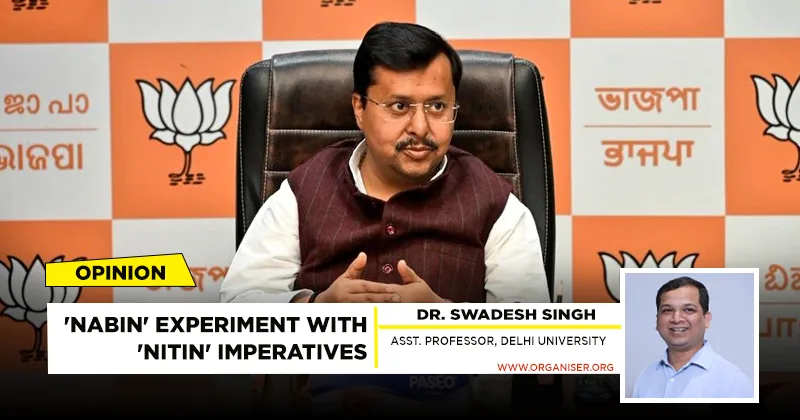
Within this framework, the elevation of Nitin Nabin to the post of working president of the BJP assumes particular significance. It seems that this is not an isolated organisational decision but part of a broader political strategy aimed at long-term transformation. By placing a relatively young leader at the helm, the BJP is clearly signalling its intent to prioritise the “youth” category among Modi’s four new social divisions. The choice reflects an understanding that India’s demographic reality—where a large proportion of the population is under 35—demands leadership that can connect with younger generations, both in language and in outlook.
On Sunday, the BJP parliamentary party nominated Nitin Nabin as its working president. A five-time legislator from Bihar, Nabin is widely regarded as a dynamic and grounded leader. He has served as a minister in the Government of Bihar for four years, gaining practical experience in governance and administration. Equally important is his long association with the party organisation at both the state and central levels. This combination of organisational grounding and governmental experience positions him as a bridge between the BJP’s cadre-driven ethos and its responsibilities as a governing party.
At 45 years of age, Nitin Nabin is among the youngest leaders to occupy such a significant organisational post in a major national party. In the context of Indian politics, where leadership positions are often dominated by individuals in their late fifties, sixties, or beyond, this is a notable departure. The BJP is not short of senior leaders with decades of experience who could plausibly stake a claim to such a role. The decision to elevate a younger leader, therefore, is not merely about individual merit but about institutional intent.
A comparison with other political parties further underscores the uniqueness of this move. Across the political spectrum, party presidents and top organisational leaders tend to belong to older age cohorts. While experience and seniority remain invaluable, this age skew often creates a perceptual and communicative gap between leadership and younger voters. By contrast, the BJP’s choice of Nabin positions it as a party consciously attempting to narrow that gap.
This decision also reflects a broader acknowledgement of youth power in contemporary politics. Across the world, recent political and social movements have highlighted the growing influence of Gen Z. This generation is digitally native, politically expressive, and often impatient with traditional hierarchies. Their concerns—ranging from employment and education to climate change and governance transparency—are shaping public discourse in unprecedented ways. Political parties that fail to engage meaningfully with this demographic risk long-term irrelevance.
Although Nitin Nabin himself belongs to the millennial generation rather than Gen Z, his age and political style place him closer to this cohort than many of his contemporaries. This proximity matters. It enables a more intuitive understanding of the aspirations, anxieties, and communication habits of younger citizens. As working president, Nabin has the potential to emerge as a stable and credible voice for youth within the party, translating their concerns into organisational priorities and political messaging.
At the same time, Indian politics presents a unique paradox regarding age and leadership. In a dynamic political environment, even leaders in their 50s or 60s are often perceived as “young” if they demonstrate energy, adaptability, and vision. By that broader yardstick, Nitin Nabin should be considered as the Gen Z President.
Seen in this light, the appointment of Nitin Nabin should not be viewed as a generational rupture but as generational continuity. It represents an effort to institutionalise youth representation rather than relying solely on individual charisma. The BJP appears to be preparing for the future by nurturing leaders who can carry forward its ideological and organisational legacy while adapting to changing societal realities.
Ultimately, the BJP’s bet on a Gen Z-ready president is about more than age. It is about recognising demographic shifts, responding to evolving political expectations, and reinforcing a culture of experimentation that has long defined the party. Whether this move delivers sustained political dividends will be tested over time. But as a strategic signal, it clearly underscores the BJP’s intent to remain attuned to the aspirations of a young and rapidly changing India.