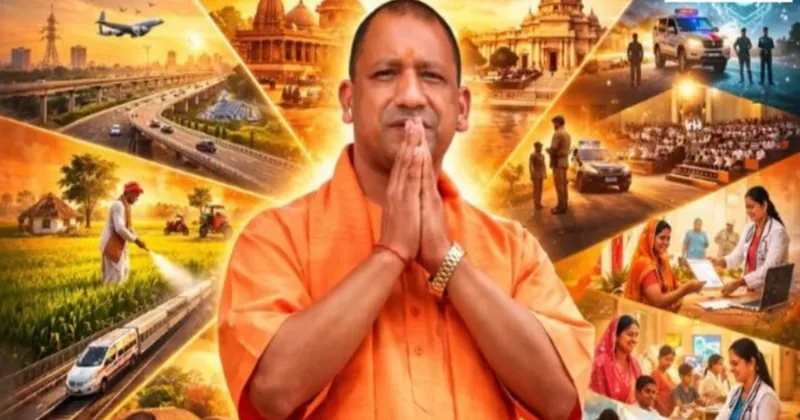
Chief Minister Yogi Adityanath addressed the ‘Samvad 2026: Charting India’s Course to 2047’ programme in Lucknow on May 18, his speech represented a blueprint of future bharat. The vision he articulated for Uttar Pradesh is both ambitious and grounded a self-reliant state that anchors a self-reliant India. In a single address, CM Yogi connected grassroots economic policy, industrial ambition and national security in a coherent, compelling narrative.
From the Bottom Up: Why Atmanirbharta Must Begin at the Village
The philosophical core of CM Yogi address rested on a proposition of national self-reliance is only as strong as its most local unit. “If the village is not self-reliant, the town is not self-reliant and the district is not self-reliant,” he said, “then the vision of a self-reliant Uttar Pradesh and a self-reliant India cannot materialise.” India Atmanirbhar Bharat programme, launched by Prime Minister Narendra Modi in 2020, has always required state-level execution. Uttar Pradesh, with its 25-crore population larger than most countries in the world.
Prime Minister Modi himself has repeatedly affirmed that the One District One Product (ODOP) model is central to achieving the self-reliance goal. Conceived and pioneered in Uttar Pradesh, ODOP has since been adopted as a national framework under the Ministry of Food Processing Industries. It identifies one distinctive product from each district, be it Agra leather goods, Varanasi silk sarees, Moradabad brassware or Lucknow chikankari and concentrates policy support, branding and market linkages around it.
CM Yogi announces that Uttar Pradesh is now advancing toward ODOC One District One Cluster, which marks the next evolutionary step in promoting districts. ODOC extends beyond promoting a single product to developing an entire ecosystem of enterprises around a district core competency. It means shared infrastructure, common facility centres, integrated supply chains and collective export potential. This transition from product to cluster is the difference between creating individual champions and building regional economies.
MSME: The Engine of Employment at Scale
No sector reflects Uttar Pradesh’s ground-level economic transformation more vividly than its Micro, Small and Medium Enterprises. CM Yogi highlighted that UP MSME units are advancing rapidly and the government has made deliberate efforts to integrate them with technology, packaging and modern marketing. This three-point integration is often overlooked in policy discussions, yet it is transformational in practice.
A craftsman weaving Banarasi silk or a unit producing Aligarh locks may have produced world-class goods for generations. But without access to e-commerce platforms, professional packaging, quality certifications and export linkages, their market was always local. The state push to modernise the MSME ecosystem includes digital onboarding, GI tag promotions and participation in national and international trade fairs has broken these geographic ceilings.
UP ‘One District One Product’ has evolved from a state initiative into what CM Yogi described as “a powerful brand of India through MSME,” with crores of people now earning livelihoods through this framework. According to government data, UP has over 96 lakhs registered MSME, making it one of the top states in the country by MSME count. The sector is a source of employment and it is the backbone of rural and semi-urban economic inclusion.
Rs 50 Lakh Crore and the Investment Story of the Decade
Perhaps the most striking data point from CM Yogi address concerns the sheer scale of investment flowing into Uttar Pradesh. The state today holds investment proposals worth ₹50 lakh crore. Of this, ₹15 lakh crore worth of investments have already seen ground-breaking meaning they have moved from proposal to active implementation. An additional Rs 7.5 lakh crore worth of projects sit in the pipeline ready for ground-breaking at any time.
India’s total Union Budget for 2024-25 was approximately Rs 47.65 lakh crore. Uttar Pradesh alone has attracted investment proposals that rival the nation’s annual fiscal envelope. This did not happen by accident.
The transformation of UP investment climate is traceable to a systematic overhaul of governance. CM Yogi pointed specifically to two platforms ‘Nivesh Sarathi’ and ‘Nivesh Mitra’ as single-window systems that have dramatically reduced friction for investors. These platforms allow investors to track approvals, resolve grievances and access clearances without navigating bureaucratic labyrinths. UP Invest portal, reforms in land allotment, plug-and-play industrial infrastructure in newly developed districts and a sharp reduction in inspector raj have together created what investors now recognise as a reliable, responsive government.
Uttar Pradesh has emerged as the top investment destination in the country in recent years. The Global Investors Summit 2023 in Lucknow generated investment commitments exceeding Rs 32.92 lakh crore a figure that has grown substantially. The state that was once associated with poor infrastructure, governance uncertainty and power shortages has rebuilt its reputation through improvements in desired sectors.
The Defence Corridor: Redefining UP’s Strategic Identity
Beyond MSMEs and civilian investment, CM Yogi’s address highlighted a dimension of Uttar Pradesh’s transformation that is of profound national significance of defence manufacturing. The Uttar Pradesh Defence Industrial Corridor, spanning nodes at Lucknow, Kanpur, Jhansi, Chitrakoot, Aligarh and Agra, has given the state an entirely new identity on India’s strategic map.
“The Defence Manufacturing Corridor has given Uttar Pradesh a new recognition,” CM Yogi said. “Now UP is advancing with complete readiness to make a significant contribution to strengthening India’s defence self-reliance.” India’s defence sector has been a weak point, the country remained the world’s largest arms importer for many years, a strategic vulnerability that successive governments acknowledged but could not quickly remedy. Prime Minister Modi’s push for indigenous defence production, embodied in the defence corridors of UP and Tamil Nadu, represents a structural break from this dependency.
The UP corridor has attracted investment from companies including Brahmos Aerospace, Hindustan Aeronautics Limited, Bharat Electronics Limited and dozens of private defence firms. Components for fighter aircraft, drones, artillery systems and missile platforms are now being manufactured in a state that was previously better known for agricultural output. The geopolitical resonance of this shift is significant in a world of supply chain disruptions and strategic competition, domestic defence manufacturing is not merely an economic matter, it is a question of sovereignty.
CM Yogi framed this clearly among the states giving ground-level reality to PM Modi’s vision, Uttar Pradesh is playing a leading role. That self-assessment is increasingly corroborated by data, investment flows and strategic importance.
The 2047 Horizon: UP’s Role in Viksit Bharat
The ‘Samvad 2026’ programme itself focused on charting India’s course to 2047, provides the larger context for everything CM Yogi described. The centenary of India’s independence is the reference point for Prime Minister Modi’s Viksit Bharat vision: a developed, self-reliant, globally competitive India. The milestones being set today in ODOP, MSME, investment attraction, defence manufacturing are the building blocks of that destination.
What CM Yogi has articulated and what his government has been translating into policy over the past several years is a model of governance that takes the federal architecture seriously. It does not wait for central directives to localise, it builds local capacity that then feeds national ambition. The ODOP model, now a national policy, originated in UP. The investor confidence now attracting ₹50 lakh crore in proposals was built through state-level administrative reforms. The defence corridor was seeded by a state government that understood what strategic manufacturing could mean for its industrial landscape.
As India approaches 2047, the story of Atmanirbhar Bharat will be written in the factories of Kanpur, the defence workshops of Jhansi and the investment corridors of Lucknow. CM Yogi’s address at Samvad 2026 was a reminder that this story is not a future aspiration.