Social Service History of RSS: Seva beyond stereotype
June 26, 2026
  • Read Ecopy
  • Circulation
  • Advertise
  • Careers
  • About Us
  • Contact Us
Android AppiPhone AppArattai
Organiser
  • ‌
  • Bharat
    • Assam
    • Bihar
    • Chhattisgarh
    • Jharkhand
    • Maharashtra
    • View All States
  • World
    • Asia
    • Europe
    • North America
    • South America
    • Africa
    • Australia
  • Editorial
  • International
  • Opinion
  • RSS @ 100
  • More
    • Op Sindoor
    • Analysis
    • Sports
    • Defence
    • Politics
    • Business
    • Economy
    • Culture
    • Special Report
    • Sci & Tech
    • Entertainment
    • G20
    • Azadi Ka Amrit Mahotsav
    • Vocal4Local
    • Web Stories
    • Education
    • Employment
    • Books
    • Interviews
    • Travel
    • Law
    • Health
    • Obituary
  • Subscribe
    • Subscribe Print Edition
    • Subscribe Ecopy
    • Read Ecopy
  • ‌
  • Bharat
    • Assam
    • Bihar
    • Chhattisgarh
    • Jharkhand
    • Maharashtra
    • View All States
  • World
    • Asia
    • Europe
    • North America
    • South America
    • Africa
    • Australia
  • Editorial
  • International
  • Opinion
  • RSS @ 100
  • More
    • Op Sindoor
    • Analysis
    • Sports
    • Defence
    • Politics
    • Business
    • Economy
    • Culture
    • Special Report
    • Sci & Tech
    • Entertainment
    • G20
    • Azadi Ka Amrit Mahotsav
    • Vocal4Local
    • Web Stories
    • Education
    • Employment
    • Books
    • Interviews
    • Travel
    • Law
    • Health
    • Obituary
  • Subscribe
    • Subscribe Print Edition
    • Subscribe Ecopy
    • Read Ecopy
Organiser
  • Home
  • Bharat
  • World
  • Operation Sindoor
  • Editorial
  • Analysis
  • Opinion
  • Culture
  • Defence
  • International Edition
  • RSS @ 100
  • Magazine
  • Read Ecopy
Home Bharat

Social Service History of RSS: Seva beyond stereotype

‘Social Service History of RSS’ is a brief but impactful contribution that sheds a light on a dimension of the Sangh that has long been neglected in academic study. By foregrounding seva — not as propaganda but as social reality — Dr Khangai has opened a rich field for future scholarship on how the RSS became deeply enmeshed with Bharatiya society

Shaan KashyapShaan Kashyap
Dec 15, 2025, 09:00 pm IST
in Bharat, Books
Follow on Google News
FacebookTwitterWhatsAppTelegramEmail

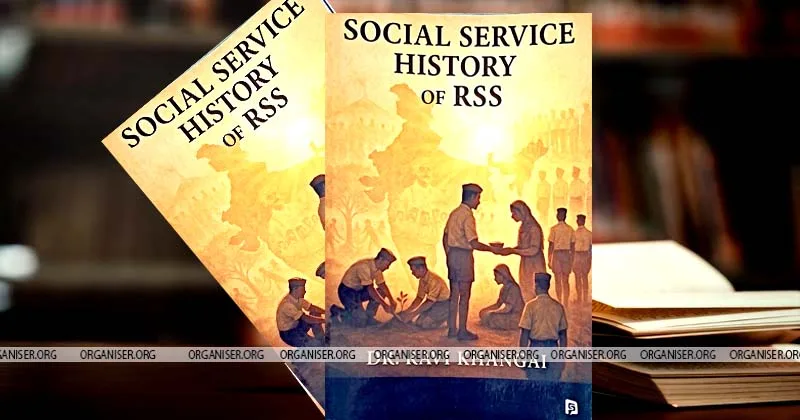
Social Service History of RSS, Dr Ravi Khangai, SPI Publications, Gurgaon, 137 pages, Rs. 350 (Paperback)

Whenever a calamity hits Bharat, a familiar sight appears. RSS Swayamsevaks move into action! They organise relief, carry food, support rescue teams, and comfort those in shock and grief. It may be a flood in Uttarakhand, Kashmir, and Kerala, a landslide in Himachal, an earthquake in Gujarat, or a cyclonic destruction in a remote coastal village in Odisha and Andhra Pradesh. Their response is quick and disciplined. It is also quiet. They arrive before the cameras and often stay long after they leave.

In daily life too, Swayamsevaks’ presence is steady. They serve food in slums, help run health camps, and walk to remote villages that remain cut off during heavy rains. After the Balasore train accident in Odisha in 2023, over a thousand Sangh volunteers worked through the night. They helped in rescue efforts, identified victims, donated blood, and supported the injured. Their work did not stop until the crisis did.

Dr Ravi Khangai’s Social Service History of RSS recognises this constant presence. It shows that seva is not a side activity in the Sangh. It is central to its identity. The book traces seva from ancient Bharatiya traditions to the Shakhas of Dr Hedgewar. It then follows its journey into schools, hospitals, relief camps, and community projects across the country.

Khangai is an academic and historian, yet he writes with clarity and care, remaining sensitive to the Sangh’s seva bhava. He shows how the supporters of Sangh see seva with pride, while critics see it with suspicion. The author acknowledges both views. He does not avoid the tension between ideology and service. Instead, he brings them together and lets the reader understand the complexity. That balance is one of the book’s strengths.

The book highlights episodes that rarely find space in academic writing. The chapter on Partition shows Swayamsevaks stepping into refugee camps within days of chaos. They supplied food and shelter when formal systems were collapsing. Another chapter describes the support given during the 1962 war. Even Prime Minister Jawaharlal Nehru recognised their work. These accounts place the RSS within the social history of the nation, not just its political story.

The RSS Model of Seva

What sets the RSS model of seva apart, Khangai argues, is its grounding in disciplined voluntarism rather than in charismatic leadership or institutional endowments alone. Where Gandhi Ji’s constructive programme drew on moral persuasion and grassroots mobilisation, and where missionary models often relied on external funding and formal NGOs, the RSS system builds service through daily discipline learned in the Shakha. For Swayamsevaks, service is not an occasional act of charity, nor the Gandhian expression of trusteeship, but an expression of duty rooted in belonging to the nation as a cultural family. This ethos, the author suggests, integrates character building with social work in ways that other models do not always articulate.

The book’s comparative chapters further illuminate this point. In the discussion on Gandhian work, for example, the emphasis is on voluntary simplicity and moral regeneration; in contrast, RSS seva is framed as rooted in cultural nationalism — a duty to protect and uplift the social body. The comparison with Christian missions and organisations like the Ramakrishna Mission and Arya Samaj highlights differences in worldview, motivation, and institutional structure. While all share a commitment to service, their philosophical anchors shape how and why they serve.

Khangai’s use of archival records, Government documents, and field testimonies adds robustness to his narrative. He moves comfortably between macro-historical analysis and micro-stories drawn from conversations with beneficiaries: slum dwellers recounting literacy classes, tribal families recalling health camps, and cyclone victims telling how shelter and food arrived when it mattered most. These voices give texture to a history that could otherwise remain abstract.

By situating seva within the broader dynamics of civil society and governance, Author underscores the urgency of understanding voluntary organisations not as peripheral forces but as central actors in bharat’s social fabric

The book does not shy away from controversy. In addressing critical perspectives — that RSS outreach may function as a subtle form of ideological expansion — Khangai neither dismisses the concern nor lets it overshadow the lived reality of service on the ground. By placing testimonies of beneficiaries beside critiques, he invites the reader to engage with complexity rather than retreat into partisan certainties.

In its middle chapters, the book traces the institutionalisation of service through organisations like Seva Bharati, which coordinates education, healthcare, and disaster relief on a scale that is often overlooked. Recent relief efforts — from flood-hit villages in Punjab where heat, hunger, and loss pressed hard on families, to the night-and-day community kitchens set up in Himachal’s mountainous districts — resonate with the historical continuity Khangai charts. In each case, the narrative of service as duty and discipline comes alive.

Seva as Social Dynamics

Yet Khangai does not treat service as unproblematic. In his later chapters, he grapples with questions about the relationship between the RSS and the state, showing how voluntary action sometimes complements, sometimes competes with official structures. By situating seva within the broader dynamics of civil society and governance, he underscores the urgency of understanding voluntary organisations not as peripheral forces but as central actors in Bharat’s social fabric.

At just the right moments, the prose soars with a lyrical sense of purpose, reminding the reader that service, however contested, remains one of the noblest human impulses. And yet, the narrative remains anchored in scholarship, inviting deeper reflection without lapsing into advocacy.

In conclusion, Social Service History of RSS is a brief but impactful contribution that shines a light on a dimension of the Sangh that has long been neglected in academic study. By foregrounding seva — not as propaganda but as social reality — Dr Khangai has opened a rich field for future scholarship on how the RSS became deeply enmeshed with Bharatiya society. His book encourages us to see beyond stereotypes and to engage with the lived experiences of service that have shaped, and continue to shape, communities across the subcontinent.

Topics: RSS swayamsevaksHimachal’s mountainousSeva as Social DynamicsKhangai’s useSocial Service History of RSS
ShareTweetSendShareSend
✮ Subscribe Organiser YouTube Channel. ✮
✮ Join Organiser's WhatsApp channel for Nationalist views beyond the news. ✮
Previous News

RSS at 100: Time to organise the society with unity and quality: Sarsanghchalak Dr Mohan Bhagwat

Next News

Chhattisgarh: Row erupts over Changai Sabha in Korba, Hindu activists allege conversion activities, demand action

Related News

Republic Day Parade 1963: Did you know that Nehru also recognised the contribution of RSS Swayamsevaks?

Safron Flag (L ) - Rahul Gandhi (R)

Congress in decline, RSS and nationalists on Rise: Fear of Rahul Gandhi explained

Dr Vannirajan, Sanghchalak- Dakshin Kshetra; Dr Mohan Bhagwath, Sarsanghchalak-RSS; Sri Kumaraswamy, Sanghchalak- Uttar Tamil Nadu; Sri Chandrashekar - Sanghchalak- Chennai Mahanagar (Left-Right)

RSS core mission is national development, not power or political control: Dr Mohan Bhagwat at Chennai event on RSS 100

Rashtriya Swayamsevak Sangh (RSS) Sarsanghchalak Dr. Mohan Bhagwat addressed an eminent gathering of intellectuals, scholars, editors, writers, and entrepreneurs during his visit to Assam

Assam: Bharat & Hindu are synonymous; India does not need official declaration to be a Hindu Rashtra: Dr Mohan Bhagwat

RSS at 100: Path Sanchalan draws massive public participation in Nalatwad

100 years of RSS and the three wars: 1962, 1965, 1971 — A civilisational reflection

Load More

Latest News

NIA Chargesheets 11 JMB Terror Operatives in Assam Terror Conspiracy Case

NIA files chargesheets against 11 Islamist terrorists of JMB offshoot terror plot in Assam, Tripura and Bengal

Karnataka: Delayed monsoon pushes the state into water crisis; BJP MP urges action as reservoirs level fall sharply

Viral Video of Crane-Hoisted Van Explosion During Muharram Procession Sparks Nationwide Outrage

MP: Van suspended 40 feet by crane, blown up during Muharram procession; NSA invoked against four

AI Image

Tamil Nadu: BJP cites 10 sexual assault cases in a day, alleges worsening law and order under TVK government

Operation Amistad: India sends relief, medical aid to earthquake hit Venezuela; Death toll rises to 235 & 4,300 injured

Chief Minister Shri Mohan Charan Majhi at CII Eastern Regional Council meeting organised at May Fair convention on 26 June 20

Odisha: CM Mohan Majhi launches ‘Go East’ initiative, announces sweeping industrial policy reforms

Over 6 crore UP citizens can fetch family ID on DigiLocker

UP Family ID on DigiLocker: Yogi government brings paperless welfare access to over 6 crore citizens

CoHNA explains of Hindu temples are repeatedly vandalised in the US as anti-Hindu hate soars

CoHNA Slams Yashica Dutt’s Anti-Hindu Propaganda: Upholds Georgia’s bill & Indian American unity against polarisation

Uttar Pradesh's growth story gains global backing as IBM, Cognizant and embassy group praise Yogi government reforms

Global firms back UP growth story at Bengaluru roadshow; IBM, Cognizant announce major expansion plans

Tamil Nadu: Zoho’s Sridhar Vembu recounts alleged bribery demands for school NOC approvals during DMK regime

Load More
  • Privacy
  • Terms
  • Cookie Policy
  • Refund and Cancellation
  • Delivery and Shipping

© Bharat Prakashan (Delhi) Limited.
Tech-enabled by Ananthapuri Technologies

  • Home
  • Search Organiser
  • Bharat
    • Assam
    • Bihar
    • Chhattisgarh
    • Jharkhand
    • Maharashtra
    • View All States
  • World
    • Asia
    • Africa
    • North America
    • South America
    • Europe
    • Australia
  • Editorial
  • Operation Sindoor
  • Opinion
  • Analysis
  • Defence
  • Culture
  • Sports
  • Business
  • RSS @ 100
  • Entertainment
  • More ..
    • Sci & Tech
    • Vocal4Local
    • Special Report
    • Education
    • Employment
    • Books
    • Interviews
    • Travel
    • Health
    • Politics
    • Law
    • Economy
    • Obituary
  • Subscribe Magazine
  • Read Ecopy
  • Advertise
  • Circulation
  • Careers
  • About Us
  • Contact Us
  • Policies & Terms
    • Privacy Policy
    • Cookie Policy
    • Refund and Cancellation
    • Terms of Use

© Bharat Prakashan (Delhi) Limited.
Tech-enabled by Ananthapuri Technologies