For nearly a century, the Sangh has dedicated itself to the monumental task of weaving the diverse and distinct currents of Hindu society into a single, unified thread. This is not a superficial union, but a deep-rooted unity founded on strength, unshakeable faith, and a realisation of our shared destiny.
The Vision of Samarasata: Beyond Equality to Harmony
The Ancient Roots of Harmony India’s eternal Sanatan culture has long held a singular worldview, beautifully captured in the Rigveda:
“Ajyeshthaso Akanishthaso Ete, Sama Bhratarah Saubhagaya.” (Rigveda 5.60.5)
This proclaims that no one is superior, and no one is inferior; all are brothers who must strive together for the collective welfare. This ancient wisdom forms the bedrock of the Sangh’s philosophy. M.S. Golwalkar (Guruji) clarified this distinction with profound insight: while “Equality” (Samanata) merely provides a legal framework, “Harmony” (Samarasata) is a feeling of the heart—and it is this emotional bond that serves as the foundation of true unity.
The Moral Call of 1969. This philosophy was crystallised historically during the Udupi Dharma Sansad of 1969. In a unanimous declaration, the gathered saints proclaimed:
“Hindavah Sodarah Sarve, Na Hindu Patito Bhavet.
Mama Diksha Dharma Raksha, Mama Mantrah Samanata.”
Translated, this means: “All Hindus are siblings; no Hindu is fallen or outcast. My initiation is the protection of Dharma; my mantra is equality.” This proclamation became the moral battle cry of the Sangh’s campaign for social harmony.
Defining the Spectrum: Samata, Samanata, and Samarasata. The Sangh distinguishes between three interconnected concepts, viewing them as a progression rather than synonyms:
Samata: The equality of ideas and perspectives; Samanata: Equality in terms of legal and social rights; Samarasata: Equality of the heart—a deep-seated sense of mutual respect and brotherhood.
The Spiritual Conclusion The essence of this journey is encapsulated in the peace mantra (Shanti Mantra), cited in the Taittiriya Upanishad:
“Om Saha Navavatu, Saha Nau Bhunaktu, Saha Veeryam Karavavahai, Tejasvinavadhitamastu, Ma Vidvishavahai.”
It signifies: “May He protect us both together; may He nourish us both together; may we work together with great energy; may our study be vigorous and effective; may we not hate or dispute with each other.”
The Sangh believes that true unity is born only when the concepts of Samata (ideological equality) and Samanata (rights-based equality) evolve into Samarasata—an organic, heartfelt harmony.
The Journey of the Sangh: From Dr. Hedgewar to Bhagwat
From the very inception of the Sangh, Dr. Hedgewar fostered a practice of integral living that rose above caste distinctions. In the Shakhas, children played, ate, and prayed together—without a shred of discrimination.
This legacy was carried forward by Guruji Golwalkar, who vehemently rejected the distinction between “touchable” and “untouchable.” He declared, “We are all Hindus, integral parts of one culture.” Under his leadership, the Udupi Dharma Sansad made the historic proclamation: “No Hindu has fallen; all are protectors of Dharma, and equality is our mantra.”
Balasaheb Deoras took an even firmer stand, stating clearly: “If untouchability is not a sin, then nothing in this world is a sin.” This was a decisive call for social reform within the Sangh. Later, K.S. Sudarshan identified family awakening (Parivar Jagran) as the first step toward social change, while Dattopant Thengadi gave this ideology an organisational structure by establishing the ‘Samajik Samarasata Manch’ (Social Harmony Forum).
Today, the call of Sarsanghchalak Dr. Mohan Bhagwat—”One Temple, One Well, and One Crematorium”—encapsulates the essence of the Sangh’s centenary vision. His message is unequivocal: societal progress is possible only when the privileged class becomes humble, and the upliftment of the deprived class is ensured.
Harmony in Practice: Shakha and Sewa
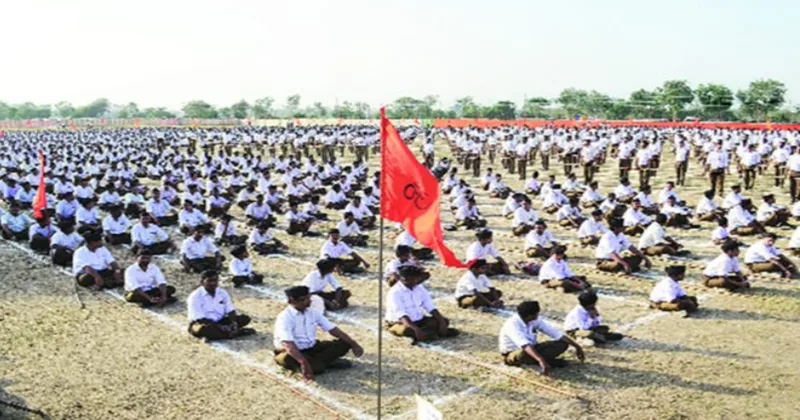
The true miracle of the Sangh is reflected in its daily practice. The Shakha serves as a laboratory for social unity—a place where everyone stands together, plays together, eats together, and prays together. Here, caste is never asked; only brotherhood is learned.
Beyond the Shakha, various organisations within the Sangh family embody this very spirit: Vanvasi Kalyan Ashram, dedicated to education, health, and self-reliance in tribal areas; Sewa Bharati, which runs service projects in urban slums and rural hinterlands; and Vidya Bharati, which imparts value-based education to children irrespective of their caste identity.
The ancient adage remains memorable here:
“Janmana Jayate Shudrah, Sanskarad Dwija Uchyate.” (Manusmriti 2.157)
This means that respect is determined not by birth, but by one’s deeds and values (Karma). This is the life mantra of the Sangh.
The Sangh’s Centenary Journey: A Trinity of Remembrance, Service, and Resolve
The centenary journey of the Sangh is not merely a celebration; it is a profound exercise in collective introspection. It is a pilgrimage of the national conscience, defined by three distinct dimensions: a journey of Remembrance (Smaran), recalling the historic moments when society lit the lamps of harmony—such as the
Udupi resolution—and when temples and water sources were opened to all. A Journey of Service (Sewa)
Reawakening the spirit of dedication and cooperation in villages, tribal settlements, and among deprived sections of society.; A Journey of Awakening (Jagran): A moment for every individual to ask themselves a hard question: “Does any trace of discrimination still linger in my mind?”; A Journey of Resolve (Sankalp): To reiterate the pledge— “Na Hindu Patito Bhavet” (No Hindu is fallen).
This collective consciousness echoes the ancient call of the Vedas:
“Sangacchadhwam Sam Vadadhwam Sam Vo Manansi Janatam.
Deva Bhagam Yatha Purve Sanjanana Upasate.” (Atharvaveda 3.30.6)
Meaning: “Walk together, speak together, and let your minds think as one, just as the ancestors and deities accepted their share of duties and worked together for the collective welfare.” This very spirit manifests today in the Sangh’s centenary year, where remembrance, service, and resolve flow in a single stream.
The ‘Panch Parivartan’: A Blueprint for Social Upliftment
In this centenary year, the Sangh has delivered a message of holistic societal upliftment through its “Panch Parivartan” (Five Transformations). Through these five dimensions—Social Harmony, Family Awakening, Swadeshi Self-reliance, Civic Duty, and Environmental Sensitivity—the Sangh clarifies that India’s future lies not just in technical progress, but in cultural balance and social integration.
The Panch Parivartan is, in a sense, a modern iteration of the Vedic ideal where every individual in society is driven by a spirit of shared welfare. Thus, this journey is not a memory of the past, but a cultural resolve for the future—to build a self-reliant, coordinated, and harmonious society based on service and integrity.
Harmony is Sanatan Dharma
Social harmony (Samarasata) has always been the fundamental element of Indian culture. From religious texts to local customs, the message has always been one of equality and brotherhood. While the social fabric may have weakened throughout history due to external influences and specific historical circumstances, this erosion was never a result of a philosophical flaw in our Dharma.
Saints like Ravidas, Kabir, Tukaram, and Namdev all reiterated the same truth: discrimination is Adharma (unrighteousness), and equality is Dharma. As Dr. Krishna Gopal has eloquently stated, “The Saint tradition bound Indian life in a thread of inclusive compassion and equality.”
Harmony—The Soul of Unity
The hundred-year journey of the Sangh proclaims a singular truth: “There is no Hindu unity without social harmony, and no national rise (Rashtrodaya) without Hindu unity.” When the Sangh Centenary procession traverses India, it will not be a mere march; it will be a flow of cultural consciousness, carrying the fragrance of equality, service, and affection. It is both a remembrance and a resolve—that in the coming century, India’s power will not be measured by numbers or borders, but by the unity of hearts.
Social harmony is Dharma. It is the life force of Hindu unity and the very soul of India’s Renaissance.