
“This, brethren, is a short sketch of the religious ideas of the Hindus. The Hindu may have failed to carry out all his plans, but if there is ever to be a universal religion, it must be one which will have no location in place or time; which will be infinite like the God it will preach, and whose sun will shine upon the followers of Krishna and of Christ, on saints and sinners alike; which will not be Brahminic or Buddhistic, Christian or Mohammedan, but the sum total of all these, and still have infinite space for development; which in its catholicity will embrace in its infinite arms, and find a place for every human being, from the lowest grovelling savage not far removed from the brute, to the highest man towering by the virtues of his head and heart almost above humanity, making society stand in awe of him and doubt his human nature. It will be a religion which will have no place for persecution or intolerance in its polity, which will recognise divinity in every man and woman, and whose whole scope, whose whole force, will be created in aiding humanity to realise its own true, divine nature.”
– Swami Vivekananda, Paper on Hinduism, Read at the Parliament of Religions at Chicago on September 19, 1893
“All human beings are born free and equal in dignity and rights”, declares Article 1 of the Universal Declaration of Human Rights (UDHR). The Preamble to the declaration recognises, ‘the inherent dignity’ and ‘the equal and inalienable rights’ of all members of the human family, as the foundation of freedom, justice and peace in the world. Unfortunately, when it comes to Hindus or all Indic religions that originated in Bharat, there is neither inherent dignity nor equality of rights. The recent Thiruparankundram Karthigai Deepam Case at the Subramaniya Swamy Temple, Madurai, in Tamil Nadu, is just another case of the denial of the fundamental right of worship to Hindus. Such a denial of rights to all Indic religious practices is not an exception but a rule due to the flawed nature of the human rights discourse.
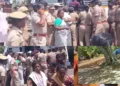
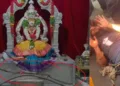
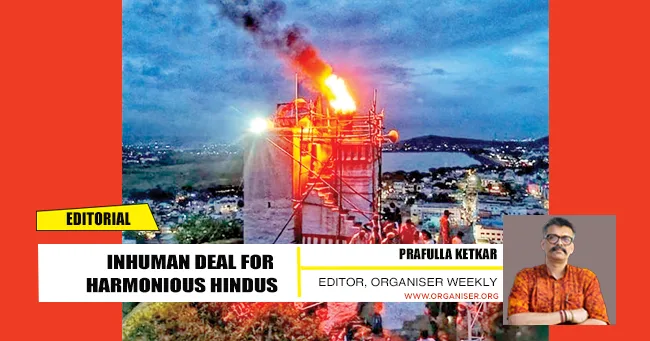
On Kartik Pournima (the full moon day) in the Hindu calendar, which fell on December 4-5 in 2025, most temples have a ritual of lighting lamps as a symbol of the triumph of good over evil. The lamppost at the Thiruparankundram Subramaniya Swamy Temple hill in Madurai is an ancient religious site considered to be the most sacred place to light a Diya (lamp) in the Tamil tradition, and the ritual has been followed for centuries. Since 2011, an organisation called the Social Democratic Party of India (SDPI), a subsidiary political outfit of the banned terror outfit Popular Front of India (PFI), has been raising issues by erecting a flag near a lamp post on Thiruparankundram hill. The notoriously fundamentalist Islamist violent group have also been claiming the right to sacrifice goats, cows, and chickens at the sacred hill, brazenly threatening even the police. The hilltop is claimed as Waqf property, with the construction of a Dargah, which is usually considered an un-Islamic practice by Islamic scholars. Hindu devotees, through a court order, secured the right to light the lamps by demonstrating historical precedent, prior judicial rulings, and the site’s uninterrupted Hindu character since antiquity. The Madurai bench of the High Court issued a clear and categorical directive to the temple’s management, which is governed by the controversial Hindu Religious & Charitable Endowments Department (HR & CE). It restored the right to light the Karthigai Deepam, describing it as a “well-established, customary tradition supported by overwhelming literary and historical evidence.” Despite all these efforts, the secular appeasement garbed under Dravidianism chose to stand by a fundamentalist group denying the basic and simple right to worship to Hindus in their own temple.
Hindu religious practices are the most inclusive and harmonious, with all kinds of worship, ranging from the formless Almighty to multiple forms of Gods – thanks to the core philosophy of omnitheism, which sees divinity in all existence. There is no binary thought of believer and non-believer; hence, all ways are considered to be true and acceptable as a form of worship. This unique character of spiritual democracy makes Hindu traditions universal, as Swami Vivekananda explains. In drafting the UDHR, the term ‘human’ found its place, replacing ‘man’, also due to a Hindu woman, Dr Hansa Mehta. Instead of recognising this strength of being Hindu, the English-speaking secular elite, along with the evangelical and Islamist forces, gang up to exploit it as a weakness.
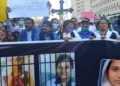
Hindus are a minority in the global context and still face allegations of majoritarianism. The most ancient and scientific civilisation that taught the entire world how to balance spirituality and material prosperity is not recognised for its contributions. The torchbearers of universal religious practices are humiliated as backwards, cow and monkey worshippers, idolaters, polytheists, non-believers and kafirs. The secular intellectuals who apply the Anglo-Saxon parameters of separating Church from the State do not realise that Dharma is not religion and religious practices are an inherent part of showing reverence to the omnipresent existence of divinity. The Hindu festivals are ridiculed and targeted in the name of environmentalism and modernity. Various faultlines are used to convert and uproot the innocent people. The calculated measures, such as illegal migration in Bharat and demographic imposition on Hindus, are intellectually justified. All this is done in the name of a civilising and equalising mission by human rights activists, while institutionalising discrimination.
In Bharat, where people practising the Sanatan Dharmic practices are still around 80 per cent, survived series of onslaughts and colonisations over the centuries, still face inhuman denial of rights in the name of secularism. What must be the state of affairs where they are actually a minority? In the partitioned territories of Pakistan and Bangladesh, they face systemic persecution in the name of blasphemy laws and forced conversions. Many countries do not permit even cremation grounds; forget about the temples to the Hindu sects. The Anglo-Saxon world has a strong racial bias against Hindus, and there are various justifications for the same.
Fortunately, Hindus are waking up and asserting themselves with the knowledge traditions rooted in seeking truth rather than just worshipping. They are fighting the legal and intellectual battle against the biased world. The quest for civilisational justice and reclamation of destroyed temple sites has become a collective desire. Many are reconnecting with their roots and opting for Ghar Wapsi by returning to the Hindu fold. A few attempts, like the International Centre for Cultural Studies (ICCS), are being networked pre-monotheistic traditions through Elderly Conferences. The so-called modern scientific forces are rattled by this upsurge of the ancient and harmonious practices; hence, more outrage against the Hinduness.
The Human rights discourse originated in the Western milieu, where the fight against the organised Church was considered modern and scientific. The separation of Church and State was seen as a guarantee for rights. Naturally, Anglo-Saxon intellectuals tend to universalise their experiences. Their contempt for the erstwhile colonies and colonised is evident; therefore, Hindus can never be humans for them unless they give up Hinduness. For Islamists, non-Muslims do not and cannot have equal rights. In fact, they are not supposed to exist. Communists talk about people’s rights by cancelling and eliminating everyone who disagrees with their model of class struggle and violent revolution. Unless these ideologies based on binaries do not expand the human rights discourse to universal philosophy of Hinduness – where harmony with all human beings, animals, nature and inanimate things is considered divine – the present framework of human rights would offer only an inhuman deal for Hindus.