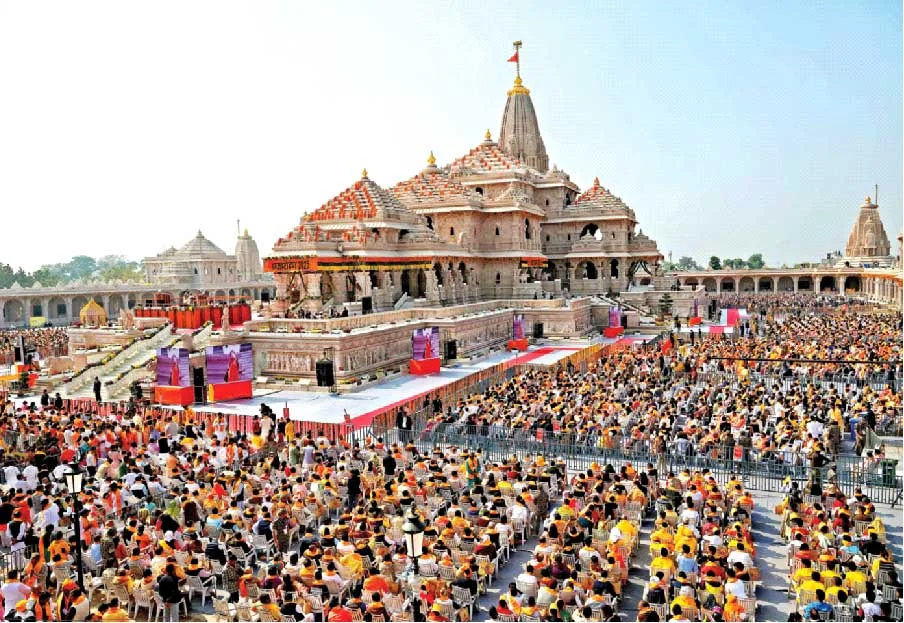
Today, the entire Bharat and the world is Rammay. There is extraordinary satisfaction in the heart of every Ram devotee. There is boundless gratitude. There is unfathomable supernatural bliss. The wounds of centuries are being healed. The pain of centuries is being put to rest today. The resolve of centuries is being fulfilled today. Today is the completion of that sacrifice whose fire remained lit for 500 years,” said Prime Minister Narendra Modi while addressing the gathering on the occasion of Dhwajarohan ceremony atop Shri Ram Mandir, Ayodhya on November 25, 2025.
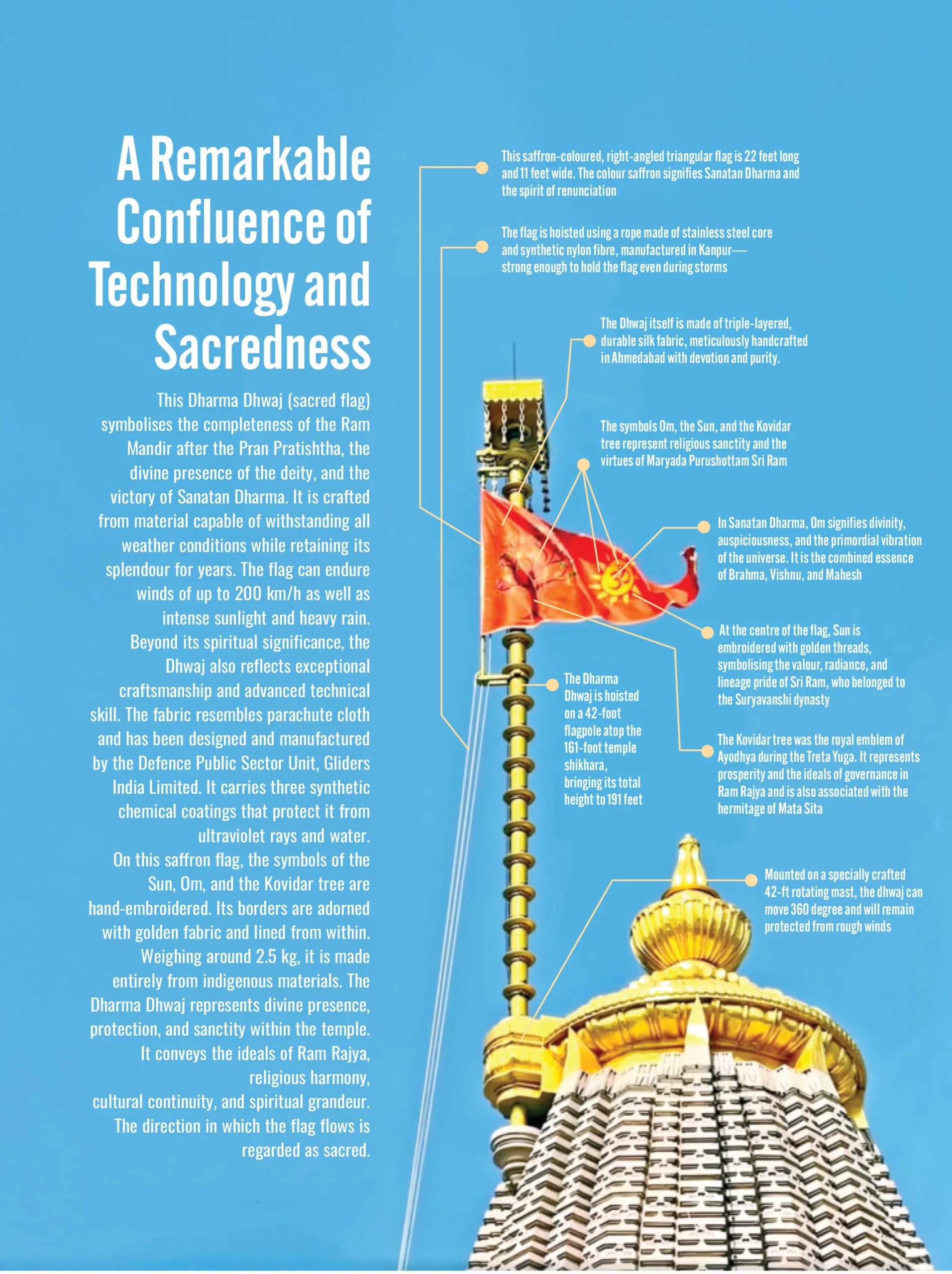
He said that the Dharma Dhwaj, established at the shikhar of the grand Ram Temple, carries profound symbolic significance.
Elaborating on the symbolism of the flag, PM Modi noted that it reflects the rebirth of an ancient civilisation and embodies the ideals of Ram Rajya. “This Dharma Dhwaj is not just a flag, it is the flag of the rejuvenation of Bharatiya civilisation. The saffron colour, the insignia of Suryavansh, the Om word, and the Kovidara tree impersonate Ram Rajya’s glory. This flag is a resolution, a success, a story of struggle to creation, a physical form of the struggle of hundreds of years. For the coming thousands of centuries, this flag will proclaim Bhagwan Ram’s values. Truth is Dharma. There should be no discrimination or pain, and there is peace and happiness. There should be no poverty, and no one is helpless,” he said.
Describing the hoisting of Dharma Dhwaj atop the Ram Janmabhoomi Temple in Ayodhya as “historic,” PM Modi said Bharat must simultaneously draw strength from its heritage and free itself from “the slave mentality” to achieve the goal of becoming a developed nation by 2047.
PM Modi invoked the values associated with Bhagwan Ram to underline the vision of building a “confident” and “future-ready Bharat”. “Ram is not a person, he is a samskar. If we want to make Bharat developed by 2047, we have to awaken Ram within ourselves. What day can be better than today for this resolution,” he said.
PM Modi emphasised that “Bhagwan Ram connects through emotion”, reaffirming that devotion and cooperation form the core of Bharatiya society.
Reflecting on Bharat’s development journey of the past decade, he said, “In the last 11 years, every section of society women, Dalits, backward classes, extremely backward classes, tribals, the deprived, farmers, workers, and youth has been placed at the centre of development.”
Pointing out that by 2047, when the nation marks 100 years of Independence, PM Modi said the “goal of building a Viksit Bharat must be fully realised”. He urged citizens to act with a vision, keeping future decades and centuries in mind.
“We must strengthen the foundation of Bharat for the next 1,000 years. Those who think only about the present do injustice to future generations. This nation existed even before us, and it will continue to exist even when we are no longer here,” PM Modi further said.
“Asserting that this historic day of November 25 brings a moment of pride in our heritage. PM Modi said the reason is the Kovidar tree inscribed on the Dharma Dhwaj. “This Kovidar tree exemplifies that when we are cut off from our roots, our glory is buried in the pages of history. When the Kovidar is being re-established in the courtyard of the Ram Mandir, it is a rejuvenation of our identity. The Kovidar tree reminds us that when we forget our identity, we lose ourselves. If the country is to progress, it must be proud of its heritage,” he explained.
PM Modi also referred to the colonial-era introduction of English as the medium of instruction in Bharat by Thomas Macaulay in 1835, calling it the beginning of attempts to uproot Bharat from its sanskritik foundations. He stated that Bharat must resolve to free itself from the “slave mentality” by 2035, marking 200 years since the introduction of the Macaulay education system in 1835.
While addressing the gathering RSS Sarsanghchalak Dr Mohan Bhagwat described the Dhwajarohan ceremony at the Ayodhya Ram Mandir as a moment of “immense historical, emotional and spiritual significance.” He called it the realisation of centuries of collective aspiration, sacrifice and struggle.
Reflecting on the long movement leading to the construction of the Ram Mandir, Dr Bhagwat invoked the memory of key figures associated with the decades-long campaign. “Numerous people saw a dream, numerous people made efforts, and numerous people made sacrifices. Their souls must be full today,” he said, adding that, “Ashok ji (Singhal) must have felt peace today. Mahant Ram Chandra Das ji Maharaj, Dalmia ji and numerous sants, householders and students sacrificed their lives and worked hard.”
Dr Bhagwat emphasised that many who were not in the frontlines also played an important role. “Those who were in the background also kept hoping for the construction of the temple,” he noted.
Materials used in construction reflect pan-bharat participation
- Stones from Chhatarpur (MP) and Jalon–Hamirpur (UP)
- Granite for elevating plinth from Telangana and Karnataka
- Pink sandstone from Bharatpur (Rajasthan)
- White marble from Makrana (Rajasthan) and Ambaji (Gujarat)
- Master stone and marble artisans from Rajasthan
- Sculptors carving deities from Odisha
- Flagstaffs manufactured in Gujarat, flags produced at the Kanpur Ordnance Factory.
- Wood for temple doors from Ballarshah (Maharashtra); craftwork by artisans from Kanyakumari and Rajasthan.
- Gold for the temple donated by a donor from Mumbai.
- Bhagwan’s gold ornaments crafted in Lucknow and Surat; Ram Lalla’s attire by Delhi-based designer.
- All idols sculpted in Jaipur; main Shivaling from Bakawan village in MP.
- Structural iron used in various buildings sourced from Bhilai Steel Plant (Chhattisgarh).
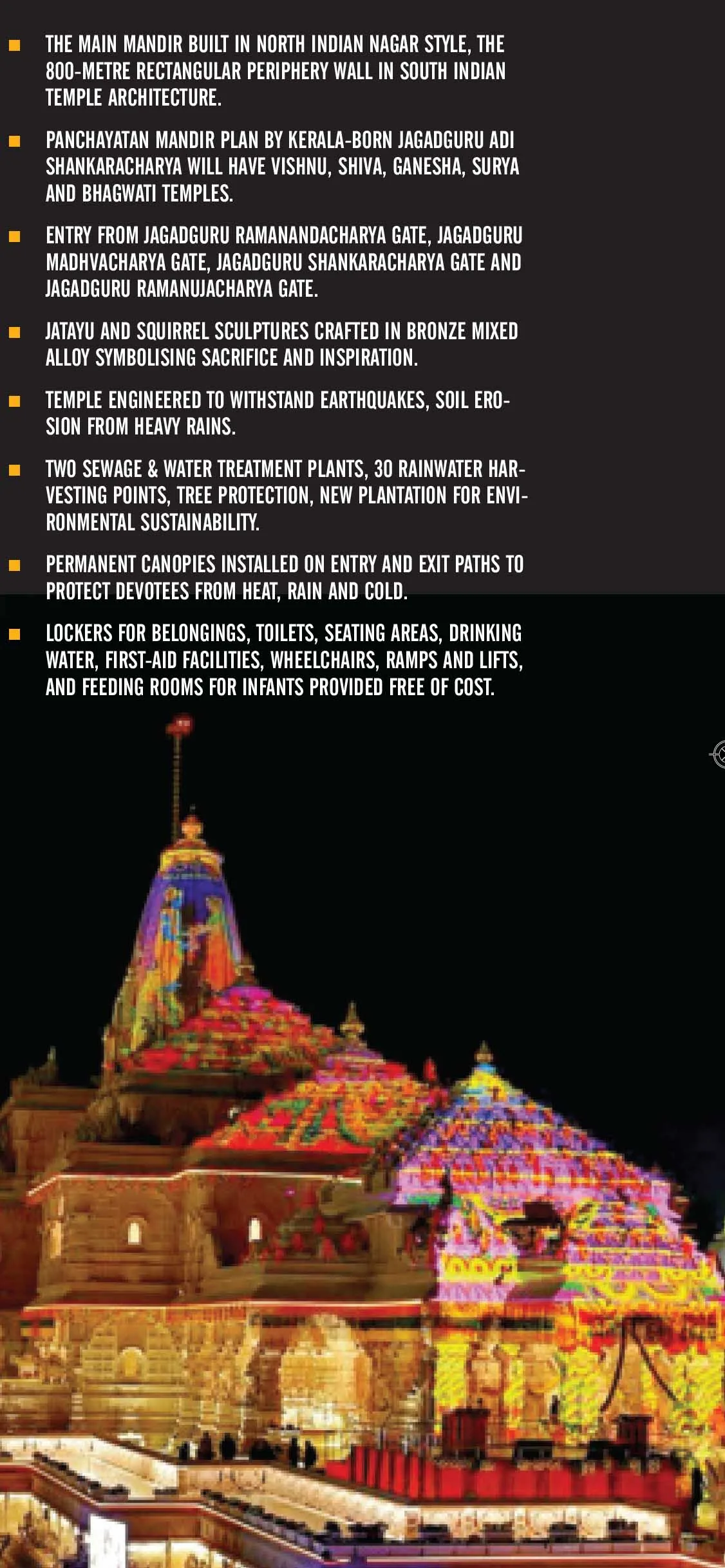
- Approximately 6.72 lakh cubic feet of granite, 14.15 lakh cubic feet of sandstone, and 14,000 cubic feet of Makrana marble used.
- Nearly 1,000 additional idols installed, around 3,000 carvings adorn the pillars and ceilings, and 7,000 designs hand-crafted after stone placement.
- Structural planning guided by experts from IIT Delhi, IIT Guwahati, NIT Surat, CBRI Roorkee, IIT Mumbai, IIT Kanpur, IIT Madras and NGRI Hyderabad.
Describing the ceremonial flag unfurled at the event, sarsanghchalak linked it to the ancient legacy of Ram Rajya — a model of just rule, peace and prosperity. “The dhwaj of Ram Rajya, which once flew high in Ayodhya and used to spread peace and prosperity to the world, is now seated at its ‘shikhar’ and we witnessed this happening,” he said.
Dr Bhagwat further said, “Through the temple, we have elevated certain principles to the highest peak, so that the whole world may move in righteousness. From individual and family life to the life of the entire creation—this is Dharma. The hoisting of this flag teaches us that the banner of our life must reach the peak, no matter the adversities. Even if the world is immersed in self-interest, our resolve must shine like the sun. For 500 years and throughout the long movement that followed, Hindu society upheld this spirit—and once Ram Lalla returned, the temple was completed. Let it be remembered that the work of describing Bharat as the giver of joy to the entire world has now begun. Seeing this symbol, we must remain courageous and strive together, even amidst all odds.”
Dr Bhagwat added that today is a day to reaffirm the resolve given by our ancestors. This country in which we were born is the most ancient—hence we are the elder brother to humanity. We must live such lives that the world learns the vidya of character and righteous living from the people of Bharat. We must build a Bharat that shares the fruits of development with all. This is the expectation of the world and our sacred duty. Sri Ram Lalla now resides in the temple; take His name and accelerate this noble work.
He stressed that the moment is not just symbolic but deeply spiritual. “The colour of this flag is Bhagwa, it is Dharma Dhwaj. The whole world will be run by that flag,” he said. Acknowledging the long struggle, Dr Bhagwat added, “It took time to build the temple. Even if you set aside the 500 years, it did take 30 years.”
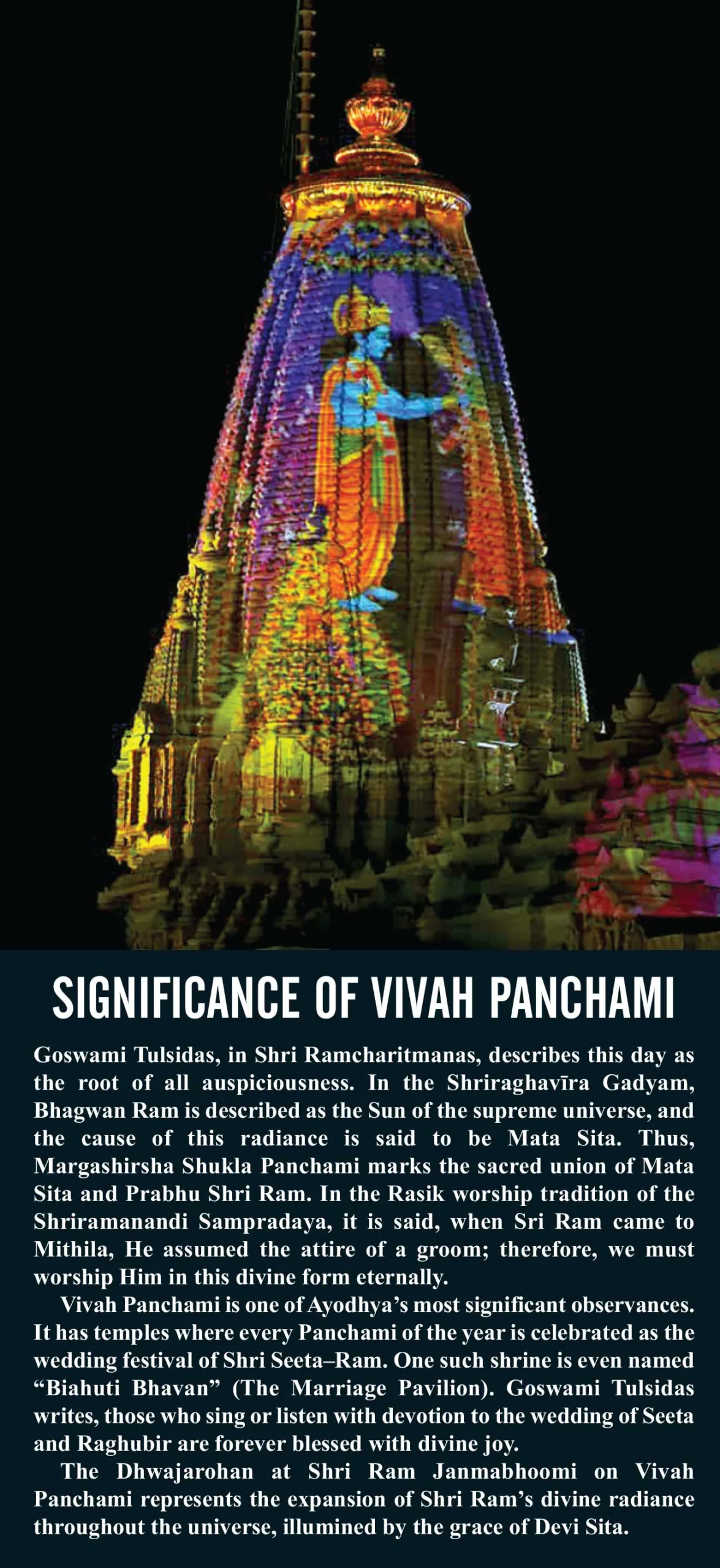
In his address Uttar Pradesh Chief Minister Yogi Adityanath said that the hoisting of the flag atop the magnificent mandir is not only the purnahuti of a great yajna, but also the auspicious beginning of a new era. The values of Ram Rajya are eternal. The longing of countless generations has taken form as this grand temple. This flag symbolises Dharma, maryada, national duty, and the vision of a developed Bharat. The Ramrajya ideal signifies a society where every person has access to food, healthcare, housing, and essential needs. This is the true proclamation of Ram Rajya.
“Empires and generations changed in the last 500 years. The only thing that did not change was commitment. When RSS got the leadership, there was only one slogan prevalent — Ram Lalla hum aayenge, mandir wahin banayenge. Lathi goli khayenge, mandir wahin banayenge” he said.
Describing the temple as a living testament to national pride and devotion. Yogi Adiyanath said “This grand temple is the symbol of 140 crore Bharatiyas’ faith and self-respect. I congratulate all the ‘Karmayogis‘ who sacrificed themselves for this. This flag is the proof that the light of Dharma is immortal and the principles of Ram Rajya are timeless,” he asserted.
The ‘Dharma Dhwaj‘ carries three sacred symbols — Om, the Sun and the Kovidara tree — each representing profound spiritual values rooted in the Sanatan tradition. Om is the eternal spiritual sound, the Sun represents Bhagwan Ram’s Suryavansh lineage, and the Kovidar tree is a hybrid of the Mandar and Parijat trees, created by Rishi Kashyap, showcasing ancient plant hybridisation.
Prime Minister Narendra Modi and RSS Sarsanghchalak Dr Mohan Bhagwat jointly completed the process of raising the flag to a height of 191 feet. Thousands of people from every community, overwhelmed with emotion, witnessed this day of fulfilment that arrived after five centuries of uninterrupted struggle. Before the ceremony, the Prime Minister and the Sarsanghchalak offered aarti and had darshan of Ram Lalla in the Ram Darbar.