
As India stands on the threshold of another Constitution Day, the nation does not merely celebrate a legal document; it celebrates the codification of a civilizational ethos that has thrived for millennia. The Bharatiya civilization has arguably been the original laboratory of democratic thought—from the ancient Sabhas and Samitis of the Vedic era to the Anubhava Mantapa of the 12th century. These were not just administrative bodies but manifestations of a culture that valued dialogue (Samvad) and consensus.
When the Constituent Assembly adopted the Constitution in 1949, it did not replace these values; it institutionalized them. To “Be Good and Do Good to the Constitution” in 2025 is to recognize that our modern democratic duties are deeply rooted in this heritage. It is a call to move from being passive beneficiaries of rights to active guardians of the Republic.
Civilizational Roots – Constitution
The civilization of a nation is profoundly and directly linked to the conscious responsibilities and duties of its citizenry. A nation’s progress and the quality of its societal fabric are not solely determined by its government, but rather constitute a reflection of the collective actions, ethics, and engagement of its populace.
The Constitution of India did not invent values for civilian society in the independent India; rather, it articulated a profound vision that was already inherent. It codified the civilizational basis of Dharma into the Rule of Law. It distilled the concept of Vasudhaiva Kutumbakam into Fraternity. The genius of the Indian Constitution resides in its four core pillars, which serve as the moral compass of the Nationhood.
“We, the People”
The preamble’s invocation of “We the People” is often viewed through the lens of Western liberalism. However, research into civilization reveals that the Constitution’s core pillars—Justice, Liberty, Equality, and Fraternity—are modern manifestations of the continuum of its civilizational traditions. For instance, the democratic spirit was vibrant in the Sabhas and Samitis of the Vedic era and the Anubhava Mantapa of the 12th century, which prioritized consensus over command.
The Constituent Assembly did not start ab initio but drew upon its enduring civilization’s value-based civic life. The core substance of these concepts is rooted in India’s intellectual tradition, prioritizing a sovereign, value-based, and well-being-oriented nationhood, profoundly articulated in foundational scriptures like the Vedas, Upanishads, and Epics. When Dr. B.R. Ambedkar and the Constituent Assembly crafted the Constitution, their work went beyond a mere legal framework; it was the formal embodiment of the civilizational values and aspirations, “Samgacchadhvam” (Let us walk together), transforming this profound prayer into the supreme law of the nation.
The Constitution endeavors to nurture “Fraternity” (Bandhuta) as the unifying principle of the Nation, thereby guaranteeing the “dignity of the individual.” This concept is a reflection of universal kinship and shared sentiment. The “Justice” articulated in the Preamble serves as the contemporary embodiment of Dharma and Ritam (Cosmic Order/Truth), establishing the foundation for Social, Economic, and Political activities. The provision for “Liberty (Swatantrata) of thought, expression, belief, faith, and worship” facilitates the existence of a pluralistic society. This further underscores the imperative of equally respecting and accommodating every belief, faith, and form of worship. Furthermore, the Preamble assures “Equality (Samata) of status and of opportunity.” This directly addresses and seeks to eliminate all forms of discrimination, aligning with the concept of inherent spiritual and social equality.
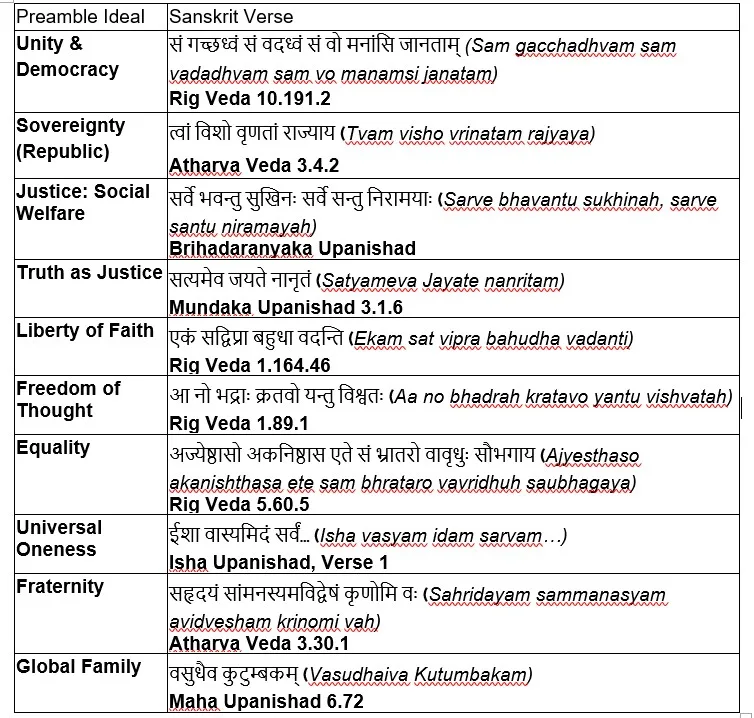
It is imperative to reflect upon the fundamental civilizational values and their intrinsic link with constitutional values, as this forms a prerequisite for comprehending and consciously endeavoring to embody them as a citizen. Below is a comparative analysis of the Preamble’s ideals and corresponding civilizational values, supported by relevant Sanskrit verses.
‘Being Good and Doing Good’ – Passive subjects to active citizens.
On the eve of the 76th Constitution Day (Samvidhan Divas), it is imperative for Indian citizens to move beyond passive adherence to the Constitution toward active “Constitutional Morality.” It argues that the Indian Constitution is not merely a colonial handover but a modern codification of civilizational values—specifically Dharma (Duty), Samvad (Dialogue), and Antyodaya (Welfare of the last person). By analyzing substantial examples from 2024-2025, including Digital Public Infrastructure (DPI) and indigenous defense sovereignty, this research illustrates how “Being Good and Doing Good to the Constitution” equates to reinforcing national sovereignty and self-reliance (Atmanirbharta).
Development as Dignity in Conflict Zones: From Authority to ‘Seva’
“Being and doing good” embodies constitutional ideals like Justice and Equality in civil service, making them concrete in last-mile service delivery. By 2025, a significant evolution was evident in administrative excellence, shifting the core focus from mere “governing” to proactive “empowering.” This change was formally recognized in the 2025 Prime Minister’s Awards for Excellence in Public Administration. Notably, officers such as Athar Aamir Khan (DC Kulgam) and Ayushi Sudan (DC Kupwara) of Jammu and Kashmir were honored for their work in regions historically marked by alienation. They successfully leveraged the constitutional framework to achieve a “saturation of welfare,” ensuring a comprehensive, 100% reach of critical flagship schemes, including Ayushman Bharat and Mission Indradhanush. This change, substituting a “security lens” with a “welfare lens,” restored citizen faith and exemplifies Constitutionalism, reinforcing the mandates of Article 21 and Article 38 by utilizing state power to maintain individual dignity and promote public welfare.
In late 2024, Jammu and Kashmir’s first Assembly Election in a decade faced security threats and voter apathy. CEO P.K. Pole and District Election Officers successfully ensured a “Free and Fair Election” (Articles 324 & 326) through extensive voter outreach and stringent security. The record turnout demonstrated the administrative machinery’s success, restoring “Democratic Faith” by prioritizing the ballot over the bullet and proving the Constitution’s efficacy in sensitive regions.
The Guardians of the Earth: Living the Fundamental Duties
The Constitution is often viewed as a menu of rights, the Padma Awards of 2024-2025 have honored “Unsung Heroes” embodying Fundamental Duties (Article 51A). Specifically, Articles 51A(g) and 51A(h) emphasize protecting the environment and fostering scientific temper and humanism.
Chami Murmu, the “Lady Tarzan” of Jharkhand, mobilized 30,000 women to independently plant over 30 lakh trees, viewing forest protection as a personal constitutional duty. Jageshwar Yadav dedicated his life to bridging the gap between the state and the marginalized Birhor tribes in Chhattisgarh, ensuring their healthcare and education. These citizens prove that defending the Republic—through environmental protection or social upliftment—requires no official badge.
Refuge for Future Generations: The “Climate Rights” Shield.
The Constitution’s inherent dynamic nature was recently exemplified by the M.K. Ranjitsinh Case (April 2024). This judgment illustrates the Constitution’s capacity to extend its protective scope to address nascent threats, specifically Climate Change. In the absence of a distinct statute safeguarding citizens from the detrimental impacts of climate change, the Supreme Court broadened the interpretation of Article 21 to incorporate the “Right to be free from the adverse effects of climate change.” This judicial expansion facilitates recourse for ordinary citizens, enabling them to initiate legal action against governmental bodies or corporate entities whose policies may compromise the environment, thereby securing a vital safeguard for posterity.
Champion of Social Equity
Divya Mittal (IAS) exemplified Article 46’s mandate to promote the educational and economic interests of weaker sections through her Participatory Governance model. In districts like Mirzapur and Deoria, she utilized “Jan Sunwai” (Public Hearings) to bring the Constitution to the village level. She collaboratively sourced solutions for rural schools and healthcare via social media, engaging the populace as active governance partners. Her work narrowed the “Ruler” and “Ruled” divide, ensuring efficient delivery of development funds and affirming the Preamble’s commitment to Equality of Status.
Samvidan – A Living Mandate
The Preamble attributes sovereign power to the collective entity designated as “The People.” This explicitly articulates the fundamental principle of collectivity and the concept of a collective consciousness. Dr. B.R. Ambedkar astutely warned that in the absence of Fraternity, Liberty and Equality would remain merely superficial concepts. Fraternity embodies the “We” inherent in “We the People.” Further, the phrase “We the People” is a moral mandate. It implies that the sovereignty of India is not just the responsibility of the soldier at the border but the citizen within the economy. To be good to democracy today requires a commitment to Atmanirbharta (Self-Reliance). A nation dependent on others for its critical needs compromises its sovereignty.
The Indian Constitution institutionalizes the nation’s ancient civilizational ethos, not merely adopting a foreign legal framework. Its pillars—Justice, Liberty, Equality, and Fraternity—are modern expressions of deep-seated values like Dharma and Vasudhaiva Kutumbakam. Dr. B.R. Ambedkar cautioned that a Constitution is only as good as the people who execute it. “Being good” to the Constitution isn’t just about celebrating it once a year; it is about Constitutional Morality. This means adhering to the core norms of the Constitution—not just legally, but in spirit—in our daily lives. To truly support the Constitution and strengthen Democracy, we must move from being passive subjects to active citizens.