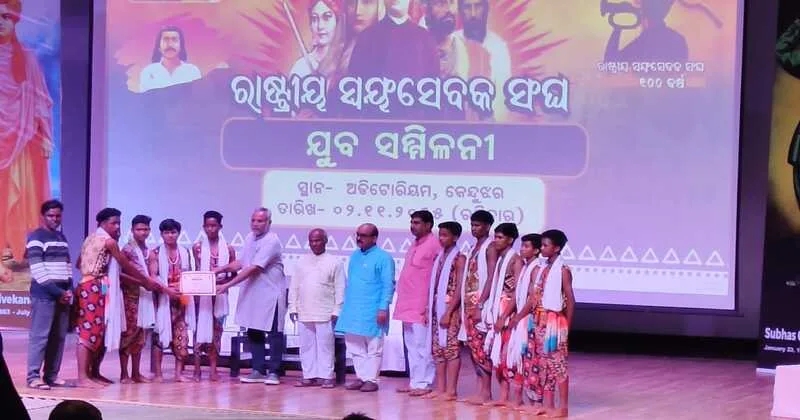
Guests at the Yuva Sammelan organised by the Rashtriya Swayamsevak Sangh in Kendujhar
Bhubaneswar: Speakers at the Rashtriya Swayamsevak Sangh (RSS) Yuva sammelan held in Keonjhar, Odisha, to mark the organisation’s centenary year emphasised that the true path to Bharat’s resurgence lies in ‘Swabodh’—a profound sense of self-awareness and national identity based on Bharatiyavalues. They asserted that by fostering this consciousness among citizens, particularly the youth, Bharat can achieve its rightful status as a prosperous and powerful nation.
Addressing the gathering, Tanmay Mahapatra, Boudhik Pramukh of RSS Odisha (Purv Prant), stated that Bharat must progress on the principles of ‘Swa’—which include Swadharma (self-duty), Swadeshi (self-reliance), and Swarajya (self-governance). He explained that Swadharma signifies the protection of one’s own culture and religion, Swadeshi denotes the promotion of indigenous thought and economic independence, and Swarajya encapsulates the restoration of governance systems rooted in Bharatiyatraditions and values.
Mahapatra noted that while Bharat achieved political independence on August 15, 1947, the journey towards true freedom remains unfinished. “Even after 78 years of independence, our governance system has not become fully self-reliant or anchored in our civilizational ethos,” he stated. “Mere political freedom is insufficient. It is equally vital that our identity as Bharatiya is recognised across every sphere of national life.”
He described Swabodh as the recognition and affirmation of Bharat’s cultural, civilisational, and moral distinctiveness. “In education, economics, science, health, and governance, we must reintegrate our own knowledge systems and perspectives. That is what true independence entails,” he emphasised.
Recalling the sacrifices of Bharat’s freedom fighters, Mahapatra acknowledged that the nation’s liberty was secured through the blood and bravery of countless patriots, including Veer Savarkar, Madan Lal Dhingra, Udham Singh, Bhagat Singh, Sukhdev, Rajguru, Jayee Rajguru, Buxi Jagabandhu, and Veer Surendra Sai. “Bharat did not liberate itself from foreign rule by chance,” he remarked. “It was the steadfast determination of these heroes who refused to let the spirit of ‘Swa’—our selfhood and pride—be extinguished.”
He further explained that successive invaders had long sought to subjugate Bharat, but their efforts faltered as long as Bharat’s cultural identity remained intact. “They ultimately realised that unless Bharat’s essence—its education, culture, and civilisation—was destroyed, the nation could never be subdued. Thus, they aimed to dismantle the very foundations of Bharat’s selfhood,” he stated.
Mahapatra continued, “it is our duty to revive that lost sense of Swabodh. Our ancestors sacrificed their lives to preserve our dignity, and we must now carry that mission forward by restoring our confidence and pride in everything that truly represents Bharat.”
He further emphasised that the integration of indigenous knowledge systems in education, health sciences, economics, vocational training, and space research is paramount. “To be a self-reliant nation, we must draw upon our own intellectual and cultural wealth,” he said.
The conference was presided over by Bhagirathi Prusti, the Sanghchalak of Keonjhar district, who emphasised that the centenary year of the RSS represents not just a milestone but also a call for national rejuvenation spearheaded by the youth. “The power to transform the nation lies in the hands of its young citizens, who must lead the way with a spirit of Swabodh and service,” he remarked.
In the second session, chaired by District Karyavah Binod Mahant, Satyaranjan Mahakud, the VibhagBoudhikpramukh of the RSS, addressed the gathering as the chief speaker. He spoke about Bharat’s glorious past, its evolving present, and its promising future, asserting that the nation’s ancient wisdom continues to influence the world even today.
“Bharat has a long and proud history of excellence in education, science, health, and philosophy,” Mahakud said. “Even now, the profound influence of Hindu culture can be seen in countries like Indonesia, Cambodia, the Philippines, and Vietnam. This cultural connection demonstrates the strength and timelessness of our civilisation.”
Mahakud highlighted that modern Bharat is progressing rapidly towards becoming a developed nation. “Our dream,” he stated, “is to see Bharat emerge as a fully self-reliant, prosperous, and globally respected nation—a true Vishwaguru.”
He urged the youth to take an active role in nation-building, asserting that the younger generation must internalise the spirit of Swa and contribute meaningfully to every aspect of national life. “If the youth take ownership of Bharat’s destiny with pride and purpose, the vision of a strong, self-reliant Bharat will surely be realised,” he added.
During the conference, several young achievers were recognised for their outstanding contributions across various fields. The event concluded with a vote of thanks from Malay Kumar Khanda, the District Mahavidyalaya Pramukh, who also conducted the proceedings.
