Chhattisgarh HC: Forced tribal conversions threaten India's unity
October 7, 2026
  • Read Ecopy
  • Circulation
  • Advertise
  • Careers
  • About Us
  • Contact Us
Android AppiPhone AppArattai
Organiser
  • ‌
  • Bharat
    • Assam
    • Bihar
    • Chhattisgarh
    • Jharkhand
    • Maharashtra
    • View All States
  • World
    • Asia
    • Europe
    • North America
    • South America
    • Africa
    • Australia
  • Editorial
  • International
  • Opinion
  • RSS @ 100
  • More
    • World Hindu Congress 2026
    • Op Sindoor
    • Analysis
    • Sports
    • Defence
    • Politics
    • Business
    • Economy
    • Culture
    • Special Report
    • Sci & Tech
    • Entertainment
    • G20
    • Azadi Ka Amrit Mahotsav
    • Vocal4Local
    • Web Stories
    • Education
    • Employment
    • Books
    • Interviews
    • Travel
    • Law
    • Health
    • Obituary
  • Subscribe
    • Subscribe Print Edition
    • Subscribe Ecopy
    • Read Ecopy
  • ‌
  • Bharat
    • Assam
    • Bihar
    • Chhattisgarh
    • Jharkhand
    • Maharashtra
    • View All States
  • World
    • Asia
    • Europe
    • North America
    • South America
    • Africa
    • Australia
  • Editorial
  • International
  • Opinion
  • RSS @ 100
  • More
    • World Hindu Congress 2026
    • Op Sindoor
    • Analysis
    • Sports
    • Defence
    • Politics
    • Business
    • Economy
    • Culture
    • Special Report
    • Sci & Tech
    • Entertainment
    • G20
    • Azadi Ka Amrit Mahotsav
    • Vocal4Local
    • Web Stories
    • Education
    • Employment
    • Books
    • Interviews
    • Travel
    • Law
    • Health
    • Obituary
  • Subscribe
    • Subscribe Print Edition
    • Subscribe Ecopy
    • Read Ecopy
Organiser
  • Home
  • Bharat
  • World
  • Operation Sindoor
  • Editorial
  • Analysis
  • Opinion
  • Culture
  • Defence
  • International Edition
  • RSS @ 100
  • Magazine
  • Read Ecopy
Home Bharat

“Mass vanvasis conversions threaten India’s unity and culture”: Chhattisgarh HC slams missionary-induced conversions

The Chhattisgarh High Court has warned that mass conversions of vanvasis by Christian missionaries threaten India’s unity, culture, and social harmony. It ruled that the constitutional right to propagate religion does not extend to conversions achieved through inducement, force, or fraud

WEBDESKWEBDESK
Nov 4, 2025, 12:30 pm IST
inBharat, Chhattisgarh
Follow on Google News
Facebook
Twitter
WhatsAppTelegramEmail

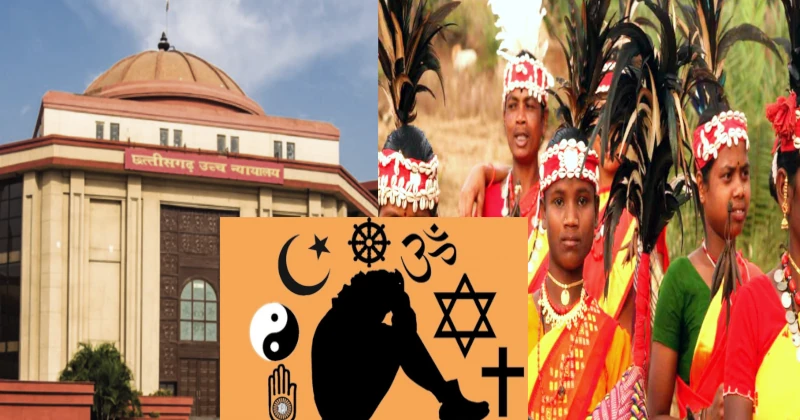
The Chhattisgarh High Court has warned that mass conversions of Scheduled Tribes by Christian missionaries are threatening India’s unity, cultural identity, and social harmony.

Delivering a strongly worded judgment while hearing a batch of petitions related to alleged restrictions on Christian missionaries in vanvasi villages, the Court held that the right to propagate religion under Article 25 of the Constitution does not extend to converting others through inducement, force, or fraud.

“The right to propagate religion does not mean the right to convert by inducement or fraud,” the Court observed, drawing a sharp distinction between voluntary faith and manipulative proselytisation.

The High Court noted that missionary activity in India, originally seen as an instrument of social service and education, has increasingly become a platform for proselytisation, particularly among the most vulnerable and marginalised vanvasi communities.

“Among economically and socially deprived sections, especially Scheduled Tribes and Scheduled Castes, this has led to gradual religious conversion under the promise of better livelihoods, education, or equality,” the Court remarked. What once appeared as social upliftment, the Court said, has in many cases turned into “a subtle instrument of religious expansion.”

The Bench expressed concern that such activities distort the essence of religious freedom and “amount to cultural coercion,” especially when carried out in areas inhabited by illiterate and impoverished families who are offered material benefits money, education, medical care, or jobs in exchange for conversion. “The menace arises when conversion ceases to be a matter of personal faith and becomes a result of inducement, manipulation, or exploitation of vulnerability,” the Court said.

Taking a broader socio-cultural view, the Court highlighted the long-term damage caused to India’s vanvasi heritage by these conversions. It observed that vanvasi communities have for centuries maintained a deep-rooted spiritual and cultural bond with nature, traditions, and local deities a connection now being eroded by organised religious campaigns.

“Conversion disrupts this organic connection. The erosion of vanvasi faiths often results in the loss of indigenous languages, rituals, and customary laws,” the Court noted. The Bench added that newly converted individuals often distance themselves from their traditional cultural practices and festivals, leading to polarisation within villages, social boycotts, and even violent clashes.

Moreover, religious conversion was found to influence political representation and constitutional benefits. The Court explained that since Scheduled Tribe and Scheduled Caste benefits are linked with religion, conversion can alter demographic patterns and political equations, creating new socio-political fault lines.

While upholding the constitutional right to freedom of religion, the Court stated that “India’s secular fabric thrives on coexistence and respect for diversity.” However, it warned that when religion becomes a tool for manipulation or mass conversion, it undermines both faith and freedom.

“When conversion becomes a calculated act of exploitation disguised as charity, it undermines both faith and freedom. The so-called ‘conversion by inducement’ by certain missionary groups is not merely a religious concern it is a social menace that threatens the unity and cultural continuity of India’s indigenous communities,” the Bench stated. The Court added that “the remedy lies not in intolerance but in ensuring that faith remains a matter of conviction, not compulsion.”

The observations came during the hearing of petitions challenging hoardings erected in at least eight villages of Kanker District, which stated that pastors and “converted Christians” were prohibited from entering.

Also Read: ‘Called and started masturbating’: Bengaluru woman harassed during morning walk in Indiranagar

The Court was informed that these hoardings were installed by Gram Sabhas under powers granted by the Panchayat (Extension to Scheduled Areas) Act, 1996 (PESA), following a circular by the State government.

However, after reviewing the facts, the Court clarified that the circular did not authorise discrimination against Christians in general. Instead, it found that the hoardings were intended to restrain entry for conversion-related activities, not to impose a blanket ban on individuals.

Referring to the Chhattisgarh Dharma Swatantrya Adhiniyam, 1968, the Court reiterated that conversion by inducement, force, or fraud is a punishable offence under the law. “The expression ‘right to propagate religion’ under Article 25 does not extend to converting another person through inducement, force, or fraudulent means. Therefore, a general cautionary hoarding intended to prevent illegal conversion activities cannot, per se, be termed unconstitutional,” the Court reasoned.


Topics: Christian MissionariesScheduled TribesVanvasi communitiesChhattisgarh HCChhattisgarh Dharma Swatantrya Adhiniyam
Share
Tweet
SendShareSend
✮ Subscribe Organiser YouTube Channel. ✮
✮ Join Organiser's WhatsApp channel for Nationalist views beyond the news. ✮
Previous News

UIDAI data shows Kerala records 4.09 cr Aadhaar cards against a population of 3.6 cr, highlighting possible duplication

Next News

“Bangladeshi infiltrators were given free rein to spread anarchy throughout Bihar”: UP CM Yogi

Related News

The SC/ST Act protects against caste-based atrocities, but its implementation must remain rooted in evidence and due process

SC/ST Act and Legal Advocacy: How prejudice and unsubstantiated claims can complicate cases and undermine justice

Two Supreme Court cases have put India’s constitutional safeguards for tribal land, representation and self-governance under renewed scrutiny

Demography as a Weapon: The Supreme Court’s twin test on tribal protections

When Faith Becomes Data: What the Joshua Project reveals about missionary targeting in India!

The debate over ‘Vanvasi’ has sparked political controversy, raising questions over tribal identity and constitutional rights (This image is generated by AI)

Why is there so much objection to the term ‘Vanvasi’? Read the Constitution, then raise your questions!

MEA slams US lawmakers for criticising FCRA amendments

MEA slams foreign criticism on FCRA amendments; Dismisses interference in India’s legislative affairs

A representative image

Missionary activities under scanner in Bengal: Allegations of tribal conversions, foreign funding spark local backlash

Load More

Latest News

Research history, spirit and national impact of Vande Mataram; study forces opposing it, says Keralam Governor Arlekar

Tamil Nadu: Centre tells SC it does not want to reopen Katchatheevu issue with Sri Lanka

PM-JANMAN and DA-JGUA Is Reshaping Indian Tribal Villages

How PM-JANMAN and DA-JGUA are reshaping India’s tribal villages

PM Narendra Modi

25 Years of Public Service Narendra Modi: From Vadnagar to the Global Stage

High Court comes down heavily on Kerala PSC: Planning Board appointment a serious anomaly, not clerical lapse

Madras HC says Abrahamic religions are exclusive while Hinduism is inclusive, cites it while denying FCRA registration

Tamil Nadu: Muslim Jamaat orders outside traders to leave village before 7 pm; Hindu Munnani condemns diktat

5 Bangladeshi intruders arrested by Assam Police

5 Bangladeshi intruders arrested in Guwahati on way to Mumbai with fake Indian IDs; Crackdown continues in Assam

Protesters hold a Palestinian flag on the day French high school and university students attend a demonstration in Strasbourg on October 6,2026.

France unrest shows how radical left and Islamist networks turn common grievances into platforms for wider agendas

25 years of PM Modi's governance

25 Years Of PM Modi Governance: The first Prime Minister of India’s algorithmic generation

Load More
  • Privacy
  • Terms
  • Cookie Policy
  • Refund and Cancellation
  • Delivery and Shipping

© Bharat Prakashan (Delhi) Limited.
Tech-enabled by Ananthapuri Technologies

  • Home
  • Search Organiser
  • Bharat
    • Assam
    • Bihar
    • Chhattisgarh
    • Jharkhand
    • Maharashtra
    • View All States
  • World
    • Asia
    • Africa
    • North America
    • South America
    • Europe
    • Australia
  • Editorial
  • Operation Sindoor
  • Opinion
  • Analysis
  • Defence
  • Culture
  • Sports
  • Business
  • RSS @ 100
  • Entertainment
  • More ..
    • Sci & Tech
    • Vocal4Local
    • Special Report
    • Education
    • Employment
    • Books
    • Interviews
    • Travel
    • Health
    • Politics
    • Law
    • Economy
    • Obituary
  • Subscribe Magazine
  • Read Ecopy
  • Advertise
  • Circulation
  • Careers
  • About Us
  • Contact Us
  • Policies & Terms
    • Privacy Policy
    • Cookie Policy
    • Refund and Cancellation
    • Terms of Use

© Bharat Prakashan (Delhi) Limited.
Tech-enabled by Ananthapuri Technologies