The Indian Space Research Organisation is all set to launch its latest mission with nation’s most powerful rocket, Launch Vehicle Mark-3 or LVM3-M5. On board will be CMS-03, a next-generation communication satellite designed exclusively to enhance the operational capabilities of the Indian Navy.
The mission signifies the capabilities of India’s growing aatmanirbharta in space-based defence communication. The satellite will replace the decade-old GSAT-7 (Rukmini) that has been an important part of India’s naval network since 2013. Weighing 4,410 kg, CMS-03 will be the heaviest communication satellite ever launched from Indian soil into a geosynchronous transfer orbit, once again underlining ISRO stature among the world’s elite space agencies.
From Rukmini to CMS-03: A Strategic Evolution
The journey started with GSAT-7 (Rukmini), launched in August 2013 from French Guiana by Arianespace. It provided the Indian Navy with its first dedicated communication platform, ensuring secure real-time connectivity across warships, submarines and aircraft. During Operation Sindoor, Rukmini played crucial role by enabling network-centric warfare and situational awareness in a way that helped India keep its strategic supremacy intact.
But over a decade later, the demands of naval operations have changed. India’s growing maritime footprint-from the Indian Ocean Region to the Western Pacific, need wider, faster, and encrypted communication coverage. The CMS-03, with its ability to operate across multiple frequency bands and to provide secure links within 2,000 km from Indian coastline.
LVM3-M5: Heavy-Lift Symbol of Aatmanirbhar
Standing 43.5 metres tall or as tall as a 15-storey building and weighing 642 tonnes, the LVM3-M5 embodies the indigenisation drive of India. Nicknamed as ‘Baahubali’ for its sheer power, the launcher has completed seven missions in a row, including the historic Chandrayaan-3 in 2023.
LVM3 is a three-stage vehicle propelled by solid, liquid and cryogenic stages. The Cryogenic Stage C25 was indigenously developed at the Liquid Propulsion Systems Centre of ISRO. This technological achievement signifies technological maturity and self-reliance for India. It is one of the cost-effective heavy-lift systems with each launch costing around Rs 500 crore.
The LVM3 is also the launch vehicle of choice for the Gaganyaan human spaceflight mission of India, underlining its reliability and versatility. With CMS-03, it is once more proving that India space engineering is not confined to the area of exploration but is equally valuable for national defence.
Why India Needs CMS-03 Now
The naval requirements have changed over the past decade in India. At a time when maritime challenges are on the rise, piracy, smuggling and geopolitical tensions in the Indian Ocean Region needs secure satellite communication for strategic dimensions.
The CMS-03 will ensure independent communication without dependence on foreign satellites or systems and protect sensitive data and command signals. It will strengthen India’s ability to coordinate multi-domain operations: integration of naval, air and coastal defense systems in real time.
India is now expanding its maritime partnerships, especially under initiatives like SAGAR (Security and Growth for All in the Region) and Indo-Pacific cooperation, needs a high-capacity indigenous communications satellite to enable its coordinated missions and regional stability. The CMS-03 joins India growing constellation of defence-oriented satellites serving various branches of the armed forces.
• GSAT-7 (Rukmini) – Launched in 2013 for Navy
• GSAT-7A: Launched in 2018 for the Indian Air Force.
• EMISAT: Launched in 2019 for electronic intelligence.
• RISAT series: Used for radar imaging and surveillance operations.
Each of these has played a particular role in building a network-centric warfare capability, enabling smooth coordination across land, air and sea. The CMS-03 offers the next in line with its increased power and secure transmission capability, bridging the next phase of communication dominance.
Engineering Precision and Timely Execution
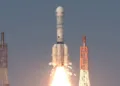
The 24-hour countdown for CMS-03 commenced at the Satish Dhawan Space Centre in Sriharikota on November 1, after final integration and pre-launch checks. The satellite and the launcher have been moved to the second launch pad, ready for the 5:26 PM lift-off window.
According to ISRO, the 16-minute flight of the LVM3-M5 will place CMS-03 into a Geosynchronous Transfer Orbit-an elliptical orbit from which it will move to its final geosynchronous slot for continuous coverage over Indian maritime region.
ISRO expert informed “All systems are GO as we move closer to liftoff” through social media update. This confidence is derived from several years of tested reliability, since the 2014 CARE (Crew Module Atmospheric Re-entry Experiment) mission, every LVM3 mission has been successful and this reflects India’s consistency in heavy-lift operations.
Space has indeed emerged as the new frontier of national security and Indian defence strategy is increasingly dependent on its orbital assets. With CMS-03, the Indian Navy acquires a digital shield in the sky-a shield that enables encrypted communications, situational awareness and operational coordination all under India’s control.
The rocket ready to launched from Sriharikota, signals not merely another launch but a strategic ascent-from dependency to autonomy, from regional capability to global competence. CMS-03 embodies the fusion of science, sovereignty and security, thus reaffirming ISRO role as both a space pioneer and a national sentinel.