India-US defence pact charts a strategic decade ahead
July 12, 2026
  • Read Ecopy
  • Circulation
  • Advertise
  • Careers
  • About Us
  • Contact Us
Android AppiPhone AppArattai
Organiser
  • ‌
  • Bharat
    • Assam
    • Bihar
    • Chhattisgarh
    • Jharkhand
    • Maharashtra
    • View All States
  • World
    • Asia
    • Europe
    • North America
    • South America
    • Africa
    • Australia
  • Editorial
  • International
  • Opinion
  • RSS @ 100
  • More
    • Op Sindoor
    • Analysis
    • Sports
    • Defence
    • Politics
    • Business
    • Economy
    • Culture
    • Special Report
    • Sci & Tech
    • Entertainment
    • G20
    • Azadi Ka Amrit Mahotsav
    • Vocal4Local
    • Web Stories
    • Education
    • Employment
    • Books
    • Interviews
    • Travel
    • Law
    • Health
    • Obituary
  • Subscribe
    • Subscribe Print Edition
    • Subscribe Ecopy
    • Read Ecopy
  • ‌
  • Bharat
    • Assam
    • Bihar
    • Chhattisgarh
    • Jharkhand
    • Maharashtra
    • View All States
  • World
    • Asia
    • Europe
    • North America
    • South America
    • Africa
    • Australia
  • Editorial
  • International
  • Opinion
  • RSS @ 100
  • More
    • Op Sindoor
    • Analysis
    • Sports
    • Defence
    • Politics
    • Business
    • Economy
    • Culture
    • Special Report
    • Sci & Tech
    • Entertainment
    • G20
    • Azadi Ka Amrit Mahotsav
    • Vocal4Local
    • Web Stories
    • Education
    • Employment
    • Books
    • Interviews
    • Travel
    • Law
    • Health
    • Obituary
  • Subscribe
    • Subscribe Print Edition
    • Subscribe Ecopy
    • Read Ecopy
Organiser
  • Home
  • Bharat
  • World
  • Operation Sindoor
  • Editorial
  • Analysis
  • Opinion
  • Culture
  • Defence
  • International Edition
  • RSS @ 100
  • Magazine
  • Read Ecopy
Home World North America USA

India-US defence pact charts a strategic decade ahead: A calculated step from the perspective of New Delhi

In a world where the Indo-Pacific is increasingly contested, India now has a more robust foundation to shape outcomes rather than react to them. The defence pact may be the most visible element of this shift, but for India it signals something deeper: it is stepping into an era where it expects to be co-creator of regional security architectures, and not simply a beneficiary

Vedika ZnwarVedika Znwar
Nov 2, 2025, 10:00 pm IST
in USA, World, India, Defence
Follow on Google News
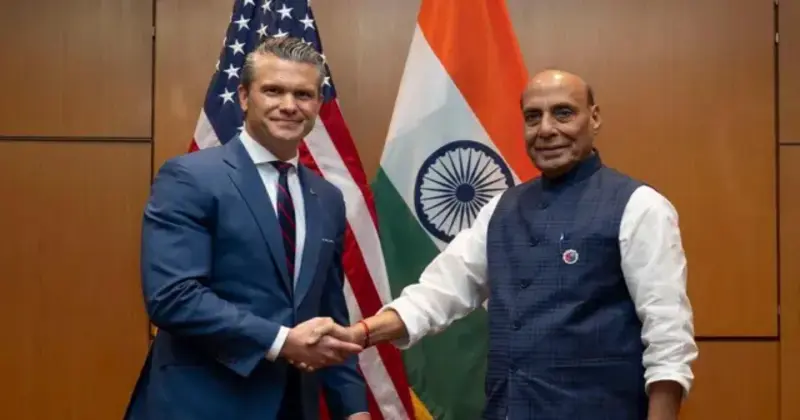
US Defence Secretary Pete Hegseth and Defence Minister Rajnath Singh

US Defence Secretary Pete Hegseth and Defence Minister Rajnath Singh

FacebookTwitterWhatsAppTelegramEmail

On October 31, 2025, India and the United States formalised a new ten-year defence framework — the Framework for the US‑India Major Defence Partnership. Signalling that despite intermittent friction in their broader relations, the strategic partnership remains robust and forward-looking. For India, this pact is less a rhetorical gesture than a clear acknowledgement of its rising status and of the mutual benefits of deeper defence ties. The deal underlines Delhi’s intent to leverage its geostrategic position, bolster its defence-industrial base and strengthen its role in a rapidly evolving Indo-Pacific environment.

The agreement, signed by India’s Defence Minister Rajnath Singh and U.S. Secretary of Defence Pete Hegseth on the sidelines of the ASEAN Defence Ministers’ Meeting-Plus in Kuala Lumpur, replaces and upgrades the earlier 2015 defence framework. The new pact explicitly seeks cooperation “across all domains – land, air, sea, space and cyberspace”, embraces defence-industry collaboration and interoperability and emphasises maritime domain awareness and joint logistics.

From India’s perspective, several factors make the timing and scope of this pact particularly significant. First, Delhi finds itself navigating a tougher regional security environment with continuing threats on its northern and western borders. A framework that deepens defence cooperation with the U.S. gives India access to advanced technology, enhanced intelligence and maritime networking opportunities in managing security challenges. The U.S. has already approved major sales – for example the multi-billion dollar contract for 31 MQ-9B drones.

Second, the pact aligns with India’s ambition of defence-industrial transformation. Under the headline framework, sits the growing collaboration in co­-production, R&D and technology transfer – for instance manufacturing jet engines (GE F404/F414) in India, leveraging the INDUS-X mechanism and building a more diversified equipment base. By signing a long-term defence pact, India signals to global industry that it is committed and stable as a partner, thereby strengthening its “Make in India – defence” narrative.

Third, this pact shows resilience in the face of temporary diplomatic and trade tensions. Earlier in 2025, the US had imposed steep tariffs on Indian exports – up to 50 per cent – as New Delhi faced pressure for its Russian oil imports. Yet, the defence channel between India and the U.S. remained largely insulated from the fallout. Indian analysts highlight that while economic and trade disagreements can flare, defence cooperation has built strong institutional momentum over years – from foundational pacts (LEMOA, COMCASA, BECA) to recurring joint exercises (for example, Yudh Abhyas). This demonstrates that India does not view the derailment of one dimension (trade) as a reason to pause another (strategic defence). In that sense, the new agreement conveys Delhi’s message: ties may strain, but strategic partnerships endure.

India stands to benefit from this pact in tangible ways. Enhanced maritime domain awareness and logistics linkages strengthen India’s role across the Indian Ocean Region (IOR) and in the broader Indo-Pacific. Given that the pact explicitly mentions a “free, open and rules-based Indo-Pacific”, India is better placed to assert its vision as a regional security provider rather than merely a recipient of external security guarantees. Secondly, by deepening interoperability with U.S. forces and defence industry, India reduces some of the risks of overdependence on any one supplier and builds a more independent defence posture. Thirdly, the strategic signalling value is high: partnering with the U.S. over a decade sends a strong message to regional actors (and competitors) alike about India’s strategic weight and the seriousness with which it is crafting its foreign and defence policy.

Looking ahead, the trajectory of India-U.S. relations under this pact is likely two-fold. On the defence-security front, we can expect more frequent and complex joint exercises, deeper intelligence sharing, maritime cooperation (including in the Indian Ocean and possibly West Indian Ocean littoral), and expanded defence-industry tie-ups. The ten-year horizon provides the temporal space for co-production and R&D agreements to mature rather than be limited to off-the-shelf procurement. On the diplomatic-economic front, the pact provides a stabilising anchor: even if trade or energy issues generate friction, the underlying defence architecture gives both sides a reason to maintain dialogue and coordination. The resilience exhibited in concluding this deal amid tariff tensions reinforces that function.

Also Read: Between Autonomy and Security: The delicate debate on Ladakh’s statehood and sixth schedule status

However, India also retains autonomy in how it operationalises this relationship. The pact does not mean alignment in every foreign policy domain; India will continue its multi-vector approach – engaging Russia, maintaining its strategic autonomy and catering to national priorities. Indeed analysts note that while the defence tie-up with the U.S. deepens, India continues to procure Russian systems and balance its diplomatic engagements accordingly. In practical terms, India must ensure that co-production commitments do not remain mere announcements and that technology transfer is meaningful rather than symbolic. For Delhi, the next challenge will be leveraging this framework in creating a domestic defence innovation ecosystem that generates indigenous capability, not just assembly lines.

From India’s vantage point, the new decade-long defence pact is a strategic investment. It underscores that despite episodic discord, the India-U.S. strategic relationship has matured beyond ad-hoc deals to institutionalised partnership. Delhi benefits by gaining strengthened capability, diplomatic leverage and industrial impetus; at the same time, it preserves its freedom of action. In a world where the Indo-Pacific is increasingly contested, India now has a more robust foundation to shape outcomes rather than react to them. The defence pact may be the most visible element of this shift, but for India it signals something deeper: it is stepping into an era where it expects to be co-creator of regional security architectures, and not simply a beneficiary.


Topics: IndiaIndo-PacificUnited StatesBilateral relationsIndia-US Defence Framework
ShareTweetSendShareSend
✮ Subscribe Organiser YouTube Channel. ✮
✮ Join Organiser's WhatsApp channel for Nationalist views beyond the news. ✮
Previous News

J&K: LG Manoj Singh remembers Dr. Rahi Masoom Raza as an unparalleled author rooted in traditions of Bharat

Next News

Bihar: PM Modi holds roadshow in Patna & takes a sharp jibe at Congress-led Mahagathbandhan; Assures farmers prosperity

Related News

Prime Minister Narendra Modi and New Zealand Prime Minister Christopher Luxon

India-New Zealand Strategic Partnership: A new horizon for New Delhi’s economic diplomacy

Economic resilience of India amid West Asia crisis

Bharat’s Data Centre Moment: From digital consumer to trusted technology power

Different shades of diplomacy and foreign policy

Prime Minister Narendra Modi and Indonesia President Prabowo Subianto

Beneath BrahMos: PM Modi’s Indonesia visit and the strategic deal underlining nickel

India and Indonesia Strengthen South-South Cooperation (This image is AI generated)

India-Indonesia Partnership – Ultimate fulcrum for global south framework

Load More

Latest News

A represetative image

PMFME crosses 2 lakh beneficiaries: How the scheme is driving India’s grassroots food processing revolution

Karnataka Public Service Commission (KPSC) Chairman Shivashankarappa S. Sahukar

Karnataka: Daughter of KPSC chairman booked for submitting false income & fake caste certificates during recruitment

Prime Minister Narendra Modi and New Zealand Prime Minister Christopher Luxon

India-New Zealand Strategic Partnership: A new horizon for New Delhi’s economic diplomacy

Legendary playback singer S S Janaki (File Photo)

Tamil Nadu: Legendary playback singer S Janaki cremated in Mysuru with full state honours

The Fragile Truce: Why the US-Iran peace deal mediated by puppet Pakistan is primed for collapse

Chariots near completion for Mahaprabhu Jagannath's sacred Shree Gundicha Yatra

Odisha Rath Yatra 2026: Nabajaubana darshan duration curtailed; Dashamula Modak to be offered during Anasara rituals

Karnataka: Sexual exploitation by Muslim trainer Ismail at Davanagere gym sparks outrage; Hindu Groups demand action

ABVP calls for NIA probe into the murder of Savariya Basant and wants the angle of organised conversion network to be looked into

Savariya Basant murder in Uzbekistan: ABVP demands exemplary punishment for the culprits

J&K: Govt cracks down on terrorism propagated through books; Orders inspection of curriculum in all schools

A representative image

From villages to national markets: How eSaras is empowering 8.99 crore SHG members through rural digital commerce

Load More
  • Privacy
  • Terms
  • Cookie Policy
  • Refund and Cancellation
  • Delivery and Shipping

© Bharat Prakashan (Delhi) Limited.
Tech-enabled by Ananthapuri Technologies

  • Home
  • Search Organiser
  • Bharat
    • Assam
    • Bihar
    • Chhattisgarh
    • Jharkhand
    • Maharashtra
    • View All States
  • World
    • Asia
    • Africa
    • North America
    • South America
    • Europe
    • Australia
  • Editorial
  • Operation Sindoor
  • Opinion
  • Analysis
  • Defence
  • Culture
  • Sports
  • Business
  • RSS @ 100
  • Entertainment
  • More ..
    • Sci & Tech
    • Vocal4Local
    • Special Report
    • Education
    • Employment
    • Books
    • Interviews
    • Travel
    • Health
    • Politics
    • Law
    • Economy
    • Obituary
  • Subscribe Magazine
  • Read Ecopy
  • Advertise
  • Circulation
  • Careers
  • About Us
  • Contact Us
  • Policies & Terms
    • Privacy Policy
    • Cookie Policy
    • Refund and Cancellation
    • Terms of Use

© Bharat Prakashan (Delhi) Limited.
Tech-enabled by Ananthapuri Technologies