With a documented history of thousand of years, the native cow holds significant value in Bharatiya culture. The statue of Bhagwan Shiva’s vehicle, the Nandi bull, is prominently displayed at Bharatiya temples and sociocultural centers. Cows were used extensively in daily life in the past. The cow’s low-fat milk was thought to be a good alternative to mother’s milk. Additionally, cooking ghrut, dairy goods, and desserts were made from cow’s milk. It’s interesting to note that cows had additional uses. Rich organic manure, such as cow dung, was utilized for both field manure and floor plastering. It was also used as fuel in the form of dung cake. Additionally, cow urine was thought to have therapeutic and pesticidal properties. Additionally, the cows were needed for breeding and offspring. Then, draught animals like bulls were helpful for both transportation and field plowing. Therefore, the cow became a valuable and cherished asset for both society and people due to scientific, cultural, and economic causes. Indeed, two chapters of Kautilya’s Arthasastra are devoted to cows. Cow slaughter was outlawed for centuries because of these socioeconomic advantages.
On the macroeconomic level, Indigenous cows creates jobs and generates income for the supply chain of milk, fodder, and labour required for grazing and pasturing. In a rising nation like Bharat, where two-thirds of the population still relies on agriculture for a living, Indigenous cow remains an important part of the rural economy, particularly for small and marginal farmers, while not being recognized.
According to some historians, the abundance of humped bull remains at every level of the archeological site at Mohenjodaro indicates that “the Indus Valley must have been particularly rich in fine breeds of cattle.” Whatever its origin, the cow has been a cornerstone of Bharatiya agriculture for centuries, providing nutrition for farmer’s families through milk and milk products, as well as draught animal power for agricultural operations such as ploughing and tilling the land and transportation of goods. The cow provided nearly all of life’s essential demands, including farming and manure, food and sustenance, transportation, and fuel.
Cows in Ancient India
When we look at Cow’s history from ancient Bharat to the present. Bharatiya indigenous cows have been adored in Bharat from antiquity for a variety of scientific reasons. Agriculture was Bharat’s primary economic force, and practically every major Bharatiya festival revolved around an agricultural activity. For the people of Bharat, the Desi cow represents riches. Cow dung has been used as a source of fuel and fertilizer by Bharatiya farmers. It was completely organic and produced high-yielding crops. Cows were the only source of sustainable agriculture with environmentally beneficial practices. In fact, cows were valued higher than gold at the time. Krishna used to herd cows and had great respect for them. Guru Nanak Dev Ji also spent a lot of time herding cows.
Cows were regarded members of one’s family. In 1580, Ralph Fitch, an early English visitor to Bharat, said in a letter home, “They have a very strange order among them – they worship a cow and esteem much of the cow’s dung to paint the walls of their houses.” They eat no flesh and survive on roots, grains, and milk.
When the Mughals arrived in Bharat, they established a tradition of slaughtering goats and sheep as a sacrifice on Bakri-Eid. They had never seen a cow before because Arab countries did not have them. Slowly, they began to sacrifice cow as well.
The British wrecked Bharat’s economic growth
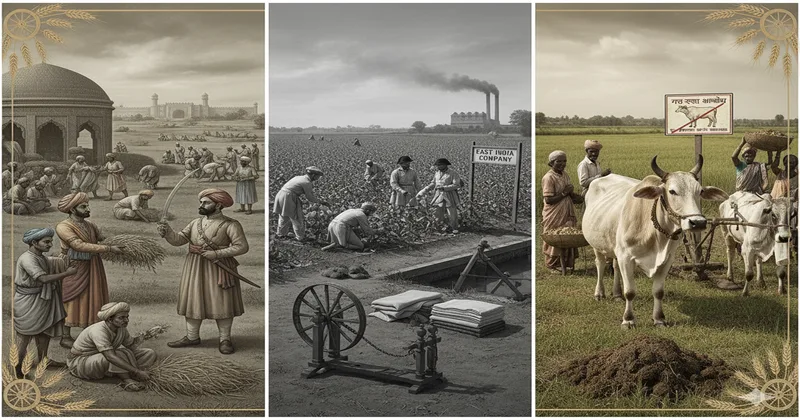
When the British got to Bharat and studied the entire subcontinent, they discovered that they couldn’t rule the nation directly. The Bharatiya economy was heavily reliant on the Desi cow and organic agriculture, and the Bharatiya education system was entirely based on morals, science, and the Gurukul system, which was profoundly ingrained in culture. Robert Clive, the Governor of British India, conducted substantial studies on agriculture in the region. Robert Clive discovered that cows are essential to Bharatiya agriculture and cannot be carried out without them. Eliminating cows was necessary to disrupt this foundation.
Slaughter House during British Rule
So the first slaughterhouse in Bharat was established in Kolkata in 1760, killing over 30,000 Desi cows per day, resulting in the elimination of at least one crore cows in a single year. British soldiers used it for nourishment or traded it to England. Beef became the main diet for the British in Bharat. When Bharatiya agriculture suffered a setback, they developed commercial farming, which was heavy on chemicals and fertilizers, and turned it into a separate commerce industry. They ruined Bharat’s entire economic system with their action. To entirely block the expansion of Desi indigenous cows, they imported jersey and crossbred it with Desi breeds of cows.
The West’s justifications for cow slaughter are no longer unquestioned. There are better protein sources than meat. Any dietician’s chart will reveal that beef, with 22% protein, scores lower than soya beans (43), groundnuts (31) and pulses (24%). One kilogram of beef requires seven kilograms of crops and 7,000 kilograms of water to create. Cow preservation makes economic and environmental sense. Swami Dayananda Saraswati, convenor of the Hindu Dharma Acharya Sabha, has asserted that non-vegetarianism indirectly contributes significantly to greenhouse gas emissions and other pollutants.
According to a 2006 UN assessment, “raising animals for meat as food generates more greenhouse gases than all the cars and trucks in the world combined”. Tens of billions of animals raised for food emit gasses including methane, nitrous oxide, and carbon dioxide through their huge amounts of excrement. The paper states that “the released methane has 23 times the global warming potential of CO2.” To allow these animals to graze, virgin forests are destroyed. The livestock sector also requires large tracts of land to grow monocrops to feed the animals. When trees and plants are killed, the CO2 they store escapes into the atmosphere.
Growing fodder necessitates extensive use of synthetic fertilizers made from fossil fuels. While this process produces a significant amount of CO2, the fertilizer itself yields nitrous oxide, a greenhouse gas that is 296 times more potent than CO2. Despite these alarming findings, all people need to do is avoid red meat. There will be no need to raise millions of animals for daily killing. The animal population will consequently decrease.
A single person who avoids eating meat saves the equivalent of 1.5 tonnes of CO2 emissions per year. This is greater than the one tonne of CO2 saved by switching from a large sedan to a small automobile. So there are several reasons to be a vegetarian. People who consume meat believe that a fully vegetarian diet is optional. But today they have no choice if they want to be aware of what is happening to this life-giving planet. Given the terrible environmental implications, there is no reason for consuming beef. A renewed enthusiasm for a Desi cow renaissance is required. It is constitutional for Bharat, and we must protect it with all of our power.
The world, which is full of kindness, love, generosity, and sacrifice, is symbolised by the cow. It lists its five goods as well. However, it has led to the brutality, abuse, and slaughter of valuable divine species for the little, material, and economic benefits of a select few. These are all headed to slaughterhouses. For the sake of human welfare and survival, it is therefore vital to combine science and tradition, put the facts in front of the public, and rescue this priceless species. The national economy and Desi cow breed will naturally be taken care of once the scientific and economic significance is recognized. Therefore, there is a significant chance that panchgavya and its products and other scientific benefits will create sustainable entrepreneurship, which will in turn create a sustainable economy and hence Cow slaughter should be completely banned.