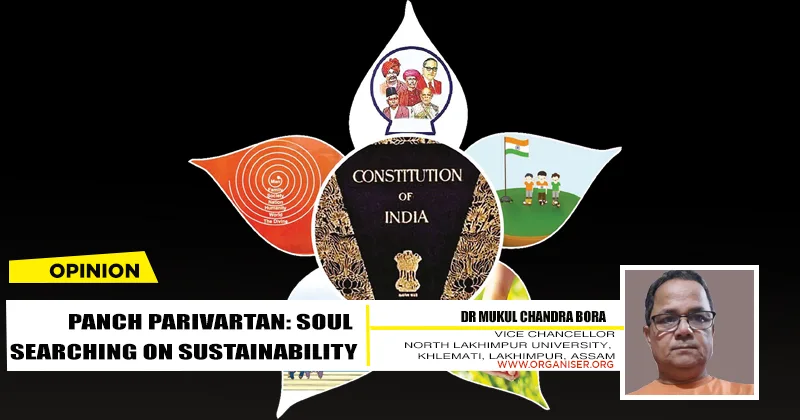
At has been observed that the concept of Panch Parivartan i.e., five changes in the society to make our Earth livable forever is given by many organisations either in whole or in part thereof. Although the concepts are coming in different names but philosophically, they are all alike and aimed at the same goal i.e., to mitigate the global warming and climate change which will lead to the Sustainable Development Goal of the United Nations. This concept is mainly focused on the Social Harmony and Equality with Nature and Human Community, Environment Friendly Lifestyle, Family Enlightenment, Self Realisation or Swadeshi and Fundamental Duties of Citizens of our society.
Interestingly, the similar philosophical concepts are found in the recently published report of the World Bank group titled Reboot Development: The Economics of a Livable Planet (September 2025). It makes a bold and timely argument: the foundational elements of development — clean air, fertile land, and sustainable water systems — are under severe stress, and failure to protect them imperils not just ecological goals, but economic and social progress.
Social Harmony and Equality: Over 90 per cent of the global population is exposed to at least one of three major environmental stressors: degraded land, poor air quality, or water stress. Alarmingly, in many low-income countries, around 80 per cent of people face all three simultaneously—fuelling cycles of poverty, ill health, and reduced productivity. The World Bank’s Reboot Development report argues that sustainable development cannot be achieved without restoring harmony with nature. It shows how environmental damage directly undermines economic progress and human well-being. The report calls for a paradigm shift—treating nature as a key development asset. Aligning policies with ecological boundaries is essential for building resilient, liveable societies.
The report frames environmental degradation not merely as an externality or an afterthought, but as an integral threat to economic growth. For example, deforestation in the Amazon is estimated to generate losses of around USD 14 billion annually, while land degradation cuts global agricultural output by about USD 379 billion—equivalent to nearly 8 per cent of agricultural GDP. The authors emphasise that many “nature-based solutions,” resource-efficiency improvements, and pollution‐reducing interventions offer very high benefit–cost ratios: in some contexts, every dollar invested in pollution control or ecosystem restoration can yield returns many times higher.
Similarities between Social Harmony & Equality & Reboot Development
Foundation for Sustainable Development: Both Social Harmony and Equality and the Reboot Development report emphasise that sustainable development requires inclusive, equitable systems. Just as social harmony depends on fair access to resources and justice, Reboot Development stresses that environmental health must benefit all—especially the poor, who are most vulnerable to ecological degradation.
Focus on Justice and Well-being: Social harmony is rooted in fairness and mutual respect, ensuring no group is left behind. Similarly, the World Bank report highlights environmental justice, noting that low-income communities often bear the brunt of pollution, degraded land, and water scarcity. Equity in environmental outcomes is essential.
Interdependence of Systems: Both perspectives recognise the interconnection between systems. Social peace relies on fair economic and social systems, while Reboot Development argues that environmental systems must be healthy for economies and societies to thrive. Ignoring either disrupts long-term stability.
Long-term Vision: Achieving both social harmony and ecological sustainability requires long-term thinking. Short-term gains that ignore inequality or environmental harm lead to instability. The report and social equity principles both call for investments that protect future generations.
Policy and Governance as Key Drivers: Strong, inclusive governance is central to both goals. Promoting social equality and ecological balance demands transparent policies, cross-sector coordination, and active public participation—central themes in the World Bank’s 3-E framework (Inform, Enable, Evaluate).
Similarities between Environment-Friendly Lifestyle and the Reboot Development:
Sustainability at the Core: Both an environment-friendly lifestyle and the Reboot Development report prioritise sustainability. They focus on reducing ecological harm, conserving resources, and ensuring that human actions do not compromise the needs of future generations.
Balance with Nature: Living in harmony with nature is a shared theme. An eco-friendly lifestyle promotes conscious consumption and minimal waste, while Reboot Development calls for policies that align with ecological limits to support a livable planet.
Prevention of Environmental Degradation: Both approaches recognise that preventing pollution, land degradation, and water stress is critical. The World Bank emphasises how environmental damage undermines economic and social progress—an idea reflected in personal lifestyle choices that aim to reduce carbon footprints and protect natural resources.
Long-Term Benefits: Whether at the personal or policy level, both highlight long-term gains over short-term convenience. Eco-friendly living improves health and well-being, just as Reboot Development argues that investing in environmental restoration yields economic, social, and health benefits.
Shared Responsibility: Both emphasise collective action. While governments and institutions must lead with systemic change, individuals also play a role through daily choices. The report and sustainable living both rely on widespread participation to create real impact.
In short, both the concepts advocate for a shift in mindset—from exploiting nature to protecting it—recognising that human well-being is deeply connected to the health of the environment.
Family Enlightenment and the Reboot Development
Family Enlightenment: Family Enlightenment and the World Bank’s Reboot Development report share a common foundation of awareness, responsibility, and sustainability. Family Enlightenment encourages values such as mindful consumption, cooperation, and long-term thinking within households, aiming to nurture responsible individuals. Similarly, Reboot Development emphasises the need for governments and societies to adopt environmentally responsible policies that view nature as a vital asset. Both advocate for harmony—within families and between humanity and nature—and highlight that true progress depends on informed choices, shared responsibility, and a commitment to protecting future generations through sustainable practices and balanced development.
Just as enlightened families teach respect for nature, mindful consumption, and care for future generations, Reboot Development urges societies and governments to adopt environmentally responsible policies that treat nature as a vital asset, not a barrier to progress. Both recognise that lasting development and well-being require harmony, awareness, and a deep sense of shared responsibility.
Self Realisation generally refers to a deep understanding of one’s own identity, capacities, values, and purpose. It involves growth, autonomy, and developing the ability to act with intention, rather than simply reacting to external pressures.
In a developmental context, self-realisation can mean having access to the resources, freedom, education, and institutional support to make choices, fulfill potential, and contribute to society.
While the World Bank doesn’t have a single report titled “Self Realisation,” many of its reports and programmes align strongly with the idea of helping individuals, communities, or countries realise their potential. Some relevant aspects:
Self Reliance & Social Protection: The Bank’s “State of Social Protection Report 2025: The 2 billion Person Challenge” emphasises how social protection can help people become selfreliant rather than endlessly dependent on aid. It shows that well designed social protection (cash transfers, economic inclusion, job training) allows people to build capacity, plan for the future, and overcome shocks.
Self Evaluation Systems (“Behind the Mirror”): The World Bank’s Independent Evaluation Group published Behind the Mirror: A Report on the Self Evaluation Systems of the World Bank Group, which examines how the Bank itself learns from its projects. Here “self-realisation” in an institutional sense means being self-aware: evaluating successes and failures, learning, being accountable, and improving practice.
Country Ownership & Capacity Building: In discussions around aid, aid fragmentation, and selfreliance, the Bank often highlights the importance of local and national capacity: allowing countries (or individuals) to design, lead, and sustain their own development processes rather than having development delivered to them. This supports realisation of agency and autonomy.
Similarities & Implications:
Both self realisation and the Bank’s work recognise that external aid, policy, or systems are helpful only if they enable internal growth and agency (in people or institutions). Empowerment, learning, autonomy, and long term vision are common threads.
Examining the Implications
For effective implementation of Reboot Development strategies, recognition and activation of citizens’ duties is crucial. Governments can’t achieve sustainability alone; citizen behavior is a major component. Education (a constitutionally enjoined duty) becomes especially important: knowledge of ecological issues, environmental rights and responsibilities, and sustainable practices. Embedding these duties in civic education and public policy helps build social norms consistent with sustainable development.
In short, the Fundamental Duties provide a moral, behavioural foundation that complements Reboot Development’s policy oriented approach. Both share the view that sustainable development depends not only on institutions and governments, but on committed, aware citizens acting responsibly. So, it may be said that the Swadeshi concept of sustainable concept is also the same as that of the developed countries and the different international organisations. It is an indirect recognition of the Bharatiya Gyana Parampara and the power of our ancient texts and the wisdom of our Rishis and the great philosophers of this great motherland known as Bharat which means a place working towards knowledge and wisdom.