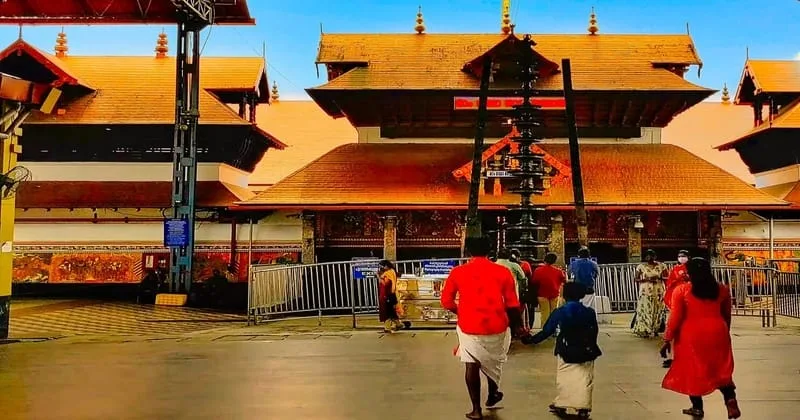
In Kerala, intrusion into the religious practices of the Hindus has become a routine habit of some people. In the case of the famous Guruvayur Sri. Krishna Mandir in Trissur district alone, there have been several incidents of violation of the customs and rules of the Mandir by non-Hindus, inspite of resistance from the devotees and disobeying the injunction of the High Court of Kerala. Despite the provision of constitutional rights for everyone to follow their own religious faith, the Hindu rituals today are under threat of being defiled. In this context, it seems appropriate to examine the Hindu vision of spiritual truth as all-inclusive, yet of the means of realising the truth as distinct and exclusive.
The unique character of the Hindu religion is the fact that it is not a body of dogmas and practices related to them. On the other hand, it is rooted in a vision or darśana of an all-inclusive principle. It is quite scientific to hold a universal principle as the ultimate cause of all multitude, since science has accepted a single energy form as the basis of all kinds of cosmic variety. While the unity among followers in other religions is enforced through the order of the clergy and its institutions, the Hindus are naturally held together by their most attractive, all-comprehensive darśana of spiritual unity. Hindus are quite proud of this magnanimous ideal, which encompasses the whole of creation within its fold. The minds that seek wisdom find fulfilment in this supremely auspicious vision of reality.
This holistic understanding of reality allows the Hindu to accept all realms of existence, living and non-living, as an expression of the one reality. Since the universe is taken to have expanded from this ultimate entity, it is termed ‘Brahman’, derived from the Sanskrit root ‘bŗh’, which means to ‘expand’ or ‘burst forth’. It is on account of this comprehensive vision of reality that Hinduism can accommodate all other religions in its fold. India’s history demonstrates it. The Indian soil, in addition to giving rise to new religious creeds such as Buddhism, Jainism and Sikhism, has also welcomed western religions to be practised here. It has lodged the major foreign religions, Islam and Christianity, here and has compromised with them since it could see them as parts of its cosmic understanding.
Two faces of Hinduism
Hinduism expresses two sides: one, its cosmic vision of reality as a single existence that includes everything, and the other, related to different religious practices. One comes across a variety of practices, though all follow the basic vision of oneness. This is also a unique feature of Hinduism that there are different paths to reach the same goal. This liberal view is in accordance with its fundamental inclusive notion of reality. It accounts for the tolerance of a Hindu towards other religions. For him, the essence of every form of existence is the same, though there are various means of reaching it. Every being, according to him, is divine, including the material realm as well as the living forms. Since every human is inherently divine for the Hindu, it is his natural tendency to accept universal brotherhood.
This ancient wisdom of Hinduism is the precious heritage of India. Actually, this excellent tradition should be the pride of all Indians, irrespective of religious differences, since all of them basically share the Hindu tradition, which has only been converted to foreign religions following the invasions of outside powers. Unfortunately, today this tradition is generally disowned by non-Hindus, confining it to the Hindus alone.
Rituals are unique and exclusive
Another peculiarity of Hinduism is that its vision of God is not simply as an object of worship; it contains the aim of realising God as the essence of man. Hence, different means of realising the truth are prescribed in it. Thus, there are the ways of knowledge, devotion, rituals, temple worship, meditation and so on. Ofcourse, there can be different goals based on different aims of life. For instance, rituals may be conducted to attain prosperity, heavenly pleasures or as a spiritual duty to attain liberation. In any case, different paths are accepted in Hinduism to reach one and the same goal.
It is a singular feature of Hinduism that its darśana of reality is not a mere belief, it bears the credential of experience. The basis of Hinduism is experience and knowledge conveyed by the great Ṛshis of the past who had realised the truth. As in science, they have provided us with procedures by following which others can also reach the same experience. Symbolic worship of God through murtis is one of the procedures. It is in respect of such religious practices that one comes across exclusion of non-Hindus. Here, each ritual is unique in that it has its own prescribed norms. One has to follow certain ceremonial rules, designed for attaining success in the desired goal.
In most of the Mandirs, devotees alone are allowed entry. This is because each of the deities is worshipped by following a specific code of ceremonies prescribed for that deity. Accordingly each Mandir has its own rules and regulations. Non-entry for non-devotees is not to be treated as religious discrimination. It is only a measure of protection of the sanctity of the consecrated murti. It is necessary because the procedure of murti worship involves the installation of prāṇa or the vital energy, a form of cosmic energy, through certain rituals and mantras prescribed by the Tantric tradition. These rituals and mantras, repeated daily, along with the faithful worship and prayers of the devotees, are intended to maintain the purity of the murti. Even devotees are not allowed to engage in mundane conversation within the inner premises of a temple.
It is in this background that one should evaluate the gravity of the interference of non-Hindus, their entering the temple premises and acting against the rules of the temple, even violating the Court order. In the Guruvayur Mandir, a Muslim woman has been frequently meddling around. Recently, another woman belonging to the same religion followed her in polluting the holy pond in which the murti is bathed. These are instances of persistent transgressions of religious tolerance, such as defying Hindu sacred institutions like the Sri Padmanabha Mandir in Thiruvananthapuram, Tiruppati Venkteshvara Mandir, Sabarimala, and Dharmasthala.
This is part of the Cultural Marxists’ political agenda of demolishing spiritual culture, especially of the majority community, in order to pave the way for establishing communism. For this purpose, they have made an alliance with the minority religions in India. The underhanded motive of the Cultural Marxists is to deconstruct the dominant culture of a country, mainly the religious and moral traditions of the people, alleging that it is being promoted and maintained by the capitalists. Along with the demolition of capitalism through the disintegration of culture by destructive criticism and political activism, Cultural Marxism, in its nefarious scheme, also includes the promotion of materialism and atheism in place of spiritual tradition. It is with this shady goal that they resort to a destructive reading of the great Epics and distort the auspicious intentions of their great authors.
It is the global failure of Marxism that prompted the Post-modern Marxists, known as cultural Marxists, to deviate from the techniques of orthodox Marxism and its concepts of economic determinism and class struggle, and turn towards subverting the existing dominant culture in order to put communism in its place. With this purpose in mind, they have formed an underhanded understanding with minority religions, which in turn find this a golden chance to advance their scheme of religious conversion intended to achieve the goal of their own domination.
To conclude, it should be emphasised that Hinduism is not based on any restricted dogma. It is a universal vision of oneness, the doors of which remain open to everyone who seeks spiritual emancipation. It confers freedom to its followers to choose the path that suits them to reach the final destination. It is only in the practice of ritualistic worship that Hindus make a distinction. This is based on the valid assumption that non-Hindus enter the Hindu temples not out of devotion nor for conducting worship, because their own religions prohibit these. Hence, it is definitely an interference with the Hindus’ freedom to practice their religion, which is a clear violation of Constitutional rights. It must necessarily be brought to the attention of the authorities concerned.