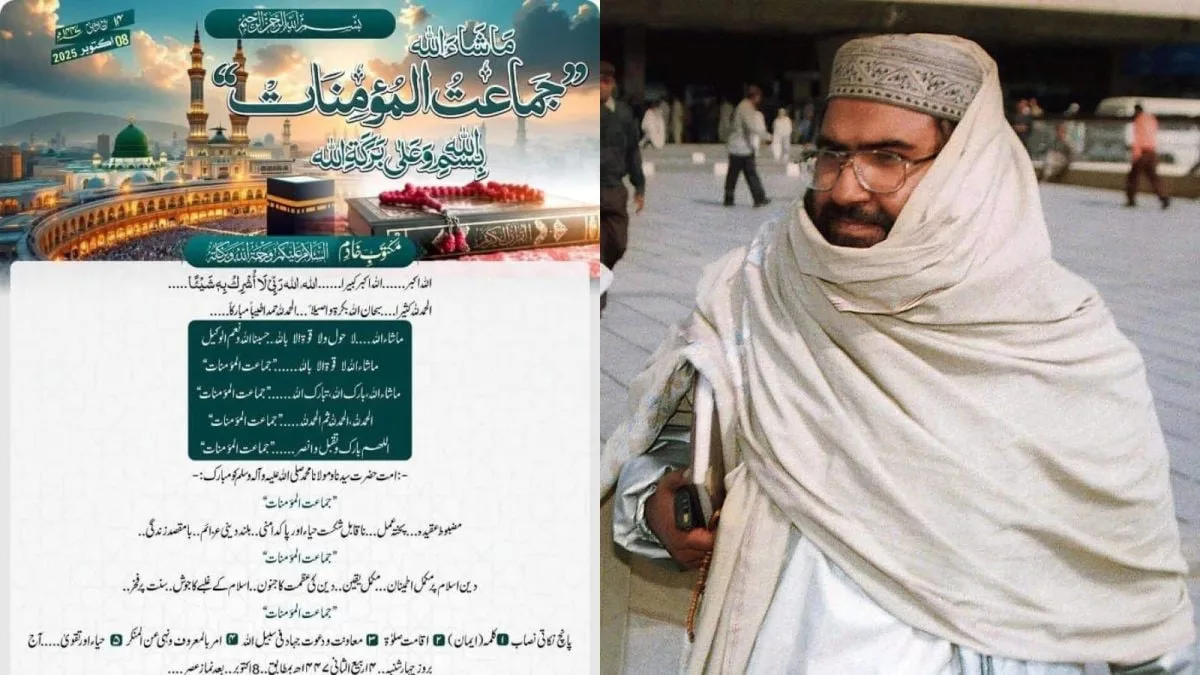
In a major intelligence revelation, top security sources quoted in a CNN-News18 report say that Pakistan-based terror outfit Jaish-e-Mohammed (JeM) is in the process of launching a covert women’s wing under the banner ‘Jamaat al-Mu’minaat’ (Community of Believing Women).
This new female front organisation has been designed as a critical component of JeM’s evolving strategy for psychological warfare and grassroots recruitment, particularly aimed at influencing educated, urban Muslim women across Jammu & Kashmir, Uttar Pradesh, and India’s southern states. The operation, sources said, is being conducted through encrypted online communication channels and religious outreach networks.
According to sources, the group’s outreach has been carefully masked in religious and devotional language, portraying itself as an Islamic reform initiative.
A circular issued by JeM, adorned with images of Makkah and Madina and Quranic verses, was crafted to give an aura of divine legitimacy. “This subtle propaganda, characterised by moral purification and devotional rhetoric, is engineered to appeal to educated Muslim women seeking spiritual engagement,” an intelligence officer was quoted as saying in the report.
Officials described this as a two-phase indoctrination plan, the first phase involves spiritual conditioning, while the subsequent stage gradually introduces recruits to JeM’s political and jihadist ideology.
The frequent mention of Jamaat al-Mu’minaat across internal communication intercepts indicates a cell-based vertical hierarchy, similar to JeM’s existing framework.
“These women’s groups are being groomed to function as recruiters, message couriers, and fundraisers, providing indirect logistical support to male operatives while staying under the radar,” a senior intelligence source was quoted saying.
This shift aligns with JeM’s post-2024 operational revamp, which focuses heavily on social media outreach and madrasa circuits across Pakistan’s Punjab province and Kashmir.
Intelligence inputs also point to markaz-level gatherings being organised under religious pretexts. The group’s pamphlet reportedly calls participation in such meetings a “spiritual obligation” and “collective duty,” phrases that mirror early women’s jihad narratives promoted by other global terror outfits.
One such pamphlet references 13th Rabi-ul-Thani (October 8, 2025), signalling a planned coordination event possibly linked to hawala or donation-based funding mechanisms. “These gatherings often act as cover for transferring funds through religious NGOs and madrasa networks, disguised as donations for islah-e-ummah (reform of the community),” sources added.
Security agencies have found that the theological tone, design, and content structure of Jamaat al-Mu’minaat’s literature closely resemble publications from Pakistan-based Al-Muhajirat, JeM’s formal female cadre initiative, as well as materials from Markaz Usman-o-Ali in Bahawalpur, JeM’s known stronghold.
JeM appears to be strategically positioning its women’s units to lead information warfare campaigns, conducting online dawa (preaching), spreading misinformation, and handling financial facilitation roles that can bypass traditional surveillance mechanisms.
“These women operatives act as digital foot soldiers in JeM’s psychological operations,” intelligence sources said.
“Their online narratives are designed to sow ideological confusion, normalise extremist views, and inspire loyalty to jihadist causes without direct militant training.”
Officials believe that this initiative represents a new frontier of terror radicalisation, blending religious devotion, gendered emotional appeal, and digital stealth tactics.