The alleged Jaish-e-Mohammed module recently uncovered by the Gujarat Anti-Terrorist Squad (ATS) has revealed the novel methods terrorists are adopting to spread a jihadi mindset and commit crimes in India. At the core of this entire network was an alleged booklet titled “Akela Mujahid”; distributed among the accused, it was reportedly used to teach them how to make explosives, conceptualise violent attacks and lure youths toward radical ideology.
Using this booklet, youths residing in the madrasa were preparing themselves for ‘Jihad’ and attempting to steer other students onto the same path. The ATS claims that these individuals organised at least three such ‘gatherings’ (dawat) at the madrasa, inviting students with the aim of drawing them into the fold of ‘Jihad’.
Arrests: Rising from 8 to 13
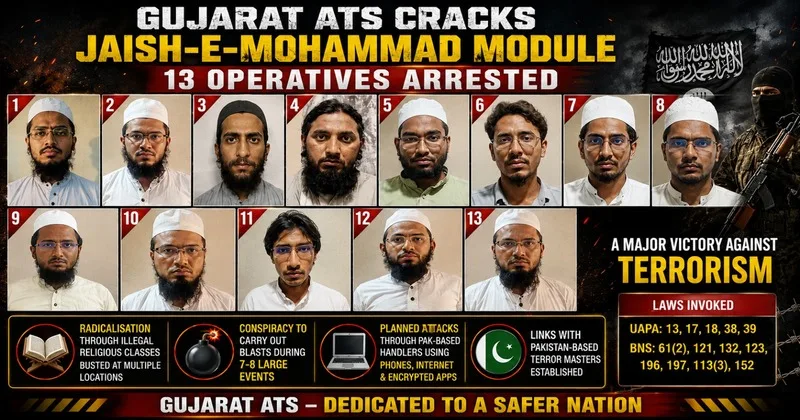
In the initial phase, the Gujarat ATS arrested eight members of the alleged Jaish-e-Mohammed module around July 3; some were apprehended in Gujarat, while one accused was picked up from Dewas, Madhya Pradesh. The eight individuals arrested were identified as Ahmed Abdullah Gaziwala (alias Abu Ubaida), Ibrahim Mohammed Hussain Ghagha (alias Abu Hamza), Mudassir Abdullah Gaziwala (alias Abu Aya), Zakaria Durrani Mohammed Ammar Ghagha (alias Ibn Ammar), Mufti Faujan Ismail Dauva (alias Mufti Saab), Mohammed Amin Shera (alias Amin Palanpuri), Mohammed Abdul Rahman Savdi (alias Abu Unesa), and Bilal Durrani Mohammed Ammar Ghagha (alias Abu Dujana).
The names that emerged during interrogation following these arrests began to further unravel the layers of this network. The Gujarat ATS conducted a raid in Khadiyal village of Patan district’s Siddhpur taluka and arrested five more individuals, identified as Bilal Abidbhai Shera, Mohammad Ayyub Kadiwala, Mohammad Ayyubbhai Sunsara (alias Mohammad Khali), Shafi Rais Mukhi (alias Shafi Chhapi) and Mohammad Hasan Hanifbhai Karadiya (alias Hasan Haidarpuri). These five were produced before a court in Kadi town, Mehsana district and remanded to ATS custody until July 24.
Jamia Abul Hasan Madrasa
The investigation revealed that several of the accused were residing at the Jamia Abul Hasan Madrasa in Khadiyal/Khadiyasana, Patan and that a significant portion of their activities was allegedly being orchestrated from there. ATS officials state that three key accused, Zakariya Durrani (Ibn Ammar), Mufti Faujan Ismail Dauva and Mohammad Amin Shera, were associated with this madrasa and that ‘classes’ on IED construction were conducted there.
It is alleged that in a section of the madrasa, these individuals studied bomb-making techniques using a booklet titled ‘How a Lone Mujahid Should Wage Jihad’. They reportedly experimented with IED assembly at the site and even conducted a successful test, carrying out a small-scale explosion to observe the results. Investigations by agencies have also revealed that the network was actively working to develop an organizational structure. According to the Gujarat ATS, some of the accused also conducted experiments related to the manufacture of explosives.
A New Model of Brainwashing
The most concerning aspect of this entire case is the radicalization of youths regarding Islamic ideology. Investigations indicate that the accused organized events at the madrasa on at least three occasions, inviting other students in an alleged attempt to draw them toward jihadi ideology. Consequently, security agencies view this entire episode as a “radicalization module.”
The ‘Akela Mujahid’ Booklet: A Crucial Element
The document garnering the most attention in this case is the booklet titled ‘How a Lone Mujahid Should Wage Jihad,’ which the ATS regards as a key piece of evidence. Investigating officers claim that this booklet was made available to all 13 accused, who repeatedly studied it in an effort to grasp the concept of a ‘lone-wolf’ jihadi attack. The booklet reportedly details how a lone individual can inflict mass casualties even without conventional weapons, how to select targets such as crowds, public spaces, and sensitive locations and how to utilize explosive devices like IEDs.
8 Locations, 7–8 Trials: Preparations for Bomb-Making
According to the ATS investigation so far, between 2023 and February 2026, members of this module conducted trials at at least eight different locations to understand explosive materials and IED mechanisms. During these trials, they allegedly prepared mixtures such as gunpowder and conducted small-scale test explosions to assess the effectiveness of various combinations and to determine how detonations could be triggered using timers or other devices. The investigation indicates that the objective of these tests was to gauge the efficacy of different chemical compositions. Some materials were procured via online platforms, while other items were purchased from local markets to avoid arousing suspicion.
Attempt to Build a Time Bomb and the Suspected ‘Master Trainer’
According to facts presented in court, the public prosecutor stated that one of the accused had attempted to construct a time bomb. In this context, the ATS informed the court that materials such as timing devices, wires, batteries and other components were yet to be recovered; only a detailed forensic analysis would clarify the potential capability or danger posed by the device.
The ATS further alleged that the network included an individual with specialized knowledge of bomb-making techniques, who reportedly acted as a ‘master trainer’ for the other members. Consequently, investigative agencies believe the module was developing not only radical, motivational material but also technical capabilities.
According to the ATS, this module was attempting to establish an active operational network for Jaish-e-Mohammed within Gujarat. The alleged plan involved recruiting new members, propagating ‘Jihadi ideology’ through madrasas and local religious institutions and arranging logistical support for future attacks. Investigators believe the module was also gathering geographical data on cities and towns, identifying potential targets and studying the response patterns of the police and administration. Explosive trials conducted at eight locations are also viewed as part of this preparation, intended to assess risks, distances and potential damage through ‘dummy’ experiments prior to a major attack.
Legal Charges: From UAPA to BNS
The Gujarat ATS has invoked several sections of the Unlawful Activities (Prevention) Act (UAPA) in this case, including Section 13 (unlawful activities), Section 17 (raising funds for terror), Section 18 (conspiracy to commit terrorist acts), Section 38 (membership of a terrorist organization) and Section 39 (support to a terrorist organization). Conviction under these sections entails provisions for long-term imprisonment and severe penalties. Additionally, Sections 61 and 148 of the Bharatiya Nyaya Sanhita (BNS), which pertain to criminal conspiracy and the concealment of plans to commit serious offenses, have been invoked against the accused. Investigative agencies are also describing this as a ‘preventive’ measure, stating that had the module not been intercepted in time, they might have attempted a major attack.
Madhya Pradesh Connection: Arrest in Dewas
A Madhya Pradesh connection also emerged in this case with the arrest of an accused from Dewas, identified as Bilal Durrani Mohammad Ammar Ghagha, alias Abu Dujana. According to the ATS, he was part of the network linked to this module and allegedly played a role in facilitating travel between Gujarat and MP, establishing contacts and mobilizing resources.
Extremist Content and Challenges of the Digital Age
This case clearly illustrates how a “virtual classroom” can be established in the digital age through extremist content, such as booklets, PDFs, and pen drives and online support. Whether it is booklets like “Akela Mujahid” or speeches by terrorist ringleaders like Masood Azhar, these elements combine to create an ecosystem that makes it easier to steer young minds toward a path of violence.
According to the ATS, members of this module stayed connected online in addition to meeting in person; they shared radical content and received instructions from alleged handlers. Such cases pose a challenge for law enforcement agencies regarding how to tackle concepts like “silent radicalization” and “lone wolf” attacks, where an individual can carry out a serious attack without the backing of a large network.
Investigation into the Pakistan Connection
Investigating agencies claim that two suspects were in contact with the top leadership at the alleged Jaish-e-Mohammed headquarters in Bahawalpur, Pakistan. Forensic analysis has reportedly uncovered evidence of digital chats, call records and online communications.
Investigation Underway
The primary concern for the Gujarat ATS and other agencies now is whether, even after the 13 arrests, there remain any networks or individuals involved in or supportive of these activities. To this end, phone records, bank accounts, potential links to ‘hawala’ transactions and social media profiles are being scrutinized closely.
Investigators are also examining whether the accused had received instructions regarding a specific ‘target list’ or dates for an attack or if they were merely at the trial and preparation stage, meaning, whether a potential target had already been identified or activities were still limited to the preparatory phase. Should any information regarding a concrete ‘attack plan’ come to light, security agencies will determine their strategy and alert levels accordingly. At present, the entire matter is subject to investigation and judicial proceedings.