This is not a subject of my mere interest; it is a subject of my reverence. I did not come to Ekatma Manav Darshan through academic study alone. I could have read it a hundred times and still missed its living core. I experienced it, on the ground, when I worked with the Swadeshi Jagaran Manch in 1992 at the instance of the Rashtriya Swayamsevak Sangh. That work showed me how Indian society actually functions: consistently with, based on, and founded in Ekatma Manav Darshan. It is not a theory to be realised or a goal to be attained; it is an explanation of how India already lives. In this essay, I offer evidence and the civilisational lens through which to see it.
Social Capital, Dharma, and the Indivisible Whole
Those who truly wish to understand the Integral Humanist Paradigm must begin with the experience of Bharat as a society and civilisation over at least five millennia. Deendayal ji distilled the juice of that experience into four lectures. The West, by contrast, lost the integrality of social life long ago. After the Church fractured traditional communities, industrialisation collapsed relationship-based living. The result was a search for new glue – contracts, not relations; individualism, not community. Modern economics grew on that base.A rare Western sociologist who sensed what was missing was Émile Durkheim: societies need intermediary institutions to connect the individual to a distant state so that economy, polity and community can function. A century later, Francis Fukuyama’s Trust and Robert Putnam’s “social capital” groped toward the same insight. But social capital is normative, not legalistic; it rests on shared values. In our idiom, that is Dharma.
This is why Deendayal ji’s discourse insists that human life is integral: person with family; individual with society; society with state; humanity with nature. None of these can be treated as silos. Economics, sociology, philosophy, statecraft – these are connected disciplines of a single living order. That is Integral Humanism.
Transcending the Context
Two figures in modern Bharat were not arrested by the context: Mahatma Gandhi and Deendayal Upadhyaya. Gandhi, a moderate and a spiritualist, used a harsh word for a reason: he called Western civilisation “evil” because he saw what it would spread if it spread. His answer was Swadeshi – not as an abstract alternative, but as a functioning viewpoint. I learned Swadeshi by watching how Bharat actually lives, not by overlaying it with corporate or macroeconomic templates.
Deendayal ji likewise refused to be captured by the fashion of socialism. In the 1970s, to speak against socialism was treated as a sin; you were called a CIA agent. Yet he articulated Integral Humanism, convinced that socialism was a comma, not a full stop. Time proved him right globally and in Bharat; the word may remain in texts, but the meaning has drained. The West’s short-termism is visible in the shrinking shelf-life of its own paradigms: colonialism lasted 200 years; mercantile capitalism, 100; socialism, 50; globalisation, 25. After the 2008 financial crisis, Americans themselves asked why they had stagnated vis-a-vis China. The answer given was simple: China played the long game; America became a short-term player. Quarterly results were massaged to pump share prices; overnight rate changes moved markets – human horizons kept shrinking.
By contrast, Asians save for their grandchildren’s future. Barry Bosworth of Brookings wrote about this in 2007. And the main civilisational protagonist of Asia is Bharat. Remove Bharat from Asia; you have no Asian philosophy left. Our family and social life have long horizons; politics and the state may have short-term goals, but society thinks long-term.
Evidence in Everyday Life: Food, Land and Climate
The Integral Humanist Paradigm is not a theory about human beings alone. It starts with the individual, merges into the family, consolidates into society, becomes the nation, aggregates to the world, and connects to the cosmic order. That integrality shows up in the most practical domains.
Consider food and land. Bharat has just 2.4 per cent of global land, yet holds 18 per cent of the world’s people, 30 per cent of bovines, 42 per cent of cattle, and around 8 per cent of bio-resources. How do we sustain so many consuming beings on so little land? The secret is the Rishi–Krishi combination. Our sages understood that cereals deliver the bulk of calories (83 per cent) and a larger share of protein (63 per cent) compared to meat (17 per cent calories; 37 per cent protein). Indian food culture tuned itself to more cereals, less meat. Our cereal consumption is ~180–185 kg per person per year; meat is about 3.5 kg (down from 5.1 in 2001). This is reinforced by traditions of restraint – no-meat days, monthly observances. It may look religious; its effect is civilisational: food security for a vast population.
Now the counterfactual: if Indians adopt the American style – Bharat would need six times its existing agricultural land, and our country would have to be two-and-a-half times larger to feed everyone. If Bharat eats like America, global climate agreements collapse. Our restraint is not quaint; it is a civilisational contribution to planetary balance. Household structure is another evidence point. Bharat’s average household size is about 4.5 persons. If it shrinks to 2.5 (like the U.S.), we will need 135 million additional houses. When the U.S. went from 3.0 to 2.5, it meant 35 million more houses – an $8.5 trillion investment. If we follow that path, we have neither land nor money nor environment to spare. What keeps Bharat viable? Sharing of space, comfort, and earnings within families. According to the State Bank of Bharat’s economic research, 80 per cent of parents live with their sons or daughters. If all elders lived alone, who would fund Social Security? In our civilisational ethic, elders are not an economic burden to be outsourced; they are respected members of the household.
Here lies the contrast between rights-centric models and duty-centric ones. In the 1960s, as American society atomised, the state took over elder care through a 12.5 per centpayroll tax. Over time, as demographics shifted, the social security account turned negative (around 2006). The present value of future obligations has been estimated in the tens of trillions (about $63 trillion at one point) a time bomb. In Bharat, if we said, “pay 12.5 per cent to Delhi and let the state keep your parents,” the country would snap.
The civilisational Frame, Not a Technocratic Scheme
I return to my starting point. Ekatma Manav Darshan is not a narrow techno-economic construct. It is a civilisational framework that explains how Bharat lives and thrives: A cereal-first food culture that secures nutrition and spares land and climate. Joint families that economise land and capital and dignify elder care. A duty ethic that sustains social security without fiscal bombs. A long-term horizon in family and society that counters the political short-term. A victory-oriented statecraft when required, nested within a dharmic society.
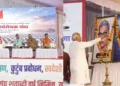
(The article is based on the his address delivered at the Organiser conclave at Mumbai commemorating 60 years of Integral Humanism – Arthayam: The Dharmic Model of Development)