Geopolitics is parallel to playing the game of ‘Rubik’s Cube’. If you seek to set right one angle, the other gets complicated and India’s relations with the US is currently entangled in a similar dilemma. From Trump’s tariff tantrums to the H-1B visa hustle to the US president’s hegemonic interests in the periphery of India such as Bagram Airbase or the Chabahar port, this chapter in New Delhi-Washington relations is marked with turbulence and fissures.
US hegemonic ambitions thus could create tremors in India’s strategic landscape and it is indeed a walk on the strategic tightrope for New Delhi. Entrenched US footprints in India’s proximity could nourish the region as a fertile geopolitical playground for the powerplay between the superpower aspirants and this can definitely derail the regional stability and ofcourse the national security & strategic autonomy of India.
A choke to the waiver on Chabahar port
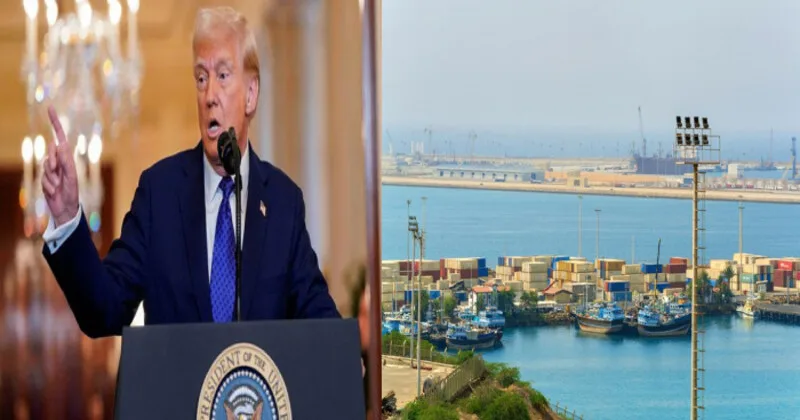
The latest in the series of prickle in the India-US bilateral relations is the President Trump’s choke to the Chabahar port waiver given to India. The Trump administration has announced that it will revoke the waiver specifically given to India on the sanctions imposed on the Chabahar port, located in Iran.
The special exemption was given to India in 2018 during President Trump’s previous term. It enabled New Delhi to freely operate in the Chabahar port and also allowed India to build terminals in the port city of Makran in Iran. Apparently, India had heavily invested on the Chabahar project to seek alternative maritime trade route through Iran surpassing Pakistan and also to strengthen the country’s national security across the oceans. The exemptions given to India will lapse on September 29 and since then India’s access to the port will be severely hit. The US’s move is deemed as a part of Washington’s “maximum pressure” tactic on Iran at a time when Tehran’s nuclear programme is spiking in an unhindered way and at a critical juncture when Iran and Israel are at loggerheads as a spill-over effect of the Israel-Hamas conflict.
However, this is also detrimental to the maritime interests of India, as Chabahar port is an ambitious infrastructure project of India. Chabahar is the nearest port of Iran to India. It is situated in the Sistan and Baluchistan province of Iran on the Makran coast. Its strategic location in the Gulf of Oman and just in the vicinity of the high-traffic Strait of Hormuz, it leverages a huge millage to India in channelizing maritime trade and propelling swift connectivity to Central Asia, Europe and beyond, devoid of the maritime route of Pakistan. Its location just 550 nautical miles from the Kandla port of Gujarat is an added advantage for India, in terms of easy, timely and cost effective accessibility. Thus, Chabahar is important for India from both connectvity and trade perspective.
Chabahar port has two key ports. Shahid Kalantari port and Shahid Beheshti port. In 2015, India signed a MoU to develop the Shahid Beheshti port. The aim was to bring in state-of –the-art infrastructure and enhance connectivity and trade prospects. India’s solid presence in the region would also assert a balance of power and ensure solid maritime security architecture in the region, as China has considerable stakes in the Gwadar port of Pakistan as a part of its China-Pakistan Economic Corridor(CPEC) project.
Despite, bureaucratic hurdles, leadership changes and other hiccups, in 2015-16 Prime Minister Narendra Modi vowed to spend USD 500 million for the project and signed a trilateral agreement with Iran and Afghanistan. The development of the port gained further momentum in 2017 with the inauguration of the Shahid Beheshti terminal. As another landmark in 2018 Iran leased the operational control of the port to India for 18 months. In this direction, another deal was inked a year ago between India and Iran, a 10 year agreement to further develop the Shahid Beheshti terminal. India has also built a 218km stretch roadway which opens India’s access to the key cities of Afghanistan that further connects to the five Central Asian countries and beyond.
US has imposed stringent restrictions on Iran since decades. However, waiver was given to India since 2018 for the use of Chabahar port. Now as an impact of the revocation of the exemptions, it will seriously derail the development and operational abilities of India with respect to the Chabahar port.
Many geopolitical analysts assert that India has hitherto acknowledged to the conditions of the US to not purchase oil from Iran. Despite that the removal of waiver is an additional and unreasonable pressure on India and Washington DC is unfairly meddling in the geopolitics of Asia. Analysts also claim that these actions of President Trump which he deems as “pressurizing” either Iran or India or Russia, in reality helps China to deepen its foot in the region. Beyond all the geopolitical calculations, the latest measure by the US can only be deemed as another thorn in the decelerating India-US relations.
The demand for the Bagram Airbase
Another hegemonic action by Trump that puts India’s strategic autonomy, national security and the larger regional security at stake is the demand for the Bagram Airbase in Afghanistan. Trump has repeatedly called the Taliban government in Afghanistan to return the Bagram Airbase, which was the largest military base of the US in Asia during its Global War on Terror since 2001. He has also threatened to take it back even through aggressive actions.
Reacting to Trump’s demands, Taliban government has exclaimed that it won’t sustain “bully behaviour” and any adverse action by the US could lead to a “strong response” from the Afghan side. If these hostilities between Washington DC and Kabul spiral-out for the sake of Bagram Airbase, it can create turbulence in India’s backyard that is consequential to the national security and economic aspirations as well.
The H-1B visas hustle
Indian’s comprise approximately 71 per cent of the total H-1B visa holders in the United States. Trump’s transactional, protectionist and anti-immigrant policies could impact adversely on Indian diaspora in the US. Additionally, the latest executive order that demands USD 100K for the new H-1B visa applicants can further fracture the long-hailed India-US bilateral relations in which people-to-people relations is a key pillar.
The world already has witnessed the tantrums of the US President Donald Trump. From imposing irrational tariffs to demanding Noble Peace Prize, his every decision impacts the world aggressively and starkly. The US President’s latest tussle with India is characterized by sharp and persistent ups and downs with unable to exactly predict or anticipate the nature of the trajectory ahead in the bilateral relations. Geopolitical analysts decode the latest moves of Trump in Asia as a deliberate tactic to counter India and calibrate US hegemony in Asia, which can also be targeted towards Russia, China and tackling Iran.
However, India’s strategic patience and calibrated calmness coupled with persistent dialogue and diplomacy can ensure the national security of the country, strengthen the maritime architecture encompassing India, ignite the economic prosperity & strategic autonomy and ultimately ensure regional security and balance of power, despite any unpredictability emanating from the Oval Office.