The political discourse in India has long been shaped by the complex interplay between religion, nationalism, and secularism. The current Indian Constitution enshrines secularism as a core principle, yet the practice of secularism in India has been riddled with contradictions. In the Indian Constitution, the word was absent in 1950. It was only during the Emergency in 1976 that the word ‘secular’ was inserted into the Preamble by the 42nd Amendment. Dr B. R. Ambedkar himself had argued that Indian society, being inherently plural, did not need the imposition of a Western model of secularism; instead, the Constitution should ensure equal rights irrespective of religion.
Yet, over time, ‘secularism’ in India came to mean something quite different. Political leaders, particularly from the Congress system, reinterpreted it as ‘sarva dharma sambhava’, equal respect for all faiths. But in practice, it became selective. Rather than treating all religions equally, governments actively engaged in minority appeasement for vote-bank politics while treating the Hindu majority as a monolithic entity that required constant restraint. As historian Arun Shourie or Sita Ram Goel observed, Indian secularism has become the art of cutting Hindu society down to size, while pampering minority groups for political advantage.
A particularly striking paradox lies in the fact that political and intellectual elites who identify as secular are quick to brand expressions of Hindu religiosity as ‘communal’, while showing little concern for or even endorsing minority appeasement. This raises critical questions: Why do Indian seculars selectively apply their critique? Why is adherence to Hindu dharma viewed as communal, while state patronage of minority religious practices is rationalised as ‘inclusive’?
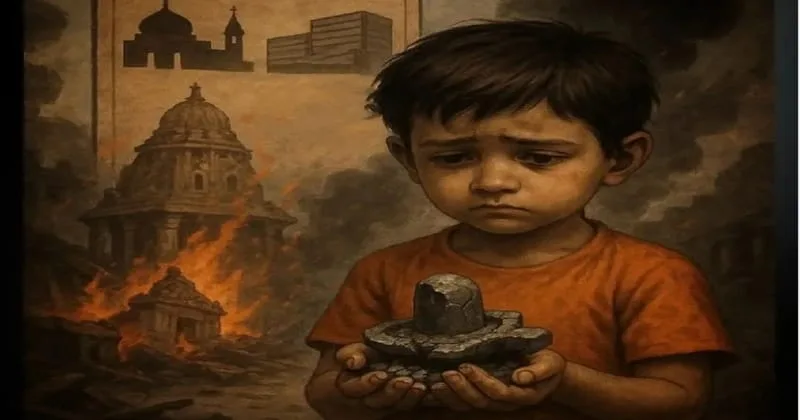
In most democracies, secularism means a clear line between state and religion. In India, however, secularism has been twisted into a weapon: state control over Hindu institutions, and state protection of minority practices. For example, Hindu temples are taken over by governments; their revenues diverted for non-religious purposes. Yet, mosques and churches are left completely autonomous, beyond state accountability.
If secularism is about equality, why this double standard? But the Seku-Makus (So called Secular) never question it, because for them, secularism is not about neutrality it is about Hindu restraint and minority indulgence.
The branding of Hindus as ‘communal’ whenever they follow their Dharma is neither accidental nor apolitical. It is the result of a systematic intellectual campaign by Marxist historians, left-leaning academics, and their political patrons. The British encouraged divisions within Indian society by portraying Hindus as oppressors and minorities as victims. This narrative was internalised by post-colonial intellectuals who adopted a Marxist framework, viewing Hinduism as an ‘upper-caste hegemony’.
Since Hindus form the demographic majority, any expression of Hindu identity is framed as ‘majoritarianism’ or ‘Hindu nationalism’. Minority assertions, however, are seen as defensive and thus legitimate. Academia, media, and cultural spaces have long been dominated by left-liberal elites who construct and make the boundaries of ‘secular’ discourse. As a result, anything associated with Hindu resurgence—RSS, VHP, or even yoga and Ayurveda at times is stigmatised as communal or regressive. As written by eminent author David Frawley, “India is the only country in the world today where the principle of secularism is invoked for regulating the practices and taking funds from the majority religion, while protecting and subsidising minority religions.”
The conduct of Indian seculars raises a fundamental question: Are they truly committed to secular principles, or are they personal beneficiaries masquerading as guardians of pluralism?
A true secularist would demand a Uniform Civil Code (UCC), equal laws for all, and neutrality of the state in matters of religion. Yet Indian seculars resist these reforms. A true secularist would condemn all forms of religious fundamentalism equally. Yet Indian seculars are conspicuously silent on Islamist radicalism or Christian conversion rackets, while being vocal against Hindu festivals (firecrackers in Deepawali, Holi colours, etc.). A true secularist would oppose state interference in Hindu temples just as much as in mosques or churches. Yet, their silence is deafening. Clearly, this is not secularism, it is opportunism. By perpetuating the narrative of ‘minorities in danger’, Indian seculars secure personal prestige, electoral relevance, and institutional dominance.
The damage caused by this false secularism goes beyond policy. It has created powerful anti-Hindu and anti-India narratives, both domestically and internationally. Marxist historians like Romila Thapar and Irfan Habib have portrayed Hindu kings as oppressive and Muslim rulers as tolerant, distorting historical memory. But now we know how the reality was. In the media, mainstream outlets often highlight crimes involving Hindu groups as evidence of ‘Hindutva terror’, while downplaying or rationalising Islamist or separatist violence. Indian secularism, as practiced, is neither secular nor principled. It is a distorted ideology that legitimises minority appeasement while vilifying Hindu assertion. It thrives on hypocrisy, double standards, and the personal gains of politicians, intellectuals, and activists who claim moral high ground while perpetuating divisions.
Behind this distorted discourse lies another reality — the influence of Western academia, think tanks, and funding agencies. From the colonial era, the West understood that Bharat’s civilisational strength lies in Hindu unity. The British introduced the policy of dividing Hindus and Muslims, codifying separate electorates, and institutionalising communal identities. Today, the same game is played under the banner of ‘human rights’ and ‘secular values. Western intellectual centres fund projects that portray Hindu dharma as ‘casteist’, ‘regressive’, and ‘communal’, while simultaneously glorifying separatist tendencies in minorities as struggles for rights. International reports selectively highlight Hindu groups as ‘radical’ but ignore extremist preachers in minority communities. Why? Because a fractured Bharat serves Western strategic interests — a weak nation cannot rise as a civilisational challenger.
At its core, the secular project is not about equality but about dismantling nationalism. Hindu identity and Indian nationalism have historically been inseparable. From Swami Vivekananda to Sri Aurobindo, from Bal Gangadhar Tilak to Veer Savarkar, every nationalist revival was rooted in Hindu civilisational pride. To attack Hindu Dharma is therefore to attack the very spirit of Bharat. By projecting Hindu assertion as ‘communal’ and minority appeasement as ‘secular’, they invert reality. Their aim is to shame Hindus into silence, glorify divisions, and hollow out the idea of Bharat Mata.
If India is to move forward, it must reclaim secularism in its truest sense: equality before law, neutrality of the state, and respect for all faiths without appeasement. The time has come to expose the false gods of India’s secularism. Appeasement is not pluralism, and anti-Hindu propaganda is not progressivism. True secularism can only emerge when Hindus are no longer treated as second-class citizens in their own Rashtra, and when politics ceases to profit from the currency of division.