"Our strength lies in a relationship-based economic society": Prof Kanagasabhapathi at Organiser-NSE Arthayam  
September 1, 2026
  • Read Ecopy
  • Circulation
  • Advertise
  • Careers
  • About Us
  • Contact Us
Android AppiPhone AppArattai
Organiser
  • ‌
  • Bharat
    • Assam
    • Bihar
    • Chhattisgarh
    • Jharkhand
    • Maharashtra
    • View All States
  • World
    • Asia
    • Europe
    • North America
    • South America
    • Africa
    • Australia
  • Editorial
  • International
  • Opinion
  • RSS @ 100
  • More
    • Op Sindoor
    • Analysis
    • Sports
    • Defence
    • Politics
    • Business
    • Economy
    • Culture
    • Special Report
    • Sci & Tech
    • Entertainment
    • G20
    • Azadi Ka Amrit Mahotsav
    • Vocal4Local
    • Web Stories
    • Education
    • Employment
    • Books
    • Interviews
    • Travel
    • Law
    • Health
    • Obituary
  • Subscribe
    • Subscribe Print Edition
    • Subscribe Ecopy
    • Read Ecopy
  • ‌
  • Bharat
    • Assam
    • Bihar
    • Chhattisgarh
    • Jharkhand
    • Maharashtra
    • View All States
  • World
    • Asia
    • Europe
    • North America
    • South America
    • Africa
    • Australia
  • Editorial
  • International
  • Opinion
  • RSS @ 100
  • More
    • Op Sindoor
    • Analysis
    • Sports
    • Defence
    • Politics
    • Business
    • Economy
    • Culture
    • Special Report
    • Sci & Tech
    • Entertainment
    • G20
    • Azadi Ka Amrit Mahotsav
    • Vocal4Local
    • Web Stories
    • Education
    • Employment
    • Books
    • Interviews
    • Travel
    • Law
    • Health
    • Obituary
  • Subscribe
    • Subscribe Print Edition
    • Subscribe Ecopy
    • Read Ecopy
Organiser
  • Home
  • Bharat
  • World
  • Operation Sindoor
  • Editorial
  • Analysis
  • Opinion
  • Culture
  • Defence
  • International Edition
  • RSS @ 100
  • Magazine
  • Read Ecopy
Home Bharat

“Our strength lies in a relationship-based economic society”: Prof Kanagasabhapathi at Organiser-NSE Arthayam  

The conclave was dedicated to commemorating sixty years of Pandit Deendayal Upadhyaya Ji’s philosophy of Ekatma Manav Darshan (Integral Humanism), a vision that insists development must harmonise with Dharma, family, and cultural roots

Subhi VishwakarmaSubhi Vishwakarma
Sep 20, 2025, 12:05 am IST
inBharat, RSS in News, Business, Economy, Maharashtra
Follow on Google News
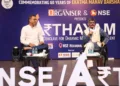
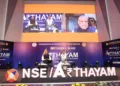
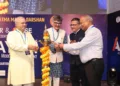
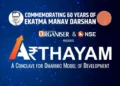
Arthayam Conclave, jointly organised by Organiser Weekly and the National Stock Exchange (NSE)

Arthayam Conclave, jointly organised by Organiser Weekly and the National Stock Exchange (NSE)

Facebook
Twitter
WhatsAppTelegramEmail

At the NSE headquarters in Mumbai, the Arthayam Conclave, jointly organised by Organiser and the National Stock Exchange (NSE), continued its deliberations with Session 3: Money Matters. The conclave was dedicated to commemorating sixty years of Pandit Deendayal Upadhyaya Ji’s philosophy of Ekatma Manav Darshan (Integral Humanism), a vision that insists development must harmonise with Dharma, family, and cultural roots.

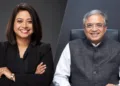
The session brought together eminent financial thinkers, Kanagasabhapathi Ji, Mrugank Ji, and Shri Satish Marathe Ji, Sahakar Bharati founding member and Director, Reserve Bank of India (RBI), who examined how India’s financial culture, savings habits, and cooperative systems continue to reflect the deep interdependence of society, economy, and spirituality.

Trust, savings and culture as economic foundations

Opening the session, Kanagasabhapathi Ji drew attention to the uniqueness of Bharat’s financial traditions. Unlike in the West, he argued, economic behaviour in India cannot be explained solely through institutions or abstract theories.

“Institutions and units don’t work in India; it is the trust system that works. That’s how I came to work around Deendayal Upadhyaya Ji’s philosophy,” he recalled from his field studies.

According to him, India’s savings culture demonstrates this trust-based model. “Even today, more than 94 percent of families put money into houses, gold, or land, while only about 5 percent invest in the stock market. This behaviour may appear conservative, but it reflects deep trust in tangible and culturally safe assets,” he said.

Kanagasabhapathi Ji stressed that this orientation has been the bedrock of India’s economic resilience. “Seventy years ago, we were a poor economy. Today we are among the most proficient economies. Why? Because of our strong fundamentals, our Sanatan culture, our families, our societies,” he explained.

He illustrated his point with community examples. The Nadar community’s Mahamay system, where a fraction of every rupee spent is mandatorily contributed to a common fund, has sustained community growth for generations. Similarly, in Rajkot, entrepreneurial practices among migrants, where individuals work in urban centres for a few years before returning to establish local enterprises, reflect how relationship-based models power grassroots economies.

Financial inclusion and integral humanism

Building on these cultural insights, Mrugank Ji linked financial inclusion directly to the principles of Ekatma Manav Darshan. He emphasised that modern policies like Swadeshi and Atmanirbharta should not be seen as temporary economic strategies but as expressions of Bharat’s civilisational philosophy, where the focus is always on empowering the “lowest common person.”

“What we have done in the last three years with Jan Dhan, Aadhaar, and Mobile (JAM) is revolutionary. It has made financial inclusion almost a fundamental right. Today, whether I go shopping or transfer money, I can do everything on my phone,” he remarked.

For him, the true test of financial systems lies not in abstract growth rates but in whether they deliver dignity, accessibility, and empowerment to people on the margins. This, he argued, is where Integral Humanism offers a guiding light, connecting technology, accessibility, and Dharma.

Strengthening the rural and cooperative economy

The session then turned to Shri Satish Marathe Ji, Sahakar Bharati founding member and RBI Director, who shed light on the neglected yet vital rural economy. He underscored that more than half of India’s MSMEs are located in rural areas and yet remain underserved by mainstream financial systems.

“India’s cooperative movement is the largest in the world, yet for years we looked at cooperatives as service societies rather than economic enterprises. That is why we demanded and finally got a dedicated Ministry,” he said.

Marathe Ji welcomed the government’s decision to establish 2.5 lakh Primary Agricultural Cooperative Societies (PACS) as a significant move but argued that deeper reforms were needed. He proposed two critical measures:

Aligning PACS with digital payment gateways so that rural enterprises can integrate seamlessly with modern markets.

Providing deposit mobilisation facilities to strengthen the financial base of rural cooperatives.

He noted that rural income patterns have undergone a dramatic shift. “It is not just agriculture anymore. Activities from small manufacturing to services need structured financial support. If we align our cooperative institutions with modern systems, the rural economy will become the backbone of India’s growth story,” he explained.

A dharmic financial model for Bharat

The session concluded with a common recognition that Bharat’s financial story cannot be reduced to Western economic models or corporate theories. Household savings in gold and land, community-based funds like Mahamay, and large-scale cooperative networks highlight how India’s economy is inseparable from its social and cultural fabric.

By rooting finance in Ekatma Manav Darshan, the speakers showed how Bharat’s economic model must remain relationship-based, family-oriented, and culturally conscious. As Kanagasabhapathi Ji aptly summed it up, “We need to work in a relationship-based economic society. That is where India’s strength lies.”

In essence, “Money Matters” reinforced the Arthayam Conclave’s larger message, that Bharat’s path to prosperity and global leadership lies in drawing from its Dharmic ethos, where economy, culture, and society are not separate silos but interwoven elements of a holistic development model.


Topics: Organiser NSE conclavePt Deendayal UpadhyayaEkatma Manav Darshan ideologyArthayam 2025
Subhi Vishwakarma
Subhi Vishwakarma
Subhi Vishwakarma is a journalist known for her reporting on issues such as forced religious conversions, organised missionary and Islamist networks, and grooming gangs. Her political coverage from Jharkhand and West Bengal has garnered significant attention for its depth and ground-level insights. In addition to her work on anti-Bharat activities, she also writes extensively on education, law, and broader social issues. She has previously been associated with SwarajyaMag, Sewa Nyaya Utthan Foundation, and Gems of Bollywood. She can be followed on X at @subhi_karma. [Read more]
Share
Tweet
SendShareSend
✮ Subscribe Organiser YouTube Channel. ✮
✮ Join Organiser's WhatsApp channel for Nationalist views beyond the news. ✮
Previous News

“US tariffs are nothing but dadagiri”: Milind Deora at Organiser-NSE Arthayam in Mumbai 

Next News

‘From Romance to Resolve’: Dr Ram Madhav at Arthayam urges Bharat to turn civilisational wisdom into working models

Related News

GST Completes 9 Years: A landmark reform reshaping India's economy

9 Years of GST: The reform that reshaped India’s economic landscape

PM Narendra Modi inaugurates Rashtriya Prerna Sthal on the occasion of the birth anniversary of former PM and BJP leader Atal Bihari Vajpayee

PM Modi inaugurates Rashtra Prerna Sthal: Tribute to Syama Prasad Mookerjee, Pt Deendayal Upadhyaya & Atal ji

Milind Deora, MP (Rajya Sabha), delivered an engaging session on “Democracy and Diplomacy in the Turbulent World”

“US tariffs are nothing but dadagiri”: Milind Deora at Organiser-NSE Arthayam in Mumbai 

Organiser Weekly, in association with the National Stock Exchange (NSE), hosted “Arthayam: A Conclave for Dharmic Model of Development” in Mumbai

“Ekatma Manav Darshan is not arrested by the context, hence eternal”: S. Gurumurthy at Organiser-NSE Arthayam in Mumbai

Organiser hosts "Arthayam: A Conclave for Dharmic Model of Development" in Mumbai with NSE

“Fairness and inclusion of all – the quintessential feature of Dharma”: Sunil Ambekar at Organiser-NSE Arthayam 

Arthayam: A Conclave for Dharmic Model of Development

Organiser to host “Arthayam: A conclave for dharmic model of development” with NSE in Mumbai

Load More

Latest News

A century-old Hindu Mandir in Pakistan’s Narowal was demolished by Islamic zealots over land encroachment claims

Over 100-year-old Hindu Mandir demolished in Pakistan’s Punjab, Narowal, to make way for madrassa

Prime Minister Narendra Modi in Tashkent

PM Modi pushes for Thirukkural translation in Tashkent as India-Uzbekistan ties reach comprehensive strategic level

The Hague based Permanent Court of Arbitration

India rejects Pakistan-favouring Indus Treaty award, calls Hague-based arbitration body ‘illegally constituted’

Augustine Brothers (inset)

Keralam: ED and SIT to probe Augustine Brothers over Rs 126 Cr deal after Nov ’25 Messi tour cancellation

Indianisation does not mean making all people Hindus; unity can be built on common spiritual reality: Guruji Golwalkar

Jharkhand's former Chief Minister Babulal Marandi (Left) and Union Home Minister Amit Shah (Right)

Bangladeshi infiltration in Jharkhand’s Santhal Pargana a national security threat: Babulal Marandi writes to Amit Shah

From left, India's EAM S. Jaishankar, PM Narendra Modi and NSA Ajit Doval during the 16th BRICS Summit in Kazan, Russia, in 2024

BRICS New Delhi Summit 2026: India to push digital currencies for uninterrupted, cheaper cross-border payments

Guru Amar Das Ji, the Third Sikh Guru

Jyoti Jot Day: Remembering Guru Amar Das Ji, the Guru who strengthened the tradition of langar and equality

Congress MLA Ashok Kumar Rai (Left), Chief Minister DK Shivakumar (Right)

Karnataka ‘7 per cent Commission’ Row: Congress MLA’s charge puts Shivakumar govt under scanner

Congress smears paint on Telangana BJP office, attacks Nalgonda leader’s home; N Ramchander Rao warns of reply

Load More
  • Privacy
  • Terms
  • Cookie Policy
  • Refund and Cancellation
  • Delivery and Shipping

© Bharat Prakashan (Delhi) Limited.
Tech-enabled by Ananthapuri Technologies

  • Home
  • Search Organiser
  • Bharat
    • Assam
    • Bihar
    • Chhattisgarh
    • Jharkhand
    • Maharashtra
    • View All States
  • World
    • Asia
    • Africa
    • North America
    • South America
    • Europe
    • Australia
  • Editorial
  • Operation Sindoor
  • Opinion
  • Analysis
  • Defence
  • Culture
  • Sports
  • Business
  • RSS @ 100
  • Entertainment
  • More ..
    • Sci & Tech
    • Vocal4Local
    • Special Report
    • Education
    • Employment
    • Books
    • Interviews
    • Travel
    • Health
    • Politics
    • Law
    • Economy
    • Obituary
  • Subscribe Magazine
  • Read Ecopy
  • Advertise
  • Circulation
  • Careers
  • About Us
  • Contact Us
  • Policies & Terms
    • Privacy Policy
    • Cookie Policy
    • Refund and Cancellation
    • Terms of Use

© Bharat Prakashan (Delhi) Limited.
Tech-enabled by Ananthapuri Technologies