Bengal Files: The unending saga of partition
August 16, 2026
  • Read Ecopy
  • Circulation
  • Advertise
  • Careers
  • About Us
  • Contact Us
Android AppiPhone AppArattai
Organiser
  • ‌
  • Bharat
    • Assam
    • Bihar
    • Chhattisgarh
    • Jharkhand
    • Maharashtra
    • View All States
  • World
    • Asia
    • Europe
    • North America
    • South America
    • Africa
    • Australia
  • Editorial
  • International
  • Opinion
  • RSS @ 100
  • More
    • Op Sindoor
    • Analysis
    • Sports
    • Defence
    • Politics
    • Business
    • Economy
    • Culture
    • Special Report
    • Sci & Tech
    • Entertainment
    • G20
    • Azadi Ka Amrit Mahotsav
    • Vocal4Local
    • Web Stories
    • Education
    • Employment
    • Books
    • Interviews
    • Travel
    • Law
    • Health
    • Obituary
  • Subscribe
    • Subscribe Print Edition
    • Subscribe Ecopy
    • Read Ecopy
  • ‌
  • Bharat
    • Assam
    • Bihar
    • Chhattisgarh
    • Jharkhand
    • Maharashtra
    • View All States
  • World
    • Asia
    • Europe
    • North America
    • South America
    • Africa
    • Australia
  • Editorial
  • International
  • Opinion
  • RSS @ 100
  • More
    • Op Sindoor
    • Analysis
    • Sports
    • Defence
    • Politics
    • Business
    • Economy
    • Culture
    • Special Report
    • Sci & Tech
    • Entertainment
    • G20
    • Azadi Ka Amrit Mahotsav
    • Vocal4Local
    • Web Stories
    • Education
    • Employment
    • Books
    • Interviews
    • Travel
    • Law
    • Health
    • Obituary
  • Subscribe
    • Subscribe Print Edition
    • Subscribe Ecopy
    • Read Ecopy
Organiser
  • Home
  • Bharat
  • World
  • Operation Sindoor
  • Editorial
  • Analysis
  • Opinion
  • Culture
  • Defence
  • International Edition
  • RSS @ 100
  • Magazine
  • Read Ecopy
Home Bharat

Bengal Files: The unending saga of partition

The powerful retelling of history brought hidden chapters of the past to light, forcing viewers to confront truths that shaped the nation. The film challenges audiences to reflect, remember, and consider the responsibility that comes with understanding history before its consequences repeat

Aritra Ghosh DastidarAritra Ghosh Dastidar
Sep 16, 2025, 07:30 pm IST
inBharat, Special Report, Culture
Follow on Google News
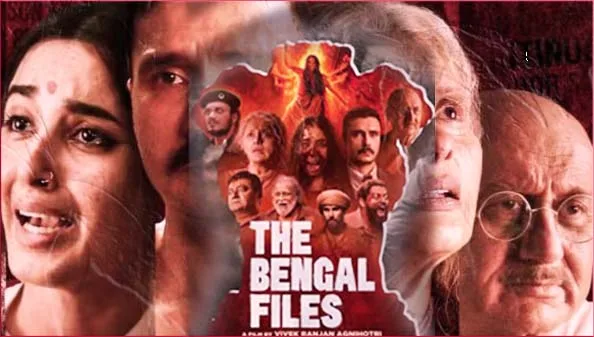
The poster of Bengal Files film

The poster of Bengal Files film

Facebook
Twitter
WhatsAppTelegramEmail

There are films that entertain, there are movies that inform, and then there are masterpieces like The Bengal Files – that awaken. It does not let the audience sit back comfortably; instead, it drags us into one of the darkest chapters of Bharatiya history and forces us to confront its relevance in today’s Bengal, both in West Bengal and in Bangladesh. The story revolves around Direct Action Day of 1946, the Noakhali riots, and the Great Calcutta Killings, those events that scarred the very soul of Bengal. Yet the film is not content with merely being a historical retelling. It draws an unflinching line between the chaos of the past and the tensions of the present. Watching it, one cannot escape the uncomfortable realisation that the faultlines of the 1940s still exist, albeit in new forms.

Characters That Speak to the Soul

Mithun Chakraborty gives a career defining performance as a madman who seems detached from reality yet speaks the deepest truths of the nation. His madness is not weakness — it is the madness of suppressed voices, of generations of people who suffered silently, of Bharat itself crying out for recognition. In his character, we see both rage and compassion, both anguish and an indomitable will to endure. He is not just an individual on screen; he becomes the mirror of our collective consciousness.

Pallavi Joshi similarly takes on the character of Bharati Banerjee metaphorically as our beloved ‘Maa Bharati ‘. It is a performance laden with symbolism. She represents the motherland — violated, injured, and still caring for her sons and daughters with hope and affection. At times, her eyes speak the tale of a thousand years of pain and persistence. Watching her means witnessing the embodiment of Mother India itself — shattered yet intact. Other historical characters such as of Suhrawardy, Gopal Mukherjee and Gandhiji beautifully intersect and weave the fabric of the film. Directed by Vivek Agnihotri, the film intertwines both the history and the present, making us think about the future.

Strength and Critique

There are moments of sharp brilliance in the film. The observation about how the police functioned then and now as puppets of the ruling powers is a criticism that hits uncomfortably close to home. It serves as a reminder of the risks that arise when institutions established to protect the people yield to political forces, losing their autonomy.

All the same, the film stutters at points. Gopal Patha’s ideology and historical gravity as one of the most central characters in those riots warranted greater elucidation and profundity. His ideology and actions, pivotal in resisting the tide of communal violence, do not just constitute a footnote in history but a whole section. By somewhat playing him down, the film misses the chance to depict the sense of self defense that Hindus in Bengal at that time represented.

Additionally, while dramatic liberties are expected in cinema, here they soften the scale of brutality of the Great Calcutta Killings. The chaos, the bloodshed, the sheer inhumanity of those days cannot be captured fully on screen, but one feels the film could have taken a bolder step in confronting the audience with the raw horror. It is known that the streets of Kolkata turned red with the dripping blood from the naked hindu women’s dead bodies. After all, history was not gentle. It was brutal, and perhaps the film could have reflected that brutality more fearlessly.

What makes The Bengal Files extraordinary is not just its historical content but its ability to hold up a mirror to the present. In today’s Bengal, where identity politics, communal divisions, and political manipulation remain as sharp as ever, this film serves as both a warning and a lesson. It tells us that if we do not learn from the mistakes of the past, we risk repeating them.

For viewers in West Bengal, it is a recapitulation of long buried wounds; for the people in Bangladesh, it evokes the unseen anguish that continues to inform their collective psyche. For the rest of Bharat, it is a primer in how vulnerable our social fabric can be when polluted by politics and power games.

Rather than history, this film is about human life — roofs blown off and families separated, mothers who cannot locate children, and people who became each other’s enemies overnight. It’s not comfortable viewing. Sometimes, it seems as if a mirror has been placed in front of you to question, “If this were to recur today, would you remain quiet? Would you do something? Or turn a blind eye?” This unease, this agitation, is what makes the film indelible.

It is a film that Bharatiyas should watch—not just as history, but as a warning and a responsibility. It recreates for us the reality that the Bengal tragedies were not isolated events; they were national tragedies that shaped the fate of the subcontinent itself. If we remember them honestly, the echoes of those events may not become reality again. The Bengal Files doesn’t just inform us about what happened; it forces us to decide what precisely we will do with that memory.


Topics: Great Calcutta KillingsWest BengalDirect Action DayNoakhali riotsThe Bengal Files
Share
Tweet
SendShareSend
✮ Subscribe Organiser YouTube Channel. ✮
✮ Join Organiser's WhatsApp channel for Nationalist views beyond the news. ✮
Previous News

Chhattisgarh liquor scam case: Chaitanya Baghel handled ‘proceeds of crime’ worth around Rs 1000 crore, claims ED

Next News

PM Narendra Modi at 75: Resolve Strength and SEWA in action

Related News

Muslim League anchored planned atrocities against Hindus on Direct Action Day in Calcutta

Decoding the horrors of Direct Action Day; Revisiting the forgotten lessons from the streets of Calcutta

Great Calcutta Killings 1946

Great Calcutta Killings in August 1946: Urban pogrom and the teleology of partition in colonial Bengal and India

Two decades after Mamata Banerjee drove Tata out of Singur, Bengal is now seeking the industrial giant's return. (AI-generated Image)

From ‘Tata go back’ to ‘Tata come back’: Bengal begins undoing Mamata’s Singur disaster

Exiled Bangladeshi writer Taslima Nasrin speaks during a citizens felicitation programme titled 'Returning to a Free West Bengal After 19 Years'

‘One of the longest nights of my life’: Taslima Nasreen recalls forced exit from Kolkata after 2007 protests

Bengal CM Suvendu Adhikari assures exiled Bangladeshi author Taslima Nasrin of security

‘Come as many times as you want’: Bengal CM Suvendu Adhikari assures Taslima Nasreen of full security

Representative Image

India to set up 40 Intelligence Bureau units in Bangladesh border; Shield against infiltration & organised crimes

Load More

Latest News

Muslim League anchored planned atrocities against Hindus on Direct Action Day in Calcutta

Decoding the horrors of Direct Action Day; Revisiting the forgotten lessons from the streets of Calcutta

Punjab: NHRC member Priyank Kanoongo flags no I-Day Celebrations at schools near India-Pak border; questions AAP Govt

Great Calcutta Killings 1946

Great Calcutta Killings in August 1946: Urban pogrom and the teleology of partition in colonial Bengal and India

Independence Day 2026: World leaders wish India, hail its global rise & growth story; Signals deeper strategic ties

Kerala: Halal Fayida Islamic Banking Cooperative Society depositors stranded as crores remain unaccounted for

Abusive language used during recent protest in Delhi cannot be the language of Bharatiya youth. It is time to introspect yourself where are we making mistakes in guiding our future generation

80th Independence Day: Youth and Nation – Change begins with responsibility

The Tiranga embodies India’s freedom, unity and values, inspiring us to turn patriotism into responsible action

From Tiranga in Every Home to Tiranga in Every Heart: Turning national pride into everyday patriotism

Atul Limaye, Sah Sarkaryavah, RSS, while addressing at an Akhil Bharatiya Vidyarthi Parishad (ABVP), the student wing of the RSS, event held in Chhatrapati Sambhajinagar in Maharashtra, on August 2

Independence Day 2026: Youth and Nation – The Anarchic alternative

Keralam: CM Satheeshan omits Vande Mataram on Independence Day at govt offices; BJP events render full version

Decolonisation saw nations across Africa and Southeast Asia reclaim their cultures, languages and identities after independence (This image is generated by AI)

From Colonial Rule to Cultural Revival: How African and Southeast Asian nations shed their colonial legacies

Load More
  • Privacy
  • Terms
  • Cookie Policy
  • Refund and Cancellation
  • Delivery and Shipping

© Bharat Prakashan (Delhi) Limited.
Tech-enabled by Ananthapuri Technologies

  • Home
  • Search Organiser
  • Bharat
    • Assam
    • Bihar
    • Chhattisgarh
    • Jharkhand
    • Maharashtra
    • View All States
  • World
    • Asia
    • Africa
    • North America
    • South America
    • Europe
    • Australia
  • Editorial
  • Operation Sindoor
  • Opinion
  • Analysis
  • Defence
  • Culture
  • Sports
  • Business
  • RSS @ 100
  • Entertainment
  • More ..
    • Sci & Tech
    • Vocal4Local
    • Special Report
    • Education
    • Employment
    • Books
    • Interviews
    • Travel
    • Health
    • Politics
    • Law
    • Economy
    • Obituary
  • Subscribe Magazine
  • Read Ecopy
  • Advertise
  • Circulation
  • Careers
  • About Us
  • Contact Us
  • Policies & Terms
    • Privacy Policy
    • Cookie Policy
    • Refund and Cancellation
    • Terms of Use

© Bharat Prakashan (Delhi) Limited.
Tech-enabled by Ananthapuri Technologies