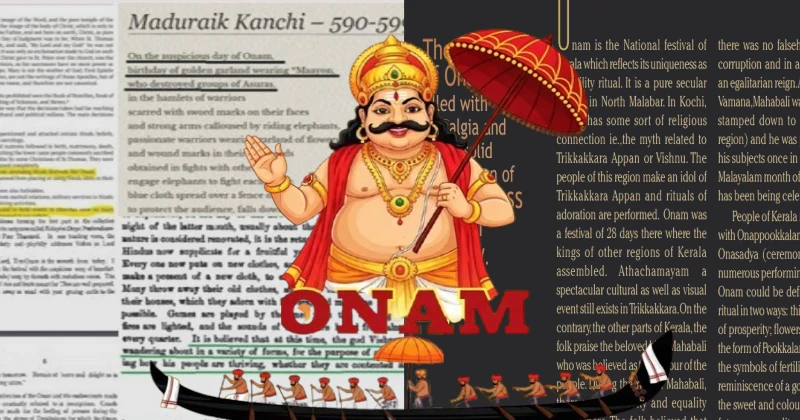
On September 5, 2025, Kerala once again lit up with the grandeur of Onam, its biggest festival marked by floral carpets, the majestic Onasadya feast, Kathakali performances, and snake-boat races. At first glance, it seemed like an innocent celebration of prosperity, equality, and joy. But beneath the layers of festivity lies a deeper ideological battle one that has raged for over a century.
Onam, historically and scripturally, is a Hindu festival dedicated to Bhagwan Vishnu and King Mahabali. Records stretching from 9th-century Chera copper plates to Sangam poetry and the Malabar Manual establish its religious character beyond doubt. Yet, from the early 20th century to the present day, political, social, and religious actors have deliberately reinterpreted, rebranded, and secularised Onam turning it from a Hindu itihasa-based festival into a “secular cultural symbol of Kerala’s unity.”
Here are 11 landmark incidents between 1920 and 2025 that demonstrate how Onam’s Hindu roots were gradually diluted, reframed, and sometimes even vilified.
Caste Reformers and Communists Recast Mahabali (1920–1940)
The earliest assault on Onam’s sacred Hindu identity came not from foreign missionaries or Islamist groups, but from within Kerala’s own political and reformist currents. The period between 1920 and 1940 marked a decisive ideological turning point, when social reformers, Communists, and Congress leaders began reinterpreting the story of Mahabali and Vamana through the lens of caste conflict and class struggle.
Early 20th-century Kerala was a land in flux. The caste system had indeed created entrenched hierarchies that left sections of society oppressed and humiliated. Social reform movements like the Sree Narayana Dharma Paripalana (SNDP) movement challenged Brahmanical dominance. Meanwhile, the Communist movement, gaining ground in Malabar and Travancore, sought local myths and symbols to mobilise people against landlords and colonial authorities.
Into this context stepped the legend of Mahabali the Asura king who was beloved for his generosity and fairness, yet was sent to the netherworld by Vishnu’s Vamana avatar. Reformists and ideologues saw in Mahabali the perfect anti-caste and anti-Brahmin symbol.
- Communist appropriation: E.M.S. Namboodiripad, Kerala’s most prominent Communist leader, argued that Mahabali’s reign symbolised a time of “primitive communism” — a classless society where justice, equality, and prosperity prevailed. For him, the Onam legend was not about devotion to Vishnu but about a pre-class utopia destroyed by Brahmanical cunning.
- Anti-Brahmin narrative: Social reform poets and leaders began to cast Mahabali as a low-caste king betrayed by Vamana, a Brahmin dwarf, who represented “Aryan trickery.” This interpretation turned a sacred story of divine dharma into a tale of caste conflict.
- Congress reinterpretation: Nationalist writers aligned Mahabali with Gandhian ideals of justice, morality, and swaraj. Mahabali was reframed as a symbol of self-rule, separated from Vishnu’s sanction.
Consequences
This period planted the first seeds of secularisation:
- Theological dislocation — Mahabali was no longer primarily Vishnu’s devotee. Instead, he was rebranded as a tragic hero of oppressed castes.
- Demonisation of Vamana — Instead of being Vishnu’s avatar upholding cosmic dharma, Vamana was portrayed as a cheat who destroyed justice with Brahminical cunning.
- Political weaponisation — Both Communists and Congress leaders used Mahabali as a mobilising tool, detaching him from temples and ritual life.
Onam Declared Kerala’s State Festival (1961): Source Kerala Tourism
If the 1920–40 reinterpretations marked the intellectual beginning of secularisation, then 1961 was the institutional milestone. That year, the government of Kerala under Pattom Thanu Pillai’s cabinet formally declared Onam as the state festival. What had always been a sacred Hindu celebration was suddenly reframed as “Kerala’s national festival.”
Post-Independence India was gripped by the Nehruvian project of secular nation-building. Festivals and traditions rooted in Hindu practice were increasingly rebranded as “cultural” or “regional” events to fit the secular socialist framework.
In Kerala, the Communist Party had already gained power by 1957 under E.M.S. Namboodiripad. Even though Pattom Thanu Pillai of the Praja Socialist Party was Chief Minister in 1961, the intellectual environment was dominated by Leftist secularism.
The decision to declare Onam as the state’s official festival had far-reaching consequences:
- Government takeover: Onam celebrations were no longer confined to temples and Hindu households. The state began organising and funding public events.
- Rebranding as “Kerala’s festival”: By calling it the “national festival of Kerala”, the government subtly erased its Vishnu–Mahabali foundation.
Secular narrative: State sponsorship meant that Onam was portrayed not as a religious festival but as a symbol of Kerala’s unity across castes and religions. - Detachment from temples: Onam rituals, especially at the Thrikkakara Vamana Temple, were sidelined in public discourse. Instead, focus shifted to civic parades, competitions, and cultural programs.
Tourism and spectacle: The seeds were sown for Onam’s later transformation into a tourism carnival, where the spiritual meaning was overshadowed by commercial display. - Normalisation of secular Onam: By elevating Onam to a state festival, the government effectively secularised it. Hindus celebrating it as Vishnu’s boon to Mahabali became one voice among many “cultural interpretations.”
Kerala Calling’s 2009 Cultural Manipulation- Source: Kerala Calling
In September 2009, the Government of Kerala’s official publication Kerala Calling released its Onam edition with an astonishing claim: Onam is not Hindu, but a festival that belongs to all Keralites, transcending religion and community. This was not a stray editorial choice it was a deliberate state-level narrative assault on the festival’s Hindu identity.
By the 2000s, Kerala was firmly entrenched in Leftist cultural politics. The Communist Party (Marxist) was in power, controlling the ideological narrative across schools, universities, and media. The push was to recast Hindu traditions as “secular cultural heritage”, stripping them of devotional legitimacy while still benefiting from their mass appeal.
Tourism had also become a driving force. Onam, with its vibrant visuals of pookalams (floral designs), Vallam Kali (snake boat races), and Pulikali (tiger dances), was packaged as Kerala’s global brand. To sell it internationally, its connection to Bhagwan Vishnu and Mahabali had to be diluted the “Hindu-ness” was bad for secular optics.
Kerala Calling’s edition proudly declared Onam as:
- A secular harvest festival: Presented as an “agrarian thanksgiving” without acknowledgment of its temple roots.
- A cultural carnival: Reduced to boat races, dances, and feasts all stripped of their spiritual context.
- Kerala’s inclusive identity: Framed as proof that all communities Hindus, Muslims, and Christians equally owned Onam.
- The deliberate omission was clear: no mention of Vishnu, Mahabali’s devotion, or Thrikkakara temple rituals.
Consequences
- State-sanctioned narrative shift: This was no longer fringe intellectual appropriation. A government magazine made it official policy that Onam was “secular.”
- Generational impact: School children, reading government publications, absorbed a sanitised version of Onam devoid of Hindu roots.
- Tourism over dharma: The story of Onam was now an export commodity for foreign audiences, not a sacred festival.
Onam’s sacred rituals still continued in temples like Thrikkakara, where devotees offered prayers to Vamana. But in official records, Onam had already been hijacked by the secular establishment.
Hussain Bappu’s 2014 facebook post: Islamists claim Onam – Source: TOI
The ideological assault on Onam reached a new level in 2014, when Hussain Bappu, a known Islamist influencer, posted a viral Facebook message claiming, “Onam is not Hindu. Onam belongs to all Keralites. In fact, Onam is part of Kerala’s Muslim history too.”
By 2014, Islamist organisations in Kerala had grown in confidence, emboldened by a mixture of Gulf funding, Leftist patronage, and intellectual cover from secular elites. Unlike the Communists who merely wanted Onam as a “cultural festival,” Islamists began pushing a more aggressive claim: Onam is ours too.
This wasn’t new. Islamist groups in Kerala had long been attempting to appropriate regional traditions, much like Christian missionaries had rebranded Hindu practices in the past. What made Hussain Bappu’s post significant was its timing and reach — social media had now become the frontline of narrative warfare.
Bappu’s post went beyond the secular narrative. He made three core claims:
- Onam as “universal”: Declared that Onam was never about Vishnu, only about “Kerala’s unity.”
- Muslim ownership: Asserted that Muslims had celebrated Onam for centuries, linking it to local feasts and harvest rituals.
- Attack on Hindus: Suggested that Hindus who insisted on the Vishnu–Mahabali story were “communalising” Onam.
Consequences
- Islamist confidence: The post emboldened Islamist groups to appropriate Onam as their own.
- Mainstream amplification: Secular media outlets began quoting such posts to argue that “Onam has always been inclusive.”
- Public opinion warfare: Hindu voices defending Onam’s true roots were branded as “Hindutva extremists.”
Hussain Bappu’s post symbolised a new phase: Islamist capture of secular narratives. What Communists had begun in the 1920s as caste-based reinterpretation, Islamists now extended into outright religious appropriation.
Muslim Educational Society (MES) Promotes Onam as a “Secular Dravidian Festival” (2016)- Source: Deccan Chronicle, TOI
The year 2016 marked a turning point. By now, Onam had already been framed in secular-cultural terms by Communists and repackaged by tourism lobbies. But Islamists wanted more: they wanted Onam detached from Hinduism completely.
The Muslim Educational Society (MES), one of Kerala’s largest networks of Muslim-run schools and colleges, took the lead. While some Islamist clerics had earlier condemned Muslims celebrating Onam as “unislamic,” MES turned the debate on its head.
The MES Standpoint
- MES declared Onam was not a Hindu festival at all, but rather a “Dravidian harvest festival” belonging to Kerala’s soil.
- They said celebrating Onam was part of Kerala’s secular heritage, not religion.
- The organisation promoted Onam celebrations in campuses, even in areas where Islamists had previously discouraged them.
This way, Muslims could celebrate without guilt, Christians could participate without hesitation, and Hindus were left robbed of their spiritual foundation.
Consequences
- Mainstream acceptance: Within a few years, media houses and textbooks began echoing this line — Onam as “Kerala’s harvest festival.”
- Marginalisation of Hindu voices: Those who pointed to Onam’s Vishnu roots were branded as “Hindutva forces” distorting history.
- Secular-Islamist alliance: MES’s positioning allowed Leftist intellectuals and Islamists to join hands in erasing Onam’s Hindu character.
But MES ensured that a generation of Malayali students would grow up hearing Onam described not as a Hindu celebration of Vishnu and Mahabali, but as a harvest carnival for all.
Kerala Reacts to Amit Shah’s Vamana Jayanti Greeting (2016)- Source: TOI, Hindustan Times
In September 2016, just before Onam, BJP president Amit Shah posted a greeting card on Twitter. It depicted Vamana placing his foot on King Mahabali’s head — a classic rendering of the Vishnu–Mahabali story. The message: “Greetings on Vamana Jayanti.”
What followed was an explosive backlash in Kerala. The outrage wasn’t just emotional it was strategic. By framing Amit Shah’s greeting as a Hindutva conspiracy.
Shashi Tharoor and Christian Nuns Performing Thiruvathirakali (2017)- Source: Hindustan Times
In 2017, Congress MP Shashi Tharoor posted a video on Facebook that went viral. It showed a group of Christian nuns performing Thiruvathirakali (the traditional women’s dance performed during Onam) around a floral pookalam.
Tharoor praised the event as the true spirit of Kerala’s Onam inclusive, secular, and beyond religion.
The video was symbolic, but loaded:
- Christian nuns, not Hindu women, were shown as the cultural torchbearers of Onam traditions.
- Tharoor framed it as proof of “Kerala’s communal harmony.”
- The media amplified the message, using the performance as evidence that Onam “belongs to all.”
Onam at Noorul Islam Madrasa and Huda Masjid (2019)- Source: The New Indian Express
In 2019, media outlets carried glowing reports about two Muslim institutions in Malappuram Noorul Islam Madrasa and Huda Masjid celebrating Onam. Children laid pookalams, sang Onam songs, and even dressed as Maveli. The masjid donated clothes to 50 Hindu families, earning praise for “communal harmony.”
- Headlines celebrated Muslims for embracing Onam.
- Secular commentators highlighted this as “Kerala’s spirit of brotherhood.”
- Hindus were expected to applaud the “generosity” of Muslims for participating.
But beneath the optics lay deeper problems:
- Islamist control: Hardline clerics who had once called Onam “unislamic” were now silent because the “secular Dravidian” framing had gained dominance.
- Power inversion: Mosques and madrasas positioned themselves as cultural hosts of a Hindu festival — a subtle but powerful shift.
- Charity politics: By donating clothes to Hindus, the masjid earned goodwill, but also reframed Hindus as “recipients” in their own festival.
Syro-Malabar Church Declares Onam “Cultural, Not Religious” (2024)- Source: Madhyamam Online
In September 2024, the Syro-Malabar Church issued an official statement:
“For Christians, Onam is not a religious festival but a cultural one. Feasting, pookalams, Pulikali, and Thiruvathirakali are cultural expressions, not religious rituals. Onam is a symbol of love, unity, and brotherhood.”
Church’s Calculated Position
- The Church did not want Christians accused of rejecting Onam.
- But it also did not want to admit that celebrating Onam meant engaging in Hindu rituals.
- So it cleverly rebranded Onam as cultural, not religious.
Pinarayi Vijayan and the Nava Kerala Narrative (2025)- Source: The Voice of Chandigarh
In September 2025, Kerala Chief Minister Pinarayi Vijayan inaugurated the state’s Onam celebrations with a political speech. He declared: “Kerala’s unity, communal harmony, and inclusive mindset are the reasons for our state’s progress. Onam symbolises this vision, which aligns with our Nava Kerala project.”
Pinarayi Vijayan used Onam as:
A political platform to showcase the Left government’s developmental agenda.
A symbol of secular Kerala where religion supposedly had no role.
A propaganda tool to project the Communist Party as the guardian of Kerala’s identity.
Consequences
State appropriation: The government projected Onam as a civic festival, not a Hindu one.
Political branding: Nava Kerala was tied to Onam, reducing the sacred into campaign material.
Narrative closure: With the state fully invested, Onam’s Hindu identity was systematically erased from official discourse.
Early 20th-Century Caste Reformers and Communists Recast Mahabali (1920–40)- Source: Indian Express
Though chronologically earlier, this incident must be revisited because it set the template for all later distortions. Between 1920–40, Kerala’s caste reformers, Communists, and Congress writers began recasting Mahabali:
- Mahabali was portrayed as a low-caste king betrayed by Brahmins.
- His reign was described as an era of “primitive communism,” echoing Marxist utopia.
- Social reform poets and Congress writers used Mahabali as a symbol of equality and justice, detached from Vishnu.
Between 1920 and 2025, Onam’s story shows a clear pattern of systematic distortion. In the 1920s–40s, caste reformers and Communists reframed King Mahabali as a victim of Brahmins and a proto-Communist hero. By 1961, the Kerala government declared it a state festival, shifting it into civic–secular space. The 1980s tourism boom commercialised it into a cultural carnival, while between 2009 and 2014, secular intellectuals and Islamists began openly branding it “secular.”
The tactic was consistent to erase Bhagwan Vishnu, recast Mahabali as secular, and market Onam as Kerala’s brand stripped of dharmic roots. The tragedy is that millions now celebrate Onam without knowing it is a Vaishnava festival rooted in Bhagwan Vishnu’s Vamana avatar, honouring Mahabali’s devotion. Its temple traditions at Thrikkakara and beyond have been overshadowed, reducing Onam to pookalams, feasts, and boat races a secular carnival divorced from its sacred essence.