One Nation, One Election: A new era of India's electoral system
June 25, 2026
  • Read Ecopy
  • Circulation
  • Advertise
  • Careers
  • About Us
  • Contact Us
Android AppiPhone AppArattai
Organiser
  • ‌
  • Bharat
    • Assam
    • Bihar
    • Chhattisgarh
    • Jharkhand
    • Maharashtra
    • View All States
  • World
    • Asia
    • Europe
    • North America
    • South America
    • Africa
    • Australia
  • Editorial
  • International
  • Opinion
  • RSS @ 100
  • More
    • Op Sindoor
    • Analysis
    • Sports
    • Defence
    • Politics
    • Business
    • Economy
    • Culture
    • Special Report
    • Sci & Tech
    • Entertainment
    • G20
    • Azadi Ka Amrit Mahotsav
    • Vocal4Local
    • Web Stories
    • Education
    • Employment
    • Books
    • Interviews
    • Travel
    • Law
    • Health
    • Obituary
  • Subscribe
    • Subscribe Print Edition
    • Subscribe Ecopy
    • Read Ecopy
  • ‌
  • Bharat
    • Assam
    • Bihar
    • Chhattisgarh
    • Jharkhand
    • Maharashtra
    • View All States
  • World
    • Asia
    • Europe
    • North America
    • South America
    • Africa
    • Australia
  • Editorial
  • International
  • Opinion
  • RSS @ 100
  • More
    • Op Sindoor
    • Analysis
    • Sports
    • Defence
    • Politics
    • Business
    • Economy
    • Culture
    • Special Report
    • Sci & Tech
    • Entertainment
    • G20
    • Azadi Ka Amrit Mahotsav
    • Vocal4Local
    • Web Stories
    • Education
    • Employment
    • Books
    • Interviews
    • Travel
    • Law
    • Health
    • Obituary
  • Subscribe
    • Subscribe Print Edition
    • Subscribe Ecopy
    • Read Ecopy
Organiser
  • Home
  • Bharat
  • World
  • Operation Sindoor
  • Editorial
  • Analysis
  • Opinion
  • Culture
  • Defence
  • International Edition
  • RSS @ 100
  • Magazine
  • Read Ecopy
Home Bharat

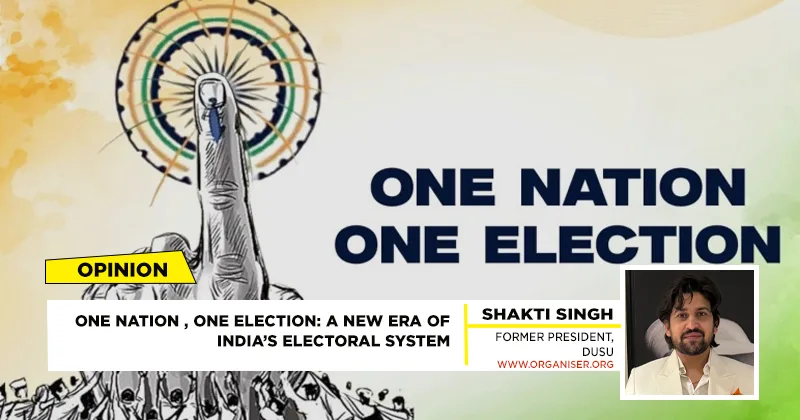
One Nation, One Election: A new era of India’s electoral system

“One Nation, One Election,” strongly championed by Prime Minister Narendra Modi, aims to synchronise Lok Sabha and State Assembly polls to cut costs, reduce governance disruptions, and bring stability to India’s democratic system

Shakti SinghShakti Singh
Sep 8, 2025, 09:15 pm IST
in Bharat, Opinion
Follow on Google News
FacebookTwitterWhatsAppTelegramEmail

In recent years, the idea of “One Nation, One Election” (ONOE) has emerged as one of the most significant electoral reform proposals in India. Championed strongly by Hon’ble Prime Minister Narendra Modi, the concept seeks to synchronise elections to the Lok Sabha and State Legislative Assemblies so that they are conducted simultaneously across the country. This reform has sparked robust debate, both for and against, but what is undeniable is its potential to reshape India’s democratic and governance landscape. At its core, One Nation, One Election envisions holding elections for the Lok Sabha (Parliament) and all state legislative assemblies simultaneously, once every five years. Instead of multiple electoral cycles spread throughout the year, India would have a single synchronised cycle. Panchayat and

municipal body elections, which are under State purview, could either be aligned subsequently or retained on separate timelines. In practice, this would mean that when voters go to the polling booths, they would cast two votes simultaneously—one for their Member of Parliament and one for their Member of the Legislative Assembly.The Election Commission of India (ECI) would thus conduct a single large-scale electoral exercise instead of organising elections in different states every few months.

India, the world’s largest democracy, also has one of the most expensive electoral processes. Elections in the country involve mammoth logistical arrangements: millions of polling booths, electronic voting machines (EVMs), security forces, polling personnel, and infrastructure

mobilisation. The 2010 Lok Sabha elections alone cost the exchequer around Rs 60,000 crore (including both government expenditure and political party spending, according to the Centre for Media Studies). A single state assembly election often costs several thousand crores,

including deployment of paramilitary forces, printing and transport of EVMs, and administrative overheads. Repeated elections divert significant resources: for example, during each Election, over 10 lakh government officials and security personnel are redeployed from regular duties. By synchronising elections, substantial savings in public expenditure can be achieved.

Manpower that is repeatedly diverted for election duties could remain focused on developmental and administrative work.

Several democracies around the world conduct synchronised national and regional elections, ensuring efficiency and stability. South Africa, for example, holds national and provincial elections simultaneously once every five years. This system provides clarity of mandate and reduces administrative costs. Sweden conducts elections to the Riksdag (national parliament) and local governments together every four years, ensuring harmony between governance levels. Similarly, Belgium organises simultaneous elections to federal, regional, and community parliaments to promote smoother governance coordination. These models demonstrate that synchronised elections are both practical and beneficial, creating electoral coherence while reducing resource strain.

The idea of simultaneous elections is not new to India. In fact, India practised it in the early years after independence. From 1951–52 to 1967, elections to the Lok Sabha and State Assemblies were held together. This system broke down when some state assemblies were

dissolved prematurely due to political instability, leading to unsynchronised cycles. Over time, frequent imposition of President’s Rule and early dissolutions widened the gap further, and India moved into a cycle of continuous elections. Thus, the current fragmented electoral calendar is not inherent to India’s democracy but a product of political contingencies.

Beyond cost and efficiency, the larger benefits of One Nation, One Election lie in governance stability and effectiveness. Model Code of Conduct (MCC), which comes into force during

elections, restricts the announcement of new schemes and projects. With elections scattered throughout the year, governance is repeatedly stalled. Simultaneous elections would reduce such interruptions. A consolidated election would also enable political parties to concentrate on policy implementation in between electoral cycles in a focused manner. And most importantly, citizens would have a clearer choice between national and state agendas in a single electoral moment, reducing fatigue and increasing turnout.

Prime Minister Narendra Modi has been the leading force behind reviving this debate. He has consistently emphasised that ONOE is not merely an administrative reform but a democratic necessity for a New India. In his speeches, PM Modi has argued that repeated

elections burden the economy, hinder governance, and impose unnecessary stress on citizens and the Election Commission alike. His leadership has ensured the idea is not just a theoretical proposal but a subject of serious discussion, with committees and think tanks examining its feasibility. This initiative reflects visionary leadership that focuses not on immediate political gains, but on long-term systemic reform.

Although there are also some legislative and technical challenges in the implementation of this reform, however, none of these challenges is insurmountable. With political consensus, phased implementation can pave the way. One Nation, One Election is not merely a logistical reform; it is a democratic reform. It promises to make India’s electoral system more efficient, cost-effective, and development-focused. The historical precedent, global examples, and governance benefits all point to its potential to strengthen India’s democratic fabric. By reducing election-related disruptions, saving resources, and enabling governments to focus squarely on policymaking, ONOE can empower both voters and institutions.

As India enters the Amrit Kaal of its democratic journey, this reform, envisioned and pushed forward by Honourable Prime Minister Sri Narendra Modi ji, could become a defining step in building a governance system that is efficient, stable, and truly responsive to the aspirations of 1.4 billion citizens.
Topics: PM ModiLok Sabha electionsOne Nation One ElectionElectoral coherenceNarendra Modi
ShareTweetSendShareSend
✮ Subscribe Organiser YouTube Channel. ✮
✮ Join Organiser's WhatsApp channel for Nationalist views beyond the news. ✮
Previous News

The leadership challenge in Punjab politics

Next News

Chhattisgarh: 3 arrested for putting Islamic flag atop Hanuman Dhwaja in Balrampur

Related News

Andhra Pradesh Minister and TDP National General Secretary Nara Lokesh

Nara Lokesh dismisses rumours of TDP sabotaging Modi government, reaffirms unconditional NDA support

Prime Minister Narendra Modi

‘Maoism is breathing its last’: PM Modi highlights crackdown on red terror in last 12 years and growth in tribal areas

Delhi Chief Minister Rekha Gupta paid tribute to Bharatiya Jana Sangh founder Syama Prasad Mookerjee on his death anniversary

Article 370 abrogation was the greatest tribute to Syama Prasad Mookerjee: Delhi CM Rekha Gupta

Prime Minister Narendra Modi

Viksit Bharat: PM Modi slams Congress — ‘Blocks development, claims credit’

A representative image

Organic manure adoption surges 3.5 times in Kharif 2026 as India builds fertiliser buffer against global turmoil

Prime Minister Narendra Modi and French President Emmanuel Macron

India-France 114-Rafale Deal: How New Delhi is turning defence procurement into a Make-in-India aerospace revolution

Load More

Latest News

Andhra Pradesh Chief Minister N. Chandrababu Naidu inaugurates the Jonnagiri Gold Mining Project in Kurnool district

Andhra Pradesh: CM Chandrababu Naidu lunches first major gold mining project in Kurnool district

AI-generated image for representation

Tamil Nadu: School teacher faces action over alleged humiliation of menstruating student

Cochin Shipyard (File Photo)

Keralam: ‘I Love Pakistan’ inscription found inside vessel at Cochin Shipyard; Central agencies launch probe

BJP national spokesperson Pradeep Bhandari

Karnataka: BJP accuses Kharge family of illegally acquiring government land worth over Rs 100 crore

Elomi Global Worship Centre in Omalloor, Pathanamthitta district ; Pastor Binu Vazhakkuttom (Left to Right)

Keralam: Child abuse allegations at Pentecostal worship centre in Pathanamthitta; locals demand Pastor Binu’s arrest

Modi Govt’s Tourism Revolution: 183 projects, Rs 9,225 crore investment & rise of India’s cultural & spiritual circuits

Padma Awards 2026: Tamil Nadu’s distinguished achievers receive national honours

India’s history is not merely a tale of foreign domination but also a remarkable story of resilience, resistance & civilisational continuity

Indian History: Not just foreign rule, but a timeless story of resistance, self-respect and civilisational resilience

From $10 Billion to $190 Billion: Indian Bioeconomy Touches New Heights in 12 Years

From $10 Billion to $190 Billion: India’s Bioeconomy leads a 12-Year science revolution

Nagpur | Acceptance of Bharatiya civilisational values is steadily increasing worldwide: Shanta Kumari

Load More
  • Privacy
  • Terms
  • Cookie Policy
  • Refund and Cancellation
  • Delivery and Shipping

© Bharat Prakashan (Delhi) Limited.
Tech-enabled by Ananthapuri Technologies

  • Home
  • Search Organiser
  • Bharat
    • Assam
    • Bihar
    • Chhattisgarh
    • Jharkhand
    • Maharashtra
    • View All States
  • World
    • Asia
    • Africa
    • North America
    • South America
    • Europe
    • Australia
  • Editorial
  • Operation Sindoor
  • Opinion
  • Analysis
  • Defence
  • Culture
  • Sports
  • Business
  • RSS @ 100
  • Entertainment
  • More ..
    • Sci & Tech
    • Vocal4Local
    • Special Report
    • Education
    • Employment
    • Books
    • Interviews
    • Travel
    • Health
    • Politics
    • Law
    • Economy
    • Obituary
  • Subscribe Magazine
  • Read Ecopy
  • Advertise
  • Circulation
  • Careers
  • About Us
  • Contact Us
  • Policies & Terms
    • Privacy Policy
    • Cookie Policy
    • Refund and Cancellation
    • Terms of Use

© Bharat Prakashan (Delhi) Limited.
Tech-enabled by Ananthapuri Technologies