Why India used air power, not drones, in Operation Sindoor?
June 28, 2026
  • Read Ecopy
  • Circulation
  • Advertise
  • Careers
  • About Us
  • Contact Us
Android AppiPhone AppArattai
Organiser
  • ‌
  • Bharat
    • Assam
    • Bihar
    • Chhattisgarh
    • Jharkhand
    • Maharashtra
    • View All States
  • World
    • Asia
    • Europe
    • North America
    • South America
    • Africa
    • Australia
  • Editorial
  • International
  • Opinion
  • RSS @ 100
  • More
    • Op Sindoor
    • Analysis
    • Sports
    • Defence
    • Politics
    • Business
    • Economy
    • Culture
    • Special Report
    • Sci & Tech
    • Entertainment
    • G20
    • Azadi Ka Amrit Mahotsav
    • Vocal4Local
    • Web Stories
    • Education
    • Employment
    • Books
    • Interviews
    • Travel
    • Law
    • Health
    • Obituary
  • Subscribe
    • Subscribe Print Edition
    • Subscribe Ecopy
    • Read Ecopy
  • ‌
  • Bharat
    • Assam
    • Bihar
    • Chhattisgarh
    • Jharkhand
    • Maharashtra
    • View All States
  • World
    • Asia
    • Europe
    • North America
    • South America
    • Africa
    • Australia
  • Editorial
  • International
  • Opinion
  • RSS @ 100
  • More
    • Op Sindoor
    • Analysis
    • Sports
    • Defence
    • Politics
    • Business
    • Economy
    • Culture
    • Special Report
    • Sci & Tech
    • Entertainment
    • G20
    • Azadi Ka Amrit Mahotsav
    • Vocal4Local
    • Web Stories
    • Education
    • Employment
    • Books
    • Interviews
    • Travel
    • Law
    • Health
    • Obituary
  • Subscribe
    • Subscribe Print Edition
    • Subscribe Ecopy
    • Read Ecopy
Organiser
  • Home
  • Bharat
  • World
  • Operation Sindoor
  • Editorial
  • Analysis
  • Opinion
  • Culture
  • Defence
  • International Edition
  • RSS @ 100
  • Magazine
  • Read Ecopy
Home Bharat

Why India used air power, not drones, in Operation Sindoor: CDS Anil Chauhan explains

Chief of Defence Staff (CDS) General Anil Chauhan has explained why India opted for air power instead of drones during Operation Sindoor, which targeted Pakistan-based terror camps after the Pahalgam attack

Shashank Kumar DwivediShashank Kumar Dwivedi
Sep 8, 2025, 10:30 am IST
in Bharat, Defence, Uttar Pradesh
Follow on Google News
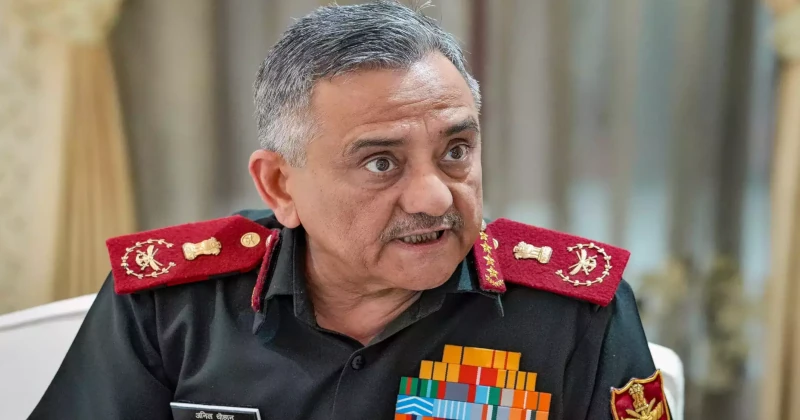
CDS General Anil Chauhan

CDS General Anil Chauhan

FacebookTwitterWhatsAppTelegramEmail

Chief of Defence Staff (CDS) General Anil Chauhan, addressing an event in Gorakhpur, shed light on the Indian military’s decision to deploy full-fledged air power instead of relying solely on drones or loitering munitions during Operation Sindoor.

The strikes, launched on May 7, 2025, came in response to the Pakistan-sponsored Pahalgam terror attack, which killed dozens of Indian pilgrims, all Hindus and security personnel. The operation marked one of the most decisive retaliatory actions in recent years, with Indian forces targeting camps deep inside Pakistan at Bahawalpur and Muridke, strongholds of globally designated terrorist groups.

“After the Pahalgam terror attack, we already had enhanced precision strike capabilities. But during deliberations with the political leadership, it was decided that drones and loitering munitions alone would not suffice. To achieve our political objectives and deliver a strong message, it was necessary to use air power,” the CDS said.

General Chauhan revealed that India’s political leadership gave a clear directive: destroy terrorist camps but avoid escalation unless provoked.

“The political leadership provided a clear direction with a clear message to destroy the terrorist camps, and retaliate only if we are attacked,” he said.

Unlike previous limited-response doctrines, Operation Sindoor gave the Indian armed forces full operational freedom, including the authority to plan, select, and execute targets across Pakistan and Pakistan-occupied Jammu and Kashmir (PoJK).

General Chauhan also linked Operation Sindoor to earlier operations, including the Uri surgical strikes (2016) and the Balakot airstrikes (2019) conducted after the Pulwama attack.

He pointed out that both India and Pakistan drew very different lessons from Balakot:

India’s lesson: invest in long-range precision strike weapons and improve post-strike damage assessment capabilities.

Pakistan’s lesson: focus heavily on air defence preparedness.

This divergence shaped the military strategies of both nations in subsequent years, eventually playing out during Operation Sindoor.

Operation Sindoor began with strikes on terrorist infrastructure in Bahawalpur and Muridke, two nerve centres of Pakistan-backed terror networks. Indian intelligence had confirmed the presence of active training camps and logistical bases in these locations.

As the operation unfolded, Pakistan retaliated by launching drones and missiles targeting Indian civilian and military assets in the western sector. However, the Indian armed forces swiftly escalated, striking high-value military targets inside Pakistan.

Among the targets hit were:

Rahim Yar Khan airbase in southern Punjab, a key Pakistani Air Force installation.
Nur Khan airbase in Rawalpindi, which had been used to support Pakistan’s air operations.

These precision strikes demonstrated India’s intent to neutralise both terror hubs and supporting military infrastructure, while keeping escalation under controlled parameters.

Why drones were not enough

Explaining why drones were not the primary option, General Chauhan stressed that while drones and loitering munitions are useful for tactical strikes, they cannot achieve strategic and political objectives at the national level.

“Drones are effective against specific targets, but the destruction of large terror camps and the need to send a decisive message to Pakistan required the employment of air power. The credibility of our response was as important as the physical damage caused,” he noted.

The use of air power ensured not only greater destruction of terror infrastructure but also international visibility, signalling India’s resolve against cross-border terrorism.

Despite the scale of Operation Sindoor, India’s approach reflected a calibrated strategy. While striking deep inside Pakistan, the political directive of “retaliate only if attacked” ensured that the operation did not spiral into uncontrolled conflict.

This approach reinforced India’s image as a responsible power that acts firmly against terrorism but avoids reckless escalation.

Operation Sindoor represents a significant evolution in India’s counter-terrorism doctrine, moving beyond defensive postures to assertive, high-precision strikes that combine military effectiveness with political messaging.

By choosing air power over drones, India ensured that its response to the Pahalgam attack was not just militarily successful but also strategically credible.

As General Anil Chauhan explained, the operation underlined the synergy between political direction and military execution, marking a new chapter in India’s fight against cross-border terrorism.


Topics: CDS Anil ChauhanPahalgam Terror AttackOperation SindoorIndia air strikes PakistanBahawalpur Muridke terror camps
ShareTweetSendShareSend
✮ Subscribe Organiser YouTube Channel. ✮
✮ Join Organiser's WhatsApp channel for Nationalist views beyond the news. ✮
Previous News

From loss to profit: J&K Banks turns the table, registers profit; Gives 2 dividend cheques of Rs 122.85 cr & Rs 7.92 cr

Next News

PM Modi pays tribute to ‘Bard of Brahmaputra’ Bhupen Hazarika on his birth anniversary

Related News

LeT terrorists & Pahalgam masterminds attend the funeral ceremony of cricketer Shoaib Akhtar's brother

Pakistan: LeT terrorists & Pahalgam masterminds attend Shoaib Akhtar brother’s funeral; Video exposes terror link

Joint Drill being held by security forces in Arunachal Pradesh

Arunachal Pradesh: Army-ITBP joint drill boosts border security readiness

India calls Indus Waters Treaty outdated at UNHRC, says Pakistan cannot seek cooperation while exporting terror

“Indus Waters Treaty outdated”: India slams Pakistan at UN for “exporting terror”

India's firm national security response after Operation Sindoor reshaped ties with Turkey, forcing Celebi's exit from the country's aviation sector

Operation Sindoor Impact: Turkish firm Celebi Aviation says India exit erased Rs 4,700 crore overnight

Chinese President Xi Jinping, Russian President Vladimir Putin and Prime Minister Narendra Modi

China’s New Tone Towards India: Tactical shift or strategic necessity? What Beijing’s push for RIC ties really signals

Saurav Das, Chief Spokesperson of CJP

Exposing CJP’s Saurav Das: Inside his controversial commentary on Article 370, Umar Khalid & nationalism

Load More

Latest News

Odisha | Snana Yatra: The sacred bathing festival of Mahaprabhu Jagannath & the spiritual prelude to Rath Yatra

Indian-origin student from Telangana found dead in London

Indian student from Telangana found dead in London under mysterious circumstances; Family seeks early repatriation

A representative image

Ashtalakshmi Rising: How India’s Northeast became the engine of connectivity, growth and strategic transformation

Bharatiya Model for Educational Revolution: Six quotients to revive the timeless concept of Acharya

Mann Ki Baat: PM Modi Celebrates India's Scientific Progress, Defence Self-Reliance and Yoga

Mann Ki Baat: PM Modi highlights indigenous innovation, defence strength, yoga & people’s participation

Love Jihad in Karnataka: Nana Saab murders Akshatha after six-month relationship; Protests erupt demanding the arrest

Old image of PM Modi used for representative purposes

‘Made from our soil, crafted by our artisans’: PM Modi’s vocal for local message ahead of Ganesh Utsav

Union Minister Ashwini Vaishnaw, US Ambassador to India Sergio Gor, US Under Secretary of State Jacob Helberg, and officials at a ceremony in New Delhi as India formally joined Pax Silica in February 2026

Pax Silica Explained: How India’s move into the US-Led AI & Chip alliance is a strategic game changer

Pakistan refugee Sheraz Malik sentenced to 10 years in jail for raping UK woman

UK’s Radical Islamist Grooming Gangs Exposed: How political correctness allowed predators to devastate British children

PM Modi recieves Seychelles ‘Guardian of the Blue Horizon’ title for environmental leadership & sustainable development

Load More
  • Privacy
  • Terms
  • Cookie Policy
  • Refund and Cancellation
  • Delivery and Shipping

© Bharat Prakashan (Delhi) Limited.
Tech-enabled by Ananthapuri Technologies

  • Home
  • Search Organiser
  • Bharat
    • Assam
    • Bihar
    • Chhattisgarh
    • Jharkhand
    • Maharashtra
    • View All States
  • World
    • Asia
    • Africa
    • North America
    • South America
    • Europe
    • Australia
  • Editorial
  • Operation Sindoor
  • Opinion
  • Analysis
  • Defence
  • Culture
  • Sports
  • Business
  • RSS @ 100
  • Entertainment
  • More ..
    • Sci & Tech
    • Vocal4Local
    • Special Report
    • Education
    • Employment
    • Books
    • Interviews
    • Travel
    • Health
    • Politics
    • Law
    • Economy
    • Obituary
  • Subscribe Magazine
  • Read Ecopy
  • Advertise
  • Circulation
  • Careers
  • About Us
  • Contact Us
  • Policies & Terms
    • Privacy Policy
    • Cookie Policy
    • Refund and Cancellation
    • Terms of Use

© Bharat Prakashan (Delhi) Limited.
Tech-enabled by Ananthapuri Technologies