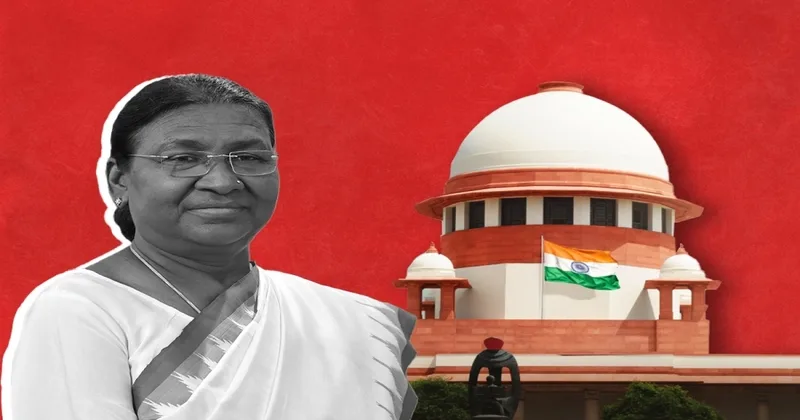
The Constitution Bench of the Supreme Court, led by Chief Justice B.R. Gavai, is presently grappling with a question that touches the very core of India’s parliamentary democracy: can the Governor or the President indefinitely withhold assent to Bills, and can the Court prescribe timelines where the Constitution is silent? This reference under Article 143 is not just a matter of legislative procedure, it is a test of how far judicial power can extend without unsettling the delicate balance of separation of powers. At stake is the fine line between judicial review and judicial overreach.
As the five-judge Constitution Bench headed by Chief Justice of India B.R. Gavai, along with Justice Surya Kant, Justice Vikram Nath, Justice P.S. Narasimha, and Justice A.S. Chandurkar, hears the Presidential Reference on whether the Court may prescribe time limits for the President and Governors to act on Bills, the dispute is less about efficiency and more about constitutional form. The question is stark: may the judiciary, by judicial fiat, insert fixed timetables into Articles 200–201 of the Constitution or would that amount to judicial legislation that upsets the carefully calibrated separation of powers? The short legal answer: it cannot, and it should not, except within the narrowest remedial margins that flow directly from constitutional text and precedent.
Constitutional text and the framers’ choice
Articles 200 and 201 set out how Bills passed by state legislatures (and those reserved by Governors for the President) are to be dealt with. Crucially, the Constitution uses the phrase “as soon as possible” rather than prescribing any fixed period. That textual choice is meaningful: when the Constitution-makers intended a hard deadline, they provided one elsewhere; where they did not, they deliberately left flexibility. Any effort by the Court to read specific days or months into that silence risks substituting its judgment for the constitutional text.
Separation of Powers- Interpretation, not Legislation
A fundamental axiom of our constitutional order is that Parliament makes law; the Judiciary interprets it. When the Court imposes a uniform timeline (for example, “30 days” or “90 days”), it effectively rewrites the constitutional scheme, performing an act the Constitution reserves for amendment by the legislature. Multiple benches of the Supreme Court have repeatedly cautioned against the judiciary performing legislative functions; the Court’s remedial powers under Article 142 are potent but remain tethered to the Constitution and cannot be used to effect a permanent textual change to constitutional provisions. Recent oral exchanges before the Bench itself by CJI Gavai, Justice Surya Kant, and Justice Vikram Nath have flagged the danger that prescribing timelines could amount to judicially amending the Constitution.
Article 361 and the special position of President/Governors
Article 361 affords the President and the Governors a special constitutional shield from ordinary judicial process in respect of acts done in the exercise of their official functions. That immunity is not an abstract privilege; it reflects the constitutional design that these high offices must perform certain functions without being constantly subject to court proceedings or personal suits. This does not render their actions wholly immune from all review (the law recognizes limited review where jurisdictional error or mala fides are shown), but it does mean the courts must exercise extreme caution before asserting remedial mechanisms that would, in effect, subject these constitutional actors to routine direction or contempt processes. Observations from Justice P.S. Narasimha and Justice A.S. Chandurkar during the ongoing hearings underlined this constitutional concern.
What the Court can do- narrow, textual, and remedial
There is a difference between policing clear constitutional abuse or jurisdictional excess and prescribing a universal procedural regime where the Constitution shows none. The Court can and will continue to protect the democratic process against manifest and indefensible abuse (for instance, where an instrumentality withholds assent indefinitely with proven mala fides to frustrate a legislative majority). In such exceptional cases the Court may frame an equitable remedy tailored to the particular wrong. But to convert exceptional, case-specific relief into a routinized rule applicable to all future contexts, thereby supplanting the constitutional allocation of powers is doctrinally and institutionally perilous.
The Tamil Nadu episode and Article 142-A a cautionary tale
The controversy that precipitated the Reference arose after the Supreme Court, in an earlier matter, used its Article 142 powers to deem assent to certain stalled state Bills, a remedy aimed at correcting an extraordinary anomaly. That intervention itself sparked the present Reference: the President has asked whether such timetabling or deeming-power is constitutionally permissible as a general rule. The very need for a Reference underlines the point: extraordinary, fact-specific exercise of judicial power is one thing; converting that into a standing rule that governs the exercise of executive discretion is quite another.
Practical and institutional consequences
If the Court were to lay down fixed periods and also insist on enforcement (for example, by threatening contempt against Governors or the President), several awkward consequences follow:
What remedy exists if a Governor or the President refuses to obey a judicial timetable? Contempt powers vis-à-vis constitutional heads raise thorny federal and institutional questions. (Raised prominently by Justice Surya Kant during arguments.)
Would courts then be expected to supervise the quotidian workings of constitutional offices? That invites continuous judicial oversight of politically charged decisions, undermining institutional balance. Concerns were voiced by Justice Vikram Nath and Justice Narasimha in recent hearings.
These are not abstract hypotheticals: they were central to the argument and interrogation during the hearing itself.
A principled way forward
Given the competing values, the need to protect legislative will and the need to preserve constitutional form , a principled path is:
1. Recognize the textual boundary: Accept that Articles 200–201 do not contain a fixed deadline; avoid judicially inserting one across the board.
2. Leave systemic reform to Parliament: If fixed timelines are judged necessary as a matter of public policy, the legitimate route is a constitutional amendment or statutory scheme enacted by Parliament (and, where relevant, state legislatures), not judicial fiat.
3. Retain case-sensitive remedies: Preserve the Court’s ability to fashion narrow, equitable relief under Article 142 or through traditional judicial review where there is demonstrable abuse, mala fides, or jurisdictional excess. Such remedies must be tightly tailored and fact-specific.
4. Insist on reasoned administrative action: Require, where appropriate, that reasons be recorded and communicated a modest rule that promotes transparency without imposing rigid timelines. (This approach respects both accountability and constitutional form.)
The law does not permit the Supreme Court to act as a substitute legislature. The constitutional architecture purposefully left certain spaces of executive discretion that are best corrected politically or legislatively. That is not to say the Court is powerless: it remains the guardian of the Constitution and may, in exceptional cases, provide corrective relief where the constitutional scheme is being subverted. But converting ad-hoc remedies into blanket time schedules, enforceable against constitutional heads, would cross a doctrinal line, one the Court should avoid if it is to preserve both constitutional fidelity and institutional legitimacy. The ongoing hearings before CJI B.R. Gavai, Justice Surya Kant, Justice Vikram Nath, Justice P.S. Narasimha, and Justice A.S. Chandurkar are likely to reflect and refine this balance; whatever the outcome, prudence and respect for constitutional process must guide the result.
The President and Governors are trustees of constitutional morality, and the remedy for perceived misuse lies in the political and parliamentary domain, not in judicial decree.
In the end, the Supreme Court’s task is not to rewrite the Constitution but to preserve its balance. While prolonged delays in assent may weaken democratic processes, the remedy lies in political accountability and, if necessary, constitutional amendment, not judicially imposed deadlines. By reaffirming the doctrine of separation of powers, the Court can remind all constitutional functionaries that true strength lies in restraint, and that fidelity to constitutional morality, not judicial compulsion, must guide the exercise of high office.