India to become world’s second-largest economy by 2038: Report
June 8, 2026
  • Read Ecopy
  • Circulation
  • Advertise
  • Careers
  • About Us
  • Contact Us
Android AppiPhone AppArattai
Organiser
  • ‌
  • Bharat
    • Assam
    • Bihar
    • Chhattisgarh
    • Jharkhand
    • Maharashtra
    • View All States
  • World
    • Asia
    • Europe
    • North America
    • South America
    • Africa
    • Australia
  • Editorial
  • International
  • Opinion
  • RSS @ 100
  • More
    • Op Sindoor
    • Analysis
    • Sports
    • Defence
    • Politics
    • Business
    • Economy
    • Culture
    • Special Report
    • Sci & Tech
    • Entertainment
    • G20
    • Azadi Ka Amrit Mahotsav
    • Vocal4Local
    • Web Stories
    • Education
    • Employment
    • Books
    • Interviews
    • Travel
    • Law
    • Health
    • Obituary
  • Subscribe
    • Subscribe Print Edition
    • Subscribe Ecopy
    • Read Ecopy
  • ‌
  • Bharat
    • Assam
    • Bihar
    • Chhattisgarh
    • Jharkhand
    • Maharashtra
    • View All States
  • World
    • Asia
    • Europe
    • North America
    • South America
    • Africa
    • Australia
  • Editorial
  • International
  • Opinion
  • RSS @ 100
  • More
    • Op Sindoor
    • Analysis
    • Sports
    • Defence
    • Politics
    • Business
    • Economy
    • Culture
    • Special Report
    • Sci & Tech
    • Entertainment
    • G20
    • Azadi Ka Amrit Mahotsav
    • Vocal4Local
    • Web Stories
    • Education
    • Employment
    • Books
    • Interviews
    • Travel
    • Law
    • Health
    • Obituary
  • Subscribe
    • Subscribe Print Edition
    • Subscribe Ecopy
    • Read Ecopy
Organiser
  • Home
  • Bharat
  • World
  • Operation Sindoor
  • Editorial
  • Analysis
  • Opinion
  • Culture
  • Defence
  • International Edition
  • RSS @ 100
  • Magazine
  • Read Ecopy
Home Bharat

India set to become second-largest economy in PPP in the world by 2038: EY Report

A new EY report projects India to overtake the US, Germany, and Japan in PPP terms by 2030, backed by strong demographics, robust savings, and fiscal prudence

Shashank Kumar DwivediShashank Kumar Dwivedi
Aug 27, 2025, 10:00 pm IST
in Bharat, Economy
Follow on Google News
A representative image

A representative image

FacebookTwitterWhatsAppTelegramEmail

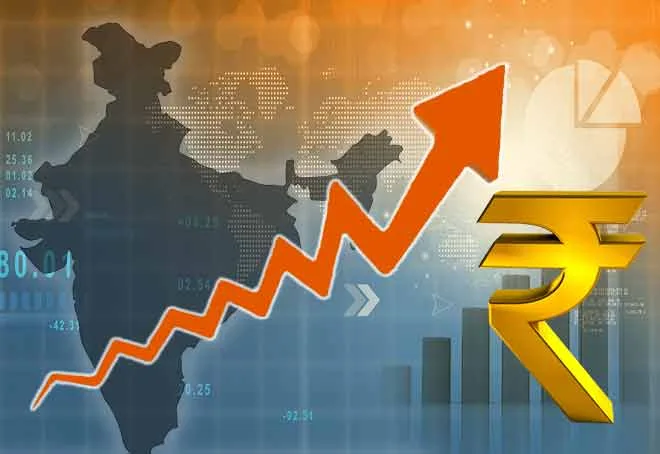
India is on course to become the world’s second-largest economy in purchasing power parity (PPP) terms by 2038, according to a report released by global consultancy EY on August 27. Citing International Monetary Fund (IMF) data, the report noted that India’s economy is projected to reach $20.7 trillion in PPP terms by 2030, overtaking the United States, Germany, and Japan, while still trailing China, which is expected to remain at the top with an estimated $42.2 trillion economy in PPP terms.

The report underlined that India’s rise is powered by its favourable demographics, a youthful population, and its robust savings and investment rates, coupled with a sustainable fiscal path that distinguishes it from other major economies struggling with ageing populations and high debt. With a median age of 28.8 years in 2025, India enjoys one of the youngest workforces globally, giving it a natural advantage in productivity and consumption-led growth.

China, though projected to remain the largest economy in PPP terms through 2030, faces severe headwinds from a rapidly ageing population and mounting debt liabilities. The United States, while resilient, is constrained by debt levels exceeding 120 percent of GDP and slower growth compared to emerging markets. Advanced economies like Germany and Japan, the report noted, continue to grapple with demographic decline and over-dependence on global trade.

In contrast, India’s economic base appears more balanced and resilient in the long run.

Highlighting the government’s fiscal discipline, EY pointed out that India’s debt-to-GDP ratio is expected to decline from 81.3 percent in 2024 to 75.8 percent by 2030. This trajectory reflects prudent fiscal management by the Modi government, with emphasis on targeted welfare spending, capital expenditure on infrastructure, and structural reforms aimed at boosting long-term productivity.

“India’s young and skilled workforce, robust saving and investment rates, and relatively sustainable debt profile will help sustain high growth even in a volatile global environment,” said DK Srivastava, Chief Policy Advisor at EY India, while presenting the report. He stressed that India’s growth story is not merely cyclical but structural, built upon reforms and demographic momentum.

The consultancy also observed that India’s structural reforms, combined with investments in critical technologies such as artificial intelligence, semiconductors, and clean energy, will strengthen its trajectory.

EY estimates that by 2028, India will surpass Germany to become the world’s third-largest economy in market exchange rate terms, a milestone that shows its global economic clout. The report linked India’s trajectory to its long-term national vision of Viksit Bharat 2047, the government’s ambitious plan to make India a fully developed nation by its centenary of independence.

Alongside EY’s bullish outlook, the Reserve Bank of India (RBI) has also released a report recently, praising the country’s Flexible Inflation Targeting (FIT) framework, calling it one of the key institutional mechanisms that have ensured macroeconomic stability amid turbulent global conditions. Introduced in 2016 with an inflation target of around 4 percent, the FIT framework has, according to the RBI, “broadly delivered on its objectives.”

Between its inception and the end of 2019, India enjoyed a period of low and stable inflation, averaging close to 4 percent, the central bank observed. While later years posed fresh challenges, most notably during the COVID-19 pandemic and the Russia-Ukraine conflict, which triggered supply shocks in global food and fuel markets, India managed to contain inflationary pressures better than many comparable economies.

The report emphasised that India’s inflation-targeting experience is unique because over half of the consumption basket is composed of food and energy items, which are highly vulnerable to supply-side shocks. In this context, maintaining stability has been far more challenging than in advanced economies, yet India has managed to navigate these difficulties effectively.

The RBI credited this achievement to a combination of monetary policy measures and government supply-side interventions. While the central bank tightened monetary policy to prevent second-round inflationary effects, the government ensured smooth availability of essential goods through targeted actions, thereby reducing pressure on household budgets.

The RBI underlined that the coordination between the government and the central bank has been crucial to the success of the FIT framework. This synergy has enhanced the credibility of India’s macroeconomic management, sending a positive signal to global investors and markets. The central bank further observed that the framework’s credibility and built-in flexibility allowed India to adapt policy responses during crises, ensuring that growth momentum was not derailed while safeguarding price stability. It suggested that India’s FIT framework could serve as a template for other developing countries facing similar vulnerabilities to supply shocks in food and energy.

The dual reports, EY’s projection of India’s ascent in the global economy and the RBI’s endorsement of inflation targeting, paint a picture of a nation on the rise, resilient in the face of global uncertainty, and guided by policies that combine ambition with pragmatism. Together, they showcase how India is balancing high growth aspirations with macroeconomic stability, ensuring that its progress is not short-lived but firmly grounded in structural strengths.

The convergence of these findings is significant. On the one hand, EY’s projections highlight the long-term opportunities that arise from India’s demographics and reforms. On the other, the RBI’s assessment demonstrates that India’s macroeconomic institutions are capable of withstanding external shocks and maintaining stability in times of crisis. This combination of growth and resilience is what sets India apart in the global economic landscape.

The Modi government has repeatedly emphasised that the coming decades represent India’s Amrit Kaal, a period of opportunity during which Bharat must transition into a developed nation. Reports such as those by EY and the RBI reinforce this narrative, suggesting that India is well-positioned to achieve its goals.

By 2038, with its demographic dividend still intact, its fiscal metrics improving, and its inflation management framework tested and proven, India is expected to stand as the world’s second-largest economy in PPP terms.

As the global economic order undergoes realignments, India’s trajectory is being closely watched. With its mix of youthful energy, strong reforms, digital transformation, and macroeconomic prudence, India is not only reshaping its own destiny but also redefining the role of emerging economies in the 21st century.

Topics: RBI inflation targetingIndia overtakes US economyViksit Bharat @2047India economy 2038PPP rankingIMF data India growthEY India report
ShareTweetSendShareSend
✮ Subscribe Organiser YouTube Channel. ✮
✮ Join Organiser's WhatsApp channel for Nationalist views beyond the news. ✮
Previous News

Tamil Nadu: DMK Police silent on Muslim Moulvi’s hate speech, file case against Hindu scholar who countered it

Next News

“US will remain dependent on India,” Surat Diamond Traders confidant of riding out Trump Tariff effects

Related News

India’s semiconductor roadmap shifts from import dependence to silicon sovereignty, aiming for a self-reliant ecosystem by Viksit Bharat 2047

From Import Dependence to Silicon Sovereignty: India’s bold semiconductor roadmap for Viksit Bharat 2047

Education and Viksit Bharat: Harmonise Bharatiya knowledge traditions with technology

India’s digital public infrastructure is turning welfare into empowerment, boosting inclusion, entrepreneurship and growth toward Viksit Bharat 2047

From Welfare to Wealth: India’s digital revolution and the road to Viksit Bharat

Odisha Chief Minister Mohan Charan Majhi at Investors' Meet at Vadodara

Odisha secures Rs 48,330 crore investment from Gujarat; CM Mohan Charan Majhi pitches industrial growth vision

Union Minister of Commerce and Industry Piyush Goyal and New Zealand’s Trade and Investment Minister Todd McClay sign the India-New Zealand Free Trade Agreement, in New Delhi on Monday

India, New Zealand sign landmark FTA, unlocking duty-free trade, $20B investment and mobility for professionals

DST inaugurates Nd-Fe-B magnet Pilot Plant to boost EV and clean energy ecosystem

India strengthens self-reliance in critical materials as ARCI launches Pilot Plant for Nd-Fe-B magnet production

Load More

Latest News

Demolition of the illegal mosque in Sambhal

Sambhal: Eight booked after ‘I Love Muhammad’ posters, Pakistan-like flags found during demolition of illegal mosque

A representative image

India’s Agricultural Transformation: How India’s Agri sector transformed over the last decade

Ken-Betwa link project: balancing development, water security and ecological responsibility (This is an AI generated Image)

Beyond Bundelkhand: Why the success of the Ken-Betwa link matters for India’s water future

Chandni Qureshi (centre) and Ayush Malik before his conversion; the image on the left purportedly shows Ayush, now known as Mohammad Ali, offering namaz

Exclusive | Chandni Qureshi, Pakistani cleric & secret nikah: Inside Shamli conversion case that triggered an SIT probe

Ceremonial lamp lighting at a seminar in Delhi University organised by Centre for Tribal Studies

Traditional tribal practices can help mitigate planetary crisis: Experts at Delhi University seminar

How India keeps cooking gas cheaper than most nations

The LPG Reality Check: Why India still has the world’s cheapest cooking gas

TMC leader Brahmananda Chakraborty arrested in Howrah after viral video shows him hiding under clothes, accused of cut money in PM Awas Yojana funds. (Image: X)

Hiding under a pile of clothes? TMC leader arrested in PM Awas Yojana ‘Cut money’ case as dramatic video goes viral

Pakistan Prime Minister Shehbaz Sharif face the brunt as Punjab draws excess water from Indus basin and Sindh suffers from scarcity

Pakistan: Indus water drifts to Punjab & erupts political rift; Acute crisis in Dadu canal & drought in Sindh

Cobra Commandos land in Manipur to curb insurgency and restore peace

CoBRA Commandos Deployed in Manipur: CRPF draws red line for insurgents, Promises decisive action

North 24 Parganas: A large crowd of Bangladeshis residing in West Bengal gathers at the Hakimpur border crossing in the Basirhat subdivision of North 24 Parganas district to cross over to Bangladesh

Unnatural Demographic Change: Hint that would create a heat

Load More
  • Privacy
  • Terms
  • Cookie Policy
  • Refund and Cancellation
  • Delivery and Shipping

© Bharat Prakashan (Delhi) Limited.
Tech-enabled by Ananthapuri Technologies

  • Home
  • Search Organiser
  • Bharat
    • Assam
    • Bihar
    • Chhattisgarh
    • Jharkhand
    • Maharashtra
    • View All States
  • World
    • Asia
    • Africa
    • North America
    • South America
    • Europe
    • Australia
  • Editorial
  • Operation Sindoor
  • Opinion
  • Analysis
  • Defence
  • Culture
  • Sports
  • Business
  • RSS @ 100
  • Entertainment
  • More ..
    • Sci & Tech
    • Vocal4Local
    • Special Report
    • Education
    • Employment
    • Books
    • Interviews
    • Travel
    • Health
    • Politics
    • Law
    • Economy
    • Obituary
  • Subscribe Magazine
  • Read Ecopy
  • Advertise
  • Circulation
  • Careers
  • About Us
  • Contact Us
  • Policies & Terms
    • Privacy Policy
    • Cookie Policy
    • Refund and Cancellation
    • Terms of Use

© Bharat Prakashan (Delhi) Limited.
Tech-enabled by Ananthapuri Technologies