Gold Nanocluster brings hope against Parkinson’s disease
July 22, 2026
  • Read Ecopy
  • Circulation
  • Advertise
  • Careers
  • About Us
  • Contact Us
Android AppiPhone AppArattai
Organiser
  • ‌
  • Bharat
    • Assam
    • Bihar
    • Chhattisgarh
    • Jharkhand
    • Maharashtra
    • View All States
  • World
    • Asia
    • Europe
    • North America
    • South America
    • Africa
    • Australia
  • Editorial
  • International
  • Opinion
  • RSS @ 100
  • More
    • Op Sindoor
    • Analysis
    • Sports
    • Defence
    • Politics
    • Business
    • Economy
    • Culture
    • Special Report
    • Sci & Tech
    • Entertainment
    • G20
    • Azadi Ka Amrit Mahotsav
    • Vocal4Local
    • Web Stories
    • Education
    • Employment
    • Books
    • Interviews
    • Travel
    • Law
    • Health
    • Obituary
  • Subscribe
    • Subscribe Print Edition
    • Subscribe Ecopy
    • Read Ecopy
  • ‌
  • Bharat
    • Assam
    • Bihar
    • Chhattisgarh
    • Jharkhand
    • Maharashtra
    • View All States
  • World
    • Asia
    • Europe
    • North America
    • South America
    • Africa
    • Australia
  • Editorial
  • International
  • Opinion
  • RSS @ 100
  • More
    • Op Sindoor
    • Analysis
    • Sports
    • Defence
    • Politics
    • Business
    • Economy
    • Culture
    • Special Report
    • Sci & Tech
    • Entertainment
    • G20
    • Azadi Ka Amrit Mahotsav
    • Vocal4Local
    • Web Stories
    • Education
    • Employment
    • Books
    • Interviews
    • Travel
    • Law
    • Health
    • Obituary
  • Subscribe
    • Subscribe Print Edition
    • Subscribe Ecopy
    • Read Ecopy
Organiser
  • Home
  • Bharat
  • World
  • Operation Sindoor
  • Editorial
  • Analysis
  • Opinion
  • Culture
  • Defence
  • International Edition
  • RSS @ 100
  • Magazine
  • Read Ecopy
Home Bharat

Gold Nanocluster innovation brings hope against neurodegenerative Parkinson’s disease

Indian scientists at INST, Mohali developed a gold nanocluster-based biosensor that detects Parkinson’s disease at an early stage, offering affordable diagnosis and new hope for millions of patients

Vivek KumarVivek Kumar
Aug 27, 2025, 07:20 pm IST
in Bharat, Sci & Tech
Follow on Google News
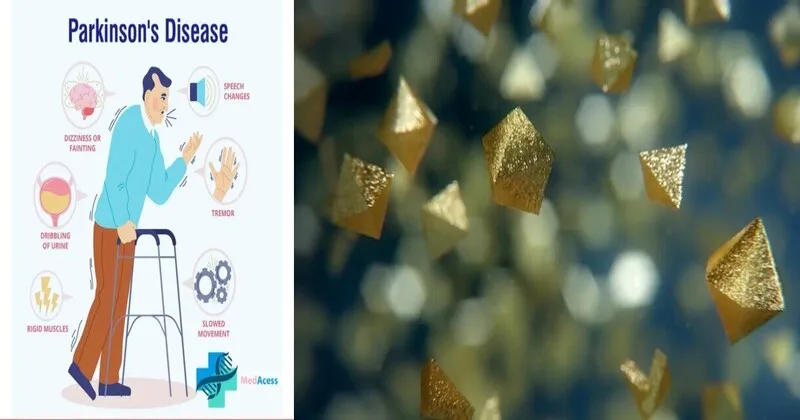
Gold Nanoclusters: A New Hope for Early Detection of Parkinson’s Disease

Gold Nanoclusters: A New Hope for Early Detection of Parkinson’s Disease

FacebookTwitterWhatsAppTelegramEmail

Tiny particles of gold with a size of few nanometers holds the key to transform how scientist can detect Parkinson’s disease. Scientists at the Institute of Nano Science and Technology (INST), Mohali, an autonomous institute under the Department of Science and Technology (DST) has demonstrated how these particles can be used to build a nanotechnology-based tool for diagnosing Parkinson’s disease much earlier than today’s methods allow.

Parkinson’s disease is the world’s fastest-growing neurological disorder. According to the Global Burden of Disease Study 2019, more than 8.5 million people worldwide live with Parkinson’s and this number has doubled since 1990. Every year approximately 120,000 people die globally due to complications linked with Parkinson’s.

In India an estimate suggests that around 5–7 lakh patients are currently living with Parkinson’s and the numbers are climbing at a fast pace as life expectancy increasing. Research published in the Journal of Parkinson’s Disease indicates that the prevalence rate in India ranges from 15 to 45 cases per 100,000 people, while in semiurban its about 7 per one lakh population. Experts warns that the numbers could nearly double by 2030. With rapidly aging population of India, the disease is threatening health care system to become a major public health challenge.

The problem gets worsened by late diagnosis. In most of the cases, Parkinson’s is detected once after 60–70% of brain cells responsible for dopamine production are already damaged. Symptoms such as tremors, stiffness and slowed movement have already creeped inside thus leaving limited treatment options. Detecting the disease earlier could mean early access to medical intervention, better quality of life and lesser healthcare costs.

Also Read: RSS was formed with Bharat at its center, and its objective is to make it Vishwaguru: Dr Mohan Bhagwat

Spark of an Idea in INST, Mohali

At the Institute of Nano Science and Technology (INST), a group scientists tinked about how proteins behave in the brain during disease sparked an innovative approach. This group started exploring that the surface charge of a protein reveals how dangerous it is?

They focused on α-synuclein a protein strongly linked to Parkinson Disease. In its normal form, α-synuclein is harmless. In certain period it can change its shape and clump together into toxic aggregates that damages brain cells. The team also started working on sensors that how protein forms apart and are charged.

Turning Gold Nanoparticles into a Biosensor

The team led by Dr. Sharmistha Sinha, Senior Scientist at INST, supported with her PhD students Ms. Harpreet Kaur and Ms. Ishani Sharma. They collaborated with Dr. Deepak Sharma and Arpit Tyagi from the CSIR-Institute of Microbial Technology (IMTECH), Chandigarh, having expertise in protein biochemistry and cell-based assays.

The collaboration between scientists and their research scholar came up with the solution in the form of gold nanoclusters (AuNCs) an ultrasmall, glowing particles just a few nanometers wide. By coating these clusters with naturally occurring amino acids, the team made them selectively sticky. Proline-coated nanoclusters were drawn to the normal version of α-synuclein. Histidine-coated nanoclusters latched onto the toxic aggregates. This property allowed the biosensor to distinguishes between harmless and harmful (amyloid) protein forms.

The journey from idea to proof-of-principle included a broad spectrum of experiments:

Engineered and purified two forms of α-synuclein (normal and mutant).
Synthesized amino acid capped gold nanoclusters and then characterized the nanoclusters using UV-Vis spectroscopy, fluorescence imaging, transmission electron microscopy (TEM) and X-ray photoelectron spectroscopy (XPS) to study their structure and optical properties.
Studied nanocluster-protein interactions using gel electrophoresis, fluorescence quenching and electrochemical methods like cyclic voltammetry and impedance spectroscopy.
Finally tested the system in human-derived SH-SY5Y neuroblastoma cells to ensure it worked safely and effectively in biological conditions.
The results confirmed that the biosensor could reliably identify toxic protein aggregates linked with Parkinson’s disease.
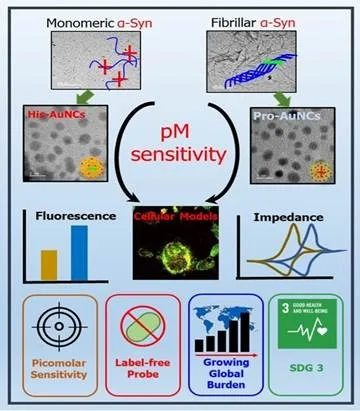
Gold nanocluster-based biosensor distinguishes between physiological and pathological α-synuclein conformers, enabling early-stage detection of Parkinson’s disease

Why This Matters for India

Currently India is facing a critical phase of neurological health crisis including depression, Obsessive Compulsion Disorder, Alzheimer and Parkinsons. With over 138 million elderly citizens expected by 2031 will suffer age-related diseases like Parkinson’s will rise steeply. Most Indian patients are diagnosed late often when symptoms severely affect daily life due less information.

A low-cost, label-free and clinically adaptable diagnostic tool gold nanocluster biosensor, could make early detection possible even in resource-limited settings. Unlike expensive imaging scans and invasive procedures. Such sensors could be deployed in point-of-care testing unit to reach rural and semi-urban populations where majority of Indian lives.

Early detection also means:

  • Timely treatment
  • Better management of lifestyle changes, physiotherapy and diet.
  • Reduced long-term burden on families and healthcare systems.

In a country where neurological care facilities are unevenly distributed, such innovations could become a lifeline. The team’s work also has broader implications. Many neurodegenerative diseases, such as Alzheimer’s are linked to misfolded proteins. A similar nanotechnology innovation could approach to detect other diseases too. By focusing on making the system simple, scalable and cost-effective, the researchers are opening doors to a new generation of diagnostic tools.

This journey from a lab discussion in Mohali to a proof-of-concept biosensor highlights the power of collaboration between young researchers and experienced scientists. It also reflects India’s growing capability in nanoscience and biotechnology.

For Parkinson’s patients and their families, the promise of profound test that can catch the disease before symptoms appear. For India, it means preparing ahead of a looming public health challenge. And for science it signals that the tiniest particles like gold nanoclusters just nanometer wide can hold answers to some of humanity’s biggest health problems.


Topics: INSTInstitute of Nano Science and TechnologyMohaliDepartment of Science and TechnologyParkinson disease
ShareTweetSendShareSend
✮ Subscribe Organiser YouTube Channel. ✮
✮ Join Organiser's WhatsApp channel for Nationalist views beyond the news. ✮
Previous News

4 Maoists gunned down in encounter near Maharashtra-Chhattisgarh border, weapons recovered

Next News

100 years of Sangh Yatra: Key takeaways from speech of Sarsanghchalak Dr Mohan Bhagwat #Day2

Related News

Satr Formation In Milky Way Galaxy

Indian scientists decode the magnetic process of star birth in the milky way

Representative Image

India advances in clean energy race with Magnetoelectric Nano-Catalyst breakthrough

Representative Image of Cholesterol and Electron Spin to aid Quantum Devices

From Biology to Quantum Tech: Indian researchers unlock spin control for future quantum and spintronic devices

Representative image

Researchers find how seaweed antioxidants help in prevention of Parkinson’s

National Science Day: Here’s all you want to know about the day and India’s recent scientific achievements

Lewy body disease can be detected before symptoms appear: Study

Load More

Latest News

Flood situation in Assam

Assam flood situation worsens: 16 people lost lives, over 3.60 lakh people affected

CJP Protest in Delhi: Exposing western media’s fake narratives, selective reporting and ignorance

Tamil Nadu: Counterfeit currency syndicate with Malaysia, Pakistan links busted in Chennai; terror angle investigated

ABVP Commemorates the Birth Centenary of Its Architect Prof. Yashwantrao Kelkar with Special Recitation Programme 'Priya Kelkar Ji in Lucknow

ABVP commemorates architect Prof Yashwantrao Kelkar’s centenary, celebrates legacy of nation-building

Punjab Pharma Officer Exam Cheating Racket Exposed: 35 detained, candidates allegedly paid up to Rs 13 lakh

(Left) Congress leader Mohammed Nalapad (Right) Karnataka Minister Priyank Kharge

RSS Defamation Case in Karnataka: Court orders personal appearance Of Priyank Kharge, Mohammed Nalapad

BMS hosts 15th BRICS Trade Union Forum (TUF) Summit 2026 in Hyderabad; Calls for worker-centric global order

BRICS TUF Summit 2026: Shifting the labour discourse

Courtesy: T.C. Rajesh’s FB post

Keralam: CPM’s Deshabhimani daily drops ‘Vijayan, the thief’ article from Sunday supplement; text Surfaces on FB

Self-immolation by Lobsang Palden in front of UN Headquarters in New York, (inset) the activist shortly before immolating himself

China and Tibet: Immolation of ‘Imposed Unity’

Authorities attacked during anti-encroachment drive in Shivajinagar

Anti-Encrochment Drive in Karnataka: Officials attacked in Shivajinagar; BJP slams govt’s appeasement politics

Load More
  • Privacy
  • Terms
  • Cookie Policy
  • Refund and Cancellation
  • Delivery and Shipping

© Bharat Prakashan (Delhi) Limited.
Tech-enabled by Ananthapuri Technologies

  • Home
  • Search Organiser
  • Bharat
    • Assam
    • Bihar
    • Chhattisgarh
    • Jharkhand
    • Maharashtra
    • View All States
  • World
    • Asia
    • Africa
    • North America
    • South America
    • Europe
    • Australia
  • Editorial
  • Operation Sindoor
  • Opinion
  • Analysis
  • Defence
  • Culture
  • Sports
  • Business
  • RSS @ 100
  • Entertainment
  • More ..
    • Sci & Tech
    • Vocal4Local
    • Special Report
    • Education
    • Employment
    • Books
    • Interviews
    • Travel
    • Health
    • Politics
    • Law
    • Economy
    • Obituary
  • Subscribe Magazine
  • Read Ecopy
  • Advertise
  • Circulation
  • Careers
  • About Us
  • Contact Us
  • Policies & Terms
    • Privacy Policy
    • Cookie Policy
    • Refund and Cancellation
    • Terms of Use

© Bharat Prakashan (Delhi) Limited.
Tech-enabled by Ananthapuri Technologies