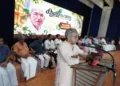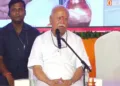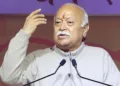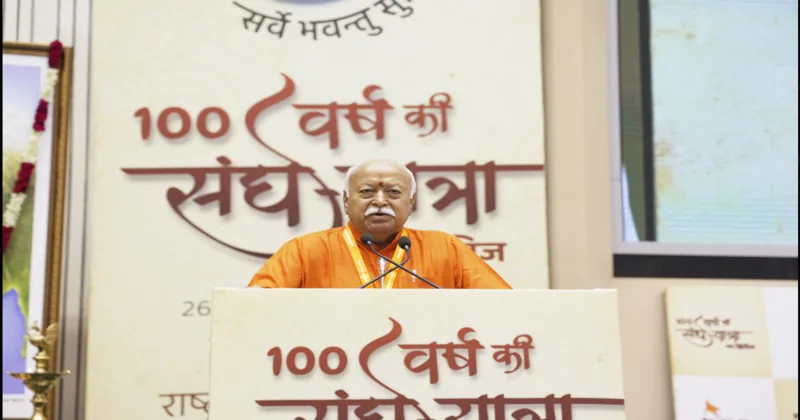
NEW DELHI: On the first day of a three-day lecture series organised to mark the Sangh’s centenary year, Rashtriya Swayamsevak Sangh (RSS) Sarsanghchalak Dr Mohan Bhagwat stated that the RSS was formed with Bharat at its core and its significance lies in elevating Bharat to the status of a Vishwaguru (world preceptor). The motivation for the Sangh’s work comes from the phrase “Bharat Mata ki Jai,” with which the daily Sangh prayer concludes. He noted that the Sangh’s growth has been a slow and continuous process, which continues to this day. Although the Sangh uses the term ‘Hindu,’ its true essence is ‘Vasudhaiva Kutumbakam’ (the world is one family). He added that the Sangh considers villages, society, and the nation as its own in this continuous evolution. The Sangh’s work is entirely volunteer-driven, with workers themselves nurturing new ones.
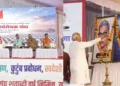
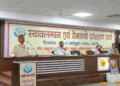
The three-day lecture series, titled ‘100 Years of Sangh Yatra – New Horizons,’ is being held at Delhi’s Vigyan Bhawan.
Explaining the purpose of the series, Dr Bhagwat said that the organization felt a need to convey the true and accurate information about the Sangh to society. A similar event was organized in 2018, and this time, programs will be held in four locations to ensure a broader reach. He said that the definition of a nation is not based on power. “Even when we were under foreign rule, our nation existed. The English word ‘nation’ is linked to the ‘state,’ whereas the Indian concept of a nation is not tied to power,” he explained.
Commenting on the freedom struggle and subsequent ideologies, he stated that the first attempt at independence in 1857 was unsuccessful, but it awakened a new consciousness. This led to a movement questioning how a handful of people could defeat Indians. One idea that emerged was that Indians lacked political awareness, which led to the formation of the Indian National Congress. However, he argued that after independence, the Congress was unable to properly carry forward the task of ideological enlightenment. “This is not an accusation, but a fact,” he clarified. After independence, one ideological stream focused on eliminating social evils, while another emphasized a return to our roots, a thought propagated by Swami Dayanand Saraswati and Swami Vivekananda.
He mentioned that Dr Keshav Baliram Hedgewar and other great personalities believed that all efforts would be incomplete without addressing the deep-seated flaws in society. The repeated subjugation by foreign powers was a clear sign of these societal defects. When others didn’t have the time to work on this, Hedgewar decided to take up the task himself, establishing the Sangh in 1925 with the goal of organising the entire Hindu society.
Clarifying the essence of the term ‘Hindu,’ the Sarsanghchalak explained that it is not merely a religious term but signifies a sense of responsibility toward the nation. He said the name was given to us by others, but we have always viewed ourselves from a humanistic perspective. “We believe that humanity and creation are interconnected and influence each other. The meaning of ‘Hindu’ is inclusion, and inclusion has no limits,” he stated. He added, “A Hindu is one who believes in following their own path without demeaning others’ beliefs and respects others’ faith without disrespecting them. Those who follow this tradition and culture are Hindus. We aim to organize the entire Hindu society, but ‘Hindu’ does not mean ‘Hindu versus all others.’ The word ‘Hindu’ is inclusive.”
He asserted that Bharat’s nature is one of coordination, not conflict. The secret to India’s unity lies in its geography, resources, and tradition of self-reflection. “Instead of looking outward, we looked inward to find the truth. This perspective taught us that there is a single element in everything, even if it appears in different forms. This is why Bharat Mata and our ancestors are revered,” he said.
Dr. Bhagwat stated that a true Hindu is one who reveres Bharat Mata and our ancestors. He acknowledged that some people refer to themselves as Hindu, while others use terms like ‘Bharatiya’ or ‘Sanatani.’ While the words may change, the underlying भावना (feeling) of devotion and reverence remains. He said that the DNA of the people of Bharat has been the same for 40,000 years, connecting everyone. He pointed out that people who once distanced themselves from the term ‘Hindu’ are now gradually embracing it. “We don’t tell them to call themselves Hindu; we just tell them that they are Hindus. It’s not about the words, but the content. The content is devotion to Bharat Mata and the tradition of our ancestors,” he added. He emphasized that the Sangh’s work is not against anyone or a reaction to anything. The concept of Hindu Rashtra has nothing to do with power.
Regarding the Sangh’s working method, he said it follows two paths for societal upliftment: developing individuals and encouraging them to work for society. “The RSS is an organisation whose work is to build individuals. While Swayamsevaks work in various fields, the organisation doesn’t control them,” he said, adding that the Sangh faced both opposition and neglect but has always considered society its own.
Sangh Runs on Personal Dedication
He highlighted that the Sangh’s uniqueness is its reliance on the personal dedication of its volunteers, not external funding. ‘Guru Dakshina’ is an integral part of its functioning, through which each volunteer expresses their faith and commitment to the organization. He stated, “Our effort is to ensure our thoughts, conduct, and values remain upright. We have to worry about the Swayamsevak; the organization worries about itself. We must not form factions; we must organize everyone together in Bharat.”
Also present on the stage were Sarkaryavah Dattatreya Hosabale, Northern Region Sanghchalak Pawan Jindal, and Delhi Province Sanghchalak Dr. Anil Agarwal. The event’s first day was attended by retired judges, former diplomats, former administrative officers, diplomats from various countries, media heads, former military officers, and figures from the fields of sports and art.