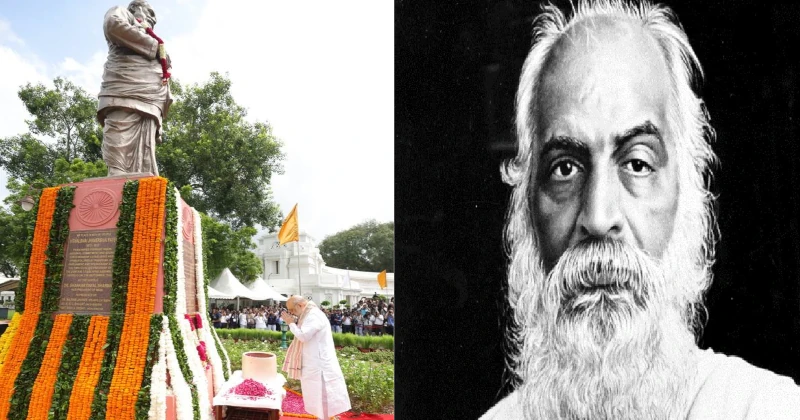
A hundred years ago, in 1925, history was written in the heart of colonial India. For the first time, an Indian Vitthalbhai Jhaverbhai Patel, elder brother of Sardar Vallabhbhai Patel was elected as the President of the Central Legislative Assembly, a post that would later evolve into the modern-day Speaker’s chair. That moment, symbolic yet revolutionary, marked the beginning of India’s own legislative journey under colonial rule and laid the foundation for the democratic traditions we take for granted today.
It was more than just a procedural victory. It was a seismic political statement: Indians were no longer content to merely petition colonial rulers; they would govern themselves, set their own rules, and preserve their dignity even inside British-designed institutions.
On August 24, Union Home Minister and Minister of Cooperation Amit Shah inaugurated the two-day All India Speakers’ Conference at the Delhi Legislative Assembly to commemorate the centenary of this historic moment. Present at the ceremony were Delhi Assembly Speaker Vijender Gupta, Union Parliamentary Affairs Minister Kiren Rijiju, Delhi Lieutenant Governor Vinay Kumar Saxena, Delhi Chief Minister Smt. Rekha Gupta, and presiding officers from across the country.
➡️ Union Home Minister and Minister of Cooperation, @AmitShah, inaugurated the two-day All India Speakers’ Conference organized at the Delhi Assembly to commemorate the completion of 100 years of freedom fighter Vitthalbhai Patel becoming the first elected Indian President of the… pic.twitter.com/8I14wjqAtV
— PIB India (@PIB_India) August 25, 2025
The Delhi Assembly complex also hosted an exhibition on the life and contributions of Vitthalbhai Patel, which Amit Shah described as “a radiant reminder that India’s democracy was not a gift of colonial rulers, but the outcome of a long struggle where Indians wrested space for their voice even inside the British-controlled legislature.”
Home Minister Amit Shah inaugurates the two-day #AllIndiaSpeakersConference at the #DelhiAssembly in the National Capital. HM says Vitthalbhai Patel ji became the first Indian Speaker of the Central Legislative Assembly 100 years ago.
▪️The conference has been organised to… pic.twitter.com/adSMC2Lzok
— All India Radio News (@airnewsalerts) August 24, 2025
It was September 1925. Inside the colonial-era Central Legislative Assembly in Delhi, a hushed tension gripped the chamber. For decades, the Assembly had been presided over by men handpicked by the Raj symbols of British authority masquerading as parliamentary order. But that day, something remarkable happened.
A Gujarati lawyer, seasoned by years of political struggle and court battles, walked up to the Speaker’s chair. His name was Vitthalbhai Jhaverbhai Patel. With his election as the first Indian President of the Central Legislative Assembly, the British monopoly over legislative control was shattered.
Born in 1873 in Karamsad, Gujarat just two years before his younger brother Vallabhbhai Vitthalbhai was the eldest son of Jhaverbhai Patel, a modest landowner. Unlike Vallabhbhai, who would later be immortalised as the “Iron Man of India,” Vitthalbhai’s life unfolded in the shadows of both the British Raj and his younger sibling’s towering legacy.
Yet Vitthalbhai was no less formidable. Trained in law in London, he returned to India to practice in Bombay, gaining a reputation as a sharp, uncompromising advocate. He was drawn early into politics, first through the Indian National Congress and later through the Swaraj Party founded by CR Das and Motilal Nehru.
What set Vitthalbhai apart was his strategic approach. While Mahatma Gandhi and his followers pushed for non-cooperation outside the system, Vitthalbhai and the Swarajists believed in entering legislatures to obstruct colonial policies from within. “If the British built the walls of the Assembly, we will use those walls to hammer at their empire,” he once declared.
By the early 1920s, the Assembly though toothless on paper had become a contested space. Indian leaders realised it could be transformed into a theatre of resistance. Against this backdrop, Vitthalbhai Patel’s elevation to the Speaker’s chair was revolutionary.
Patel’s tenure as Speaker was marked by his unyielding insistence on independence. He institutionalised the Legislative Department and Assembly Secretariat, ensuring that the Speaker’s office and staff were not controlled by the executive. This autonomy was crucial it meant that the Assembly could function without being reduced to a bureaucratic arm of the Raj.
His philosophy was clear: “No legislative assembly can function under the control of elected governments. Its independence is the only guarantee of meaningful debate.” Patel refused to allow colonial officials to ride roughshod over Indian members. He upheld the right of legislators to criticise policies fearlessly and rejected attempts to muzzle debate in the name of “order.”
Amit Shah, in his centenary speech, captured Patel’s spirit: “Vitthalbhai Patel never let the British mindset dominate the Assembly. He never let the dignity of the Speaker’s office be diminished. He created traditions that guide us to this day.”
He urged that Patel’s speeches and rulings be compiled and distributed to every legislative library in the country, so that lawmakers and youth alike can understand how the spirit of independence was ignited inside the House. While celebrating history, Amit Shah also warned that the dignity of legislatures across India is being eroded by frequent disruptions, walkouts, and partisan deadlock.
“Symbolic protests have their place, but assemblies that are paralysed session after session cannot serve the people. When discussions cease, the legislature becomes a lifeless building,” he said, in what was clearly a pointed message to both ruling and opposition benches.
Calling the Speaker “the most challenging role in the House,” Amit Shah reminded presiding officers that impartiality and justice remain their sacred responsibilities. “The Speaker is both guardian and servant of the House,” he said, stressing that the chair must remain above party lines once elected.
He also emphasised the triad of legislative responsibility wisdom, ideas, and lawmaking. Wisdom gives rise to ideas, and ideas translate into laws, he said, stressing that the ultimate aim of any legislation must be public welfare and national interest. Amit Shah contrasted India’s resilience with global experiences. Many countries that adopted democracy in the 20th century have since reverted to authoritarianism. India, however, saw multiple peaceful transfers of power without bloodshed.
“This stability is because we preserved our legislative process with utmost care and reformed it whenever necessary. Democracy runs in the veins of our civilisation,” Amit Shah said. Indeed, from the Central Legislative Assembly of 1925 to today’s Parliament, India has treated its legislative houses as more than just lawmaking bodies they have been the conscience of the nation.
The centenary celebrations of Patel’s speakership are not mere nostalgia. They serve as a reminder of what legislatures are meant to be: forums of debate, consensus, and national vision. As Amit Shah put it, “The House is the engine of democracy. If healthy traditions are nurtured here, the nation’s direction becomes clear. If we lose the dignity of our assemblies, the consequences will be severe.”
The two-day All India Speakers’ Conference aims to take forward Patel’s legacy by deliberating on how to strengthen state assemblies and legislative councils, restore the sanctity of debate, and ensure that public trust in these institutions is not lost.