NISAR launch marks historic leap in Indo-US space cooperation
August 4, 2026
  • Read Ecopy
  • Circulation
  • Advertise
  • Careers
  • About Us
  • Contact Us
Android AppiPhone AppArattai
Organiser
  • ‌
  • Bharat
    • Assam
    • Bihar
    • Chhattisgarh
    • Jharkhand
    • Maharashtra
    • View All States
  • World
    • Asia
    • Europe
    • North America
    • South America
    • Africa
    • Australia
  • Editorial
  • International
  • Opinion
  • RSS @ 100
  • More
    • Op Sindoor
    • Analysis
    • Sports
    • Defence
    • Politics
    • Business
    • Economy
    • Culture
    • Special Report
    • Sci & Tech
    • Entertainment
    • G20
    • Azadi Ka Amrit Mahotsav
    • Vocal4Local
    • Web Stories
    • Education
    • Employment
    • Books
    • Interviews
    • Travel
    • Law
    • Health
    • Obituary
  • Subscribe
    • Subscribe Print Edition
    • Subscribe Ecopy
    • Read Ecopy
  • ‌
  • Bharat
    • Assam
    • Bihar
    • Chhattisgarh
    • Jharkhand
    • Maharashtra
    • View All States
  • World
    • Asia
    • Europe
    • North America
    • South America
    • Africa
    • Australia
  • Editorial
  • International
  • Opinion
  • RSS @ 100
  • More
    • Op Sindoor
    • Analysis
    • Sports
    • Defence
    • Politics
    • Business
    • Economy
    • Culture
    • Special Report
    • Sci & Tech
    • Entertainment
    • G20
    • Azadi Ka Amrit Mahotsav
    • Vocal4Local
    • Web Stories
    • Education
    • Employment
    • Books
    • Interviews
    • Travel
    • Law
    • Health
    • Obituary
  • Subscribe
    • Subscribe Print Edition
    • Subscribe Ecopy
    • Read Ecopy
Organiser
  • Home
  • Bharat
  • World
  • Operation Sindoor
  • Editorial
  • Analysis
  • Opinion
  • Culture
  • Defence
  • International Edition
  • RSS @ 100
  • Magazine
  • Read Ecopy
Home Bharat

NISAR launch marks historic leap in Indo-US space cooperation

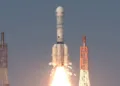
ISRO and NASA successfully launched the NISAR satellite on July 30, 2025, aboard GSLV-F16 from Sriharikota, marking a milestone in Indo-US space cooperation

Martand JhaMartand Jha
Aug 24, 2025, 03:30 pm IST
in Bharat, World, Opinion, Sci & Tech
Follow on Google News
FacebookTwitterWhatsAppTelegramEmail

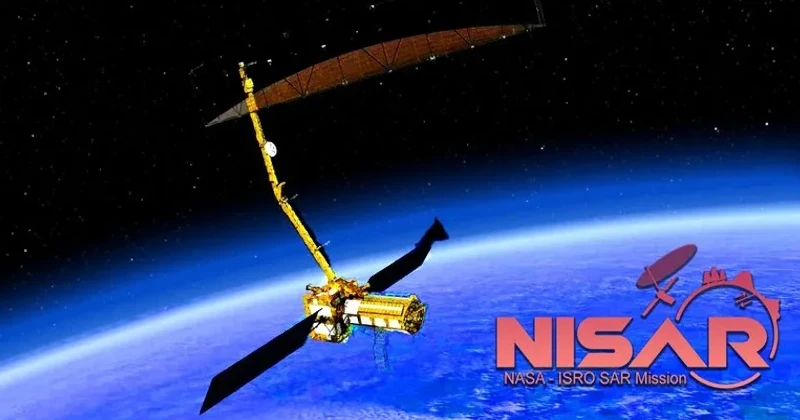
The Indo-US Space cooperation has a chequered history. The most recent development in their bilateral space cooperation was the launch of the NISAR satellite on July 30, 2025. The word NISAR comes from the acronymising NASA-ISRO Synthetic Aperture Radar. It will use dual frequencies and thereby will become the first radar imaging satellite to do so. Due to the remote-sensing nature of this satellite, it is expected to monitor (observe and understand) the natural phenomena and processes on the Earth.

This satellite was originally scheduled to be launched in March 2024, but due to some required technical modifications, the satellite underwent a hardware upgrade. The interesting point to note is that the satellite has been manufactured at the Jet Propulsion Laboratory (JPL) in California, United States. Still, the site for its launch was chosen to be the Satish Dhawan Space Centre, ISRO in India. At the JPL, a reflective coating was added to the satellite to mitigate the risk of overheating during its mission. The duration of this mission is approximately three years. The satellite, after being reworked, was carried by NASA’s own C-130 from the Wallops flight facility in Virginia. After multiple stopovers in Hawaii and the Philippines, it reached Bengaluru in India.

As per NASA, “NISAR is a joint Earth-observing mission between NASA and the Indian Space Research Organization (ISRO) with the goal to make global measurements of the causes and consequences of land surface changes using advanced radar imaging. This mission concept and the resulting partnership are in response to the National Academy of Science’s 2007 survey of Earth observational priorities for the next decade, known as the decadal survey. One of the top priorities identified in this survey was to gain data and insight in three Earth science domains: ecosystems, deformation of Earth’s crust and cryospheric sciences.”

In 2014, ISRO and NASA signed an agreement to collaborate and partner with each other to launch NISAR. The agreement was formalised on September 30 2014. The signatories to this joint Earth-observing satellite mission included ISRO’s then Chairman, Dr. K Radhakrishnan, and NASA’s administrator Charles Bolden. The NISAR mission was intended to establish a pathway for many joint bilateral space operations in the future. The unique feature of this mission is that it will be the first satellite mission to use two different radar frequencies, i.e., the L-Band and the S-Band. This will help measure the changes occurring on the Earth’s surface over a range of one centimetre. While NASA has provided the L-Band synthetic aperture radar, ISRO has provided the S-Band radar.

Similarly, ISRO is provided the spacecraft bus, the launch vehicle, as well as the various other associated launch services.

NISAR’s launch was aboard the ISRO’s Geosynchronous Satellite Launch Vehicle (GSLV-F16) from the Satish Dhawan Space Centre (SDSC) at Sriharikota. This launch is considered one of the most precise launches ever. The reason is that this five-stage rocket has operated flawlessly at every stage. It was successful in injecting the satellite into its precise orbit with a margin of just two to three kilometres. The NISAR satellite will be circling the Earth fourteen times every day. By this, it would be able to scan nearly all the Earth’s land and ice surfaces twice every 12 days.

This earth-observation satellite would detect even minute changes on the land, sea, ice and in vegetation. It will also allow the decision-makers to respond quickly to any natural disasters and map farmlands to improve crop output. It will also be observing the Earth with a swath of 242 km and a very high spatial resolution. For this task, SweepSAR technology has been used for the first time. As per ISRO, “NISAR can detect even small changes on the earth’s surface, such as ground deformation, ice sheet movement, and vegetation dynamics. Further applications include sea ice classification, ship detection, shoreline monitoring, storm characterisation, changes in soil moisture, mapping and monitoring of surface water resources, and disaster response”.

The successful launch of NISAR has come as a major relief to ISRO’s efforts to launch this satellite. Since 2024, multiple reschedules for ISRO’s other missions, such as the PSLV-C61/EOS-09 mission on May 18, 2025, due to a technical glitch, have marred ISRO’s satellite efforts. To sum it up, NISAR’s launch is a crucial chapter in the Indo-US space cooperation, which started way back in the year 1963 when the United States supplied India with the Nike-Apache sounding rockets, which were launched from Thumba in Trivandrum, Kerala, on November 21 1963, thereby marking the advent of the Indian space program. NISAR’s success would be further analysed once it completes its mission in the next three years.


Topics: NISAR satelliteNISARSynthetic Aperture RadarIndo-US space cooperationISRO
ShareTweetSendShareSend
✮ Subscribe Organiser YouTube Channel. ✮
✮ Join Organiser's WhatsApp channel for Nationalist views beyond the news. ✮
Previous News

Noida woman burnt alive over dowry: Husband shot in leg while trying to escape police custody

Next News

Indubitably, Sanskrit language is one of the wonders of the world

Related News

Mukesh Bansal & Skyroot: Investor who weaved wings to startup with Rs 12cr & fuelled India’s private space revolution

From Thumba's humble beginnings to private rocket launches, Atmanirbhar Bharat has transformed ISRO-led reforms into a thriving space ecosystem

From Thumba to the Space Economy: How Atmanirbhar Bharat is powering ISRO’s private space revolution

AI Generated Image

Bharat Beyond Western Lens: How science, tech, education, defence & infrastructure progress are powering nation’s rise

Skyroot’s Vikram-1 Reaches Orbit: India’s first private orbital-class rocket powers rise in the global space frontiers

India's first privately developed orbital rocket, Vikram-1, built by Skyroot Aerospace, is set for its historic maiden launch from Sriharikota on July 18

Vikram-1 Mission Aagaman: India’s first private orbital rocket to attempt historic satellite launch on July 18

Representative image made using AI

GAGAN: How India’s homegrown satellite navigation system is transforming aviation and strategic infrastructure

Load More

Latest News

Rain, Hunger Strike and Tarpaulin Shelters: Why Jharkhand's Student Protest Stands Apart

Days under tarpaulins, nights in rain: No violence, no abuse, no ‘Azadi’ slogans – How Jharkhand protest is different

PoJK bloodshed raises questions over Western media's selective coverage; India seeks global scrutiny

PoJK bloodshed exposes questions over Western media’s selective coverage of human rights crisis

Zuckerberg must apologise for blocking PM Modi's video, says MPs' panel chief

Parliamentary panel seeks Zuckerberg’s public apology over PM Modi video removal, warns of safe harbour review

Keralam BJP VP KS Radhakrishnan alleges two Christian Bishops mobilised youths for CJP agitation

DRDO calls MSMEs to build swarm drones; The game-changing tech to consolidate India’s capabilities in next-gen warfare

Balochistan & Enthno-Nationalist Armed Resistance: A nightmare for the Pakistani Army

Tamil Nadu: Supreme Court refuses to stay HC order on Thiruparankundram Deepam; TVK govt faces legal setback

Beyond the “Gaumutra” jibe

FCRA and NGOs: Ensuring accountability, protecting sovereignty

Tamil Nadu: Hindu Munnani’s protest stops meat waste dumping at historic Shiva temple in Tiruvallur

Load More
  • Privacy
  • Terms
  • Cookie Policy
  • Refund and Cancellation
  • Delivery and Shipping

© Bharat Prakashan (Delhi) Limited.
Tech-enabled by Ananthapuri Technologies

  • Home
  • Search Organiser
  • Bharat
    • Assam
    • Bihar
    • Chhattisgarh
    • Jharkhand
    • Maharashtra
    • View All States
  • World
    • Asia
    • Africa
    • North America
    • South America
    • Europe
    • Australia
  • Editorial
  • Operation Sindoor
  • Opinion
  • Analysis
  • Defence
  • Culture
  • Sports
  • Business
  • RSS @ 100
  • Entertainment
  • More ..
    • Sci & Tech
    • Vocal4Local
    • Special Report
    • Education
    • Employment
    • Books
    • Interviews
    • Travel
    • Health
    • Politics
    • Law
    • Economy
    • Obituary
  • Subscribe Magazine
  • Read Ecopy
  • Advertise
  • Circulation
  • Careers
  • About Us
  • Contact Us
  • Policies & Terms
    • Privacy Policy
    • Cookie Policy
    • Refund and Cancellation
    • Terms of Use

© Bharat Prakashan (Delhi) Limited.
Tech-enabled by Ananthapuri Technologies